On this page10
- What AI Share Of Voice Actually Means
- Why Raw Mention Count Is A Vanity Metric
- Reading A Share-Of-Voice Trend As A Leading Indicator
- Mentions Versus Citations, And Why The Numbers Differ
- How The Wider Category Frames The Problem
- How SKYA Turns Mentions Into A Benchmark
- How AI Models Choose Brands To Recommend
- How To Measure Your Share Of Voice Against Competitors
- Turning Share Of Voice Into An Ongoing Practice
- Frequently asked questions
Quick Answer AI share of voice is your brand's mentions divided by all brand mentions across a fixed prompt set, expressed as a percentage. Raw mention counts have no denominator, so they cannot tell you whether you are gaining or losing ground. Run the same prompt set weekly across ChatGPT, Gemini, Perplexity, and Claude, then judge direction over a rolling four-week window.
A brand can rank first on Google and still lose the buyer entirely. When a shopper asks ChatGPT or Gemini for a recommendation, the answer is a short list of named brands, not ten blue links.
If your brand is not on that list, the sale often goes to whoever is. This is why an AI share of voice tool has become as essential as a rank tracker was a decade ago.
Across 8,400 commercial prompts tested in 2026, Perplexity named a brand in 84.2% of responses, ChatGPT in 71.4%, and Gemini in 62.8%. The average query surfaced 3.7 named brands per answer.
That is a small, contested space. Understanding your position in it, and how it moves relative to named rivals, is the entire point of running an AI share of voice tool against your category week after week.
What AI Share Of Voice Actually Means
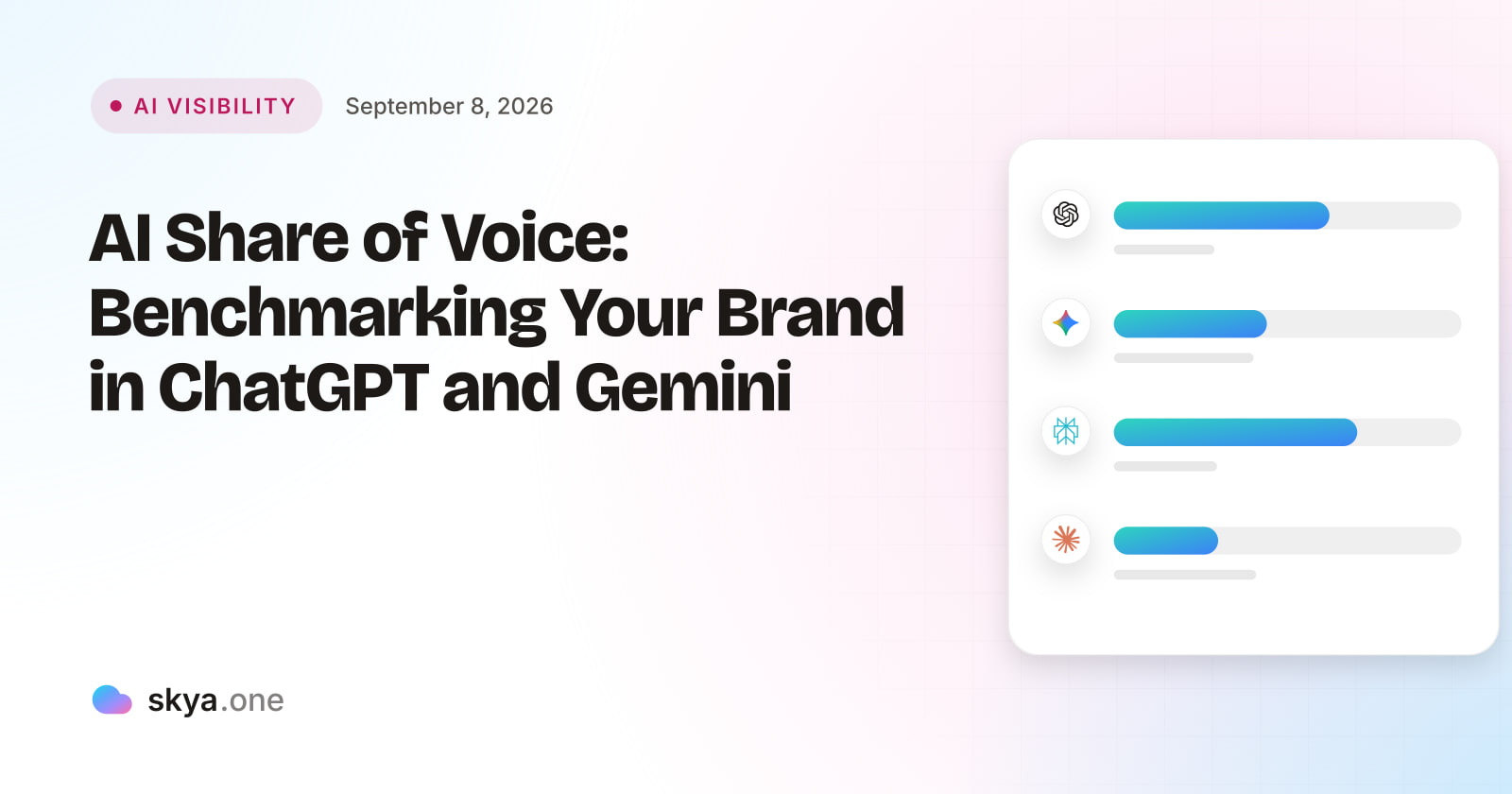
AI share of voice measures how often your brand appears against named competitors across an identical set of prompts. It is not a single number pulled from one lucky ChatGPT reply.
The formula is simple: your brand mentions divided by total brand mentions across the tracked prompt set, multiplied by 100. A brand appearing in 50 of 200 total mentions holds a 25% share.
This only works as a competitive metric, not a vanity one, when the prompt set stays fixed. Every rival gets asked about under the same buying scenarios, on the same platforms, over the same window.
A 2026 analysis of 2.4 million AI responses and 19 million citations across eight models found ChatGPT mentions at least one brand in 73.6% of its answers. That base rate matters, because it tells you how much competitive air exists to fight over in the first place.
A dedicated AI share of voice tool exists to automate this comparison at scale. Running the same prompt set by hand across five AI engines, every week, is not realistic for any team.
Why Raw Mention Count Is A Vanity Metric
"We were mentioned 40 times this month" sounds like progress. Without a competitive baseline, it tells you almost nothing.
Forty mentions could mean you are the runaway category leader, or it could mean you are a distant fourth while a rival racked up 400. Raw counts have no denominator, so they cannot be benchmarked against anything.
Sector-level data makes this clear. Across a recent 8,400-prompt panel, the top-cited brand in any category captured an average of 31.4% of all brand citations. The top three brands combined captured 64.7%, leaving roughly 28 other brands to split the remaining third.
That concentration is the real story. A brand celebrating 40 mentions while sitting outside the top three is likely losing share, not gaining it.
This is exactly why brand visibility in AI search has to be read as a relative position, not an absolute count. Position among named rivals, not volume alone, decides whether a buyer sees you as the obvious choice.
An AI share of voice tool solves this by tracking your mentions and every named competitor's mentions inside the same prompt set, side by side, on the same dashboard. Without that view, a rising mention count can quietly mask a falling market position.
Reading A Share-Of-Voice Trend As A Leading Indicator
A single week's share of voice is a snapshot. A trend line across 8 to 12 weeks is a forecast.
Brands cited in AI Overviews see a 23% branded search lift within 30 days, according to a 2026 brand-tracking study. That lift shows up in search demand before it shows up in revenue reporting.
This is the leading-indicator argument. If your dashboard shows a competitor's mentions climbing steadily over six weeks, expect their direct traffic and branded search volume to follow within a month or two.
Waiting for the lagging numbers, like organic sessions or paid CPCs, means reacting to a shift that has already been baked into the market for weeks.
B2B SaaS illustrates this well. AI Overview penetration in that sector grew from 36% to 82% year over year, and top-quartile brands in the category now hold 35% or more share of voice. That is not a static number; it is a curve worth watching monthly.
The practical habit: check weekly, but judge direction over a rolling month. One good or bad week rarely means anything on its own. Four consecutive weeks of decline almost always does.
Mentions Versus Citations, And Why The Numbers Differ
Every share-of-voice figure depends on how the underlying mention volume was captured. Prompt sets, platform coverage, and citation-detection accuracy all shape the final number.
The short version worth knowing before you compare tools: mentions count every time a platform names your brand in an answer, while citations count only the times it links to your domain as a source. The two numbers rarely match.
Reliable tracking also depends on refresh frequency. A dashboard sampled monthly will always lag behind one refreshed weekly, which is the clearest difference between a casual mention checker and a tool built for ongoing use.
How The Wider Category Frames The Problem
SKYA is not the only platform treating AI visibility as a competitive sport. It helps to know how others define the problem before picking any single tool.
Otterly.ai built a composite Brand Visibility Index that plots brands on two axes: brand coverage, meaning how often a brand appears, and likelihood to buy, drawn from average answer position. That quadrant sorts brands into leaders, niche players, low-conversion names, and low performers.
Profound frames the same problem through visibility rank and citation share, positioning a brand's rank among all cited names rather than a raw percentage.
Both approaches agree on the core idea: visibility only means something when it is measured against named rivals, not in isolation.
How SKYA Turns Mentions Into A Benchmark
SKYA organises its specialised agents into four categories. Competitive intelligence is the one that turns raw mentions into a usable share-of-voice benchmark.
Inside that category, the competitive agent runs a three-tier threat model: direct deal threats, positioning erosion, and adjacent or structural competitors. Rivals are ranked by a threat score rather than treated as equally dangerous.
Paired with AI visibility tracking, this becomes a working competitor analysis view, not just a mention counter. You see who is gaining share, on which platform, and against which specific prompts.
The weekly competitor watchlist surfaces movement automatically, so a rival climbing in Gemini responses gets flagged before it becomes a quarterly surprise.
How AI Models Choose Brands To Recommend
Share of voice is the outcome. Understanding how models pick brands is the input worth reverse-engineering.
Language models draw from indexed content, structured data, review signals, and citation patterns already present on the web. A brand with clear schema markup, consistent third-party mentions, and answer-shaped content gets pulled into responses more often.
This is why on-page structure and reputation signals correlate with share-of-voice movement over time. A model is more likely to recommend a brand it can confidently describe than one with thin, inconsistent coverage.
Prompt phrasing matters more than most teams expect. A comparison-style query, such as "brand A vs brand B", surfaces more named brands per answer, at 88% to 96% depending on platform, than a purely informational query. Tracking both prompt types separately gives a fuller read than a single blended average.
How To Measure Your Share Of Voice Against Competitors
Start with a fixed prompt set of 30 to 50 buyer questions that reflect real buying scenarios, not brand-name lookups.
Run that same set across every platform your buyers actually use, typically ChatGPT, Gemini, Perplexity, and Claude. Track mentions, citations, and answer position for your brand and every named rival, then calculate the percentage split.
Repeat weekly rather than once. A single measurement is a snapshot; a repeated one becomes the trend line that predicts where demand is heading.
Turning Share Of Voice Into An Ongoing Practice
Benchmarking against named rivals in ChatGPT and Gemini is not a one-time audit. It is a habit that compounds when repeated weekly, the same way rank tracking did for SEO.
If you want to see where your brand currently stands against the competitors AI models are already naming, SKYA's competitive intelligence agents build that picture automatically across all major platforms.
Frequently asked questions

Written by
SKYA Editorial Team
The SKYA Editorial Team publishes field-tested research on Answer Engine Optimization, Generative Engine Optimization and AI Visibility. Every article is reviewed by senior practitioners from the SKYA product and research groups before publication.
Related posts
Keep exploring the SKYA Journal.