On this page8
- Why lower profile brands are more exposed, not less
- What brand hallucinations actually look like in practice
- Why enterprise grade models make this more urgent, not less
- How to detect hallucinations before a customer does
- Fixing AI hallucinations about your brand, in practical steps
- A note for regulated industries
- The bottom line
- Frequently asked questions
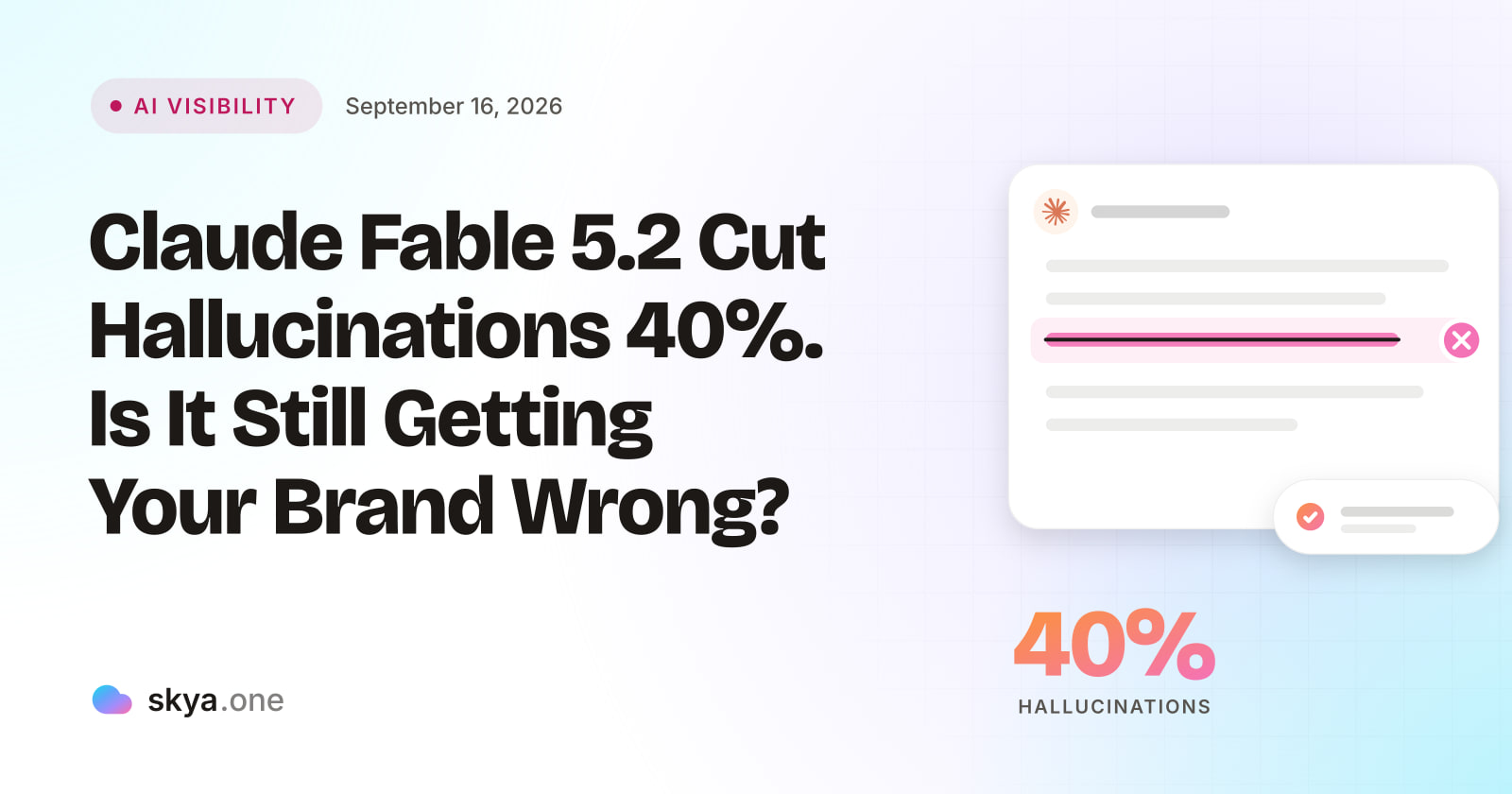
Quick Answer Possibly, yes, and you may not know it yet. A 40% drop in hallucinations is a benchmark average measured across broad test sets. It says nothing about whether the model still gets your specific, lower profile brand wrong. Models are far more likely to hallucinate on entities they have seen mentioned rarely or inconsistently, which describes most companies, even well established ones inside their own category.
Anthropic's update to Claude Fable improved agentic planning and reduced hallucination rates, while cutting cost per token by 40%, a change Anthropic itself attributes to a 75% cut in cache read pricing explicitly aimed at making the model competitive for enterprise deployment. That is genuinely good news for AI reliability at a broad level. But population level improvement and brand level accuracy are two very different things, and conflating them is exactly how a brand ends up blindsided by an error it never checked for.
Why lower profile brands are more exposed, not less
Large language models learn patterns from however much data exists about a given entity. A household name with thousands of consistent mentions across the web gives a model a strong, stable pattern to draw from. A mid sized SaaS company, an agency, or a regional brand with a much thinner footprint gives the model far less to work with, and far more room to fill gaps with something plausible sounding but wrong.
Reduced hallucination rates at the benchmark level do not close this gap. If anything, benchmark improvements are often measured against well documented topics, which means the improvement you read about in a press release may barely apply to a company like yours at all.
What brand hallucinations actually look like in practice
A model confidently states your company was acquired by a competitor when it was not. It quotes pricing that is two product versions out of date. It attributes a competitor's headline feature to you, or gives your actual feature to them. It states flatly that you do not offer something you have actually supported for years. It merges two similarly named companies into a single, confused description.
None of these come with a correction link. There is no "did you mean" prompt. In most cases, the person asking the question has no way of knowing they have just been given wrong information, and neither do you, unless you are actively checking.
Why enterprise grade models make this more urgent, not less
Claude Fable 5.2's 40% cost reduction is explicitly aimed at enterprise deployment, meaning more procurement teams, analysts and internal research functions inside larger companies will be running exactly this kind of due diligence question through the model at scale. "Does this vendor support SOC 2." "What is included in their enterprise tier." "How do they compare to the market leader." A single hallucinated answer at that specific stage of a buying cycle can quietly end a deal you never even knew was underway, because that research often happens well before any sales conversation starts.
Industry data backs up how much buying behavior is already shifting into this kind of AI mediated research. A 2026 AI search referral study tracking 14.7 million AI attributed sessions found that traffic arriving from AI search converts at 4.21%, more than double the 1.94% conversion rate of standard Google organic traffic, and spends nearly four times longer on site once it arrives. The people reaching your site through an AI answer are further along in a decision, more engaged and more likely to convert, which means a hallucinated answer at that stage carries outsized weight compared to a random organic visitor who is still just browsing.
How to detect hallucinations before a customer does
Manual spot checking, occasionally typing your brand name into ChatGPT or Claude to see what comes back, only catches the hallucinations you happen to ask about, at the exact moment you happen to ask. It misses errors that surface on follow up questions, on comparison queries against named competitors, or in non-English prompts entirely.
SKYA's AI Search Intelligence platform is built specifically to run hallucination audits continuously, and it is the only tool in this category tracking AI hallucinations over time, so you can see not just that an error exists, but exactly when it first appeared and whether it is spreading from one model to another.
Fixing AI hallucinations about your brand, in practical steps
Start with an audit. Run a structured set of real buyer intent questions about your brand across ChatGPT, Claude, Gemini and Perplexity. Log every factual claim each model makes about you, whether it is right or wrong, and note which model said what.
Fix the source, not the symptom. Models retrieve from somewhere. Find where the outdated or incorrect information likely originated, an old press release still indexed somewhere, a stale directory listing, a discontinued product page that never got taken down, and correct it at the source rather than only on your own homepage.
Publish clean, current, quotable facts. A single, clearly written page stating your plan name, its price and what it includes gives a model an unambiguous, current source to pull from instead of guessing based on outdated information elsewhere.
Recheck after every major model release. Claude Fable 5.2, Gemini 3.9 Ultra and OpenAI's Astra Pro all shipped within a few weeks of each other. Each release is a fresh opportunity for an old, uncorrected error to either finally get fixed in the model's output, or to get baked in even further as the model retrains on newer data that may still contain the same mistake.
Track it continuously, not on a quarterly cadence. Hallucinations are not static. They drift as models retrain and as the web's underlying data shifts. A single audit is a snapshot of one moment. It is not a safeguard against what happens next month.
A note for regulated industries
If you operate in finance, healthcare or another regulated sector, a hallucinated claim carries more than a lost deal's worth of risk. A model stating incorrect compliance credentials, incorrect coverage details or a false regulatory status can create real exposure, not just a marketing headache. This is one of the reasons hallucination monitoring matters more as more enterprise buyers route research through cheaper, more capable models like Claude Fable 5.2.
The bottom line
Claude Fable 5.2's improvements are real, and the direction is genuinely positive for AI reliability as a whole. But a lower average error rate does not mean zero errors on your specific brand, and as more enterprise buyers route serious due diligence questions through cheaper models at greater scale, a single uncaught hallucination becomes more consequential, not less.
Continuous monitoring is what turns "we hope it is saying the right thing about us" into "we know exactly what it is saying, and we caught the last error within 48 hours of it appearing."
Frequently asked questions

Written by
SKYA Editorial Team
The SKYA Editorial Team publishes field-tested research on Answer Engine Optimization, Generative Engine Optimization and AI Visibility. Every article is reviewed by senior practitioners from the SKYA product and research groups before publication.
Related posts
Keep exploring the SKYA Journal.