On this page10
- What Happened, Day by Day
- Who Could See the Change
- What Changed and What Did Not
- Why Citations Matter More Than the Mention
- Site Problem or Platform Change?
- What an AI Brand Monitoring Tool Must Do
- A Limit Worth Asking Every Vendor About
- Five Steps for Agencies
- What to Tell Clients
- Frequently Asked Questions
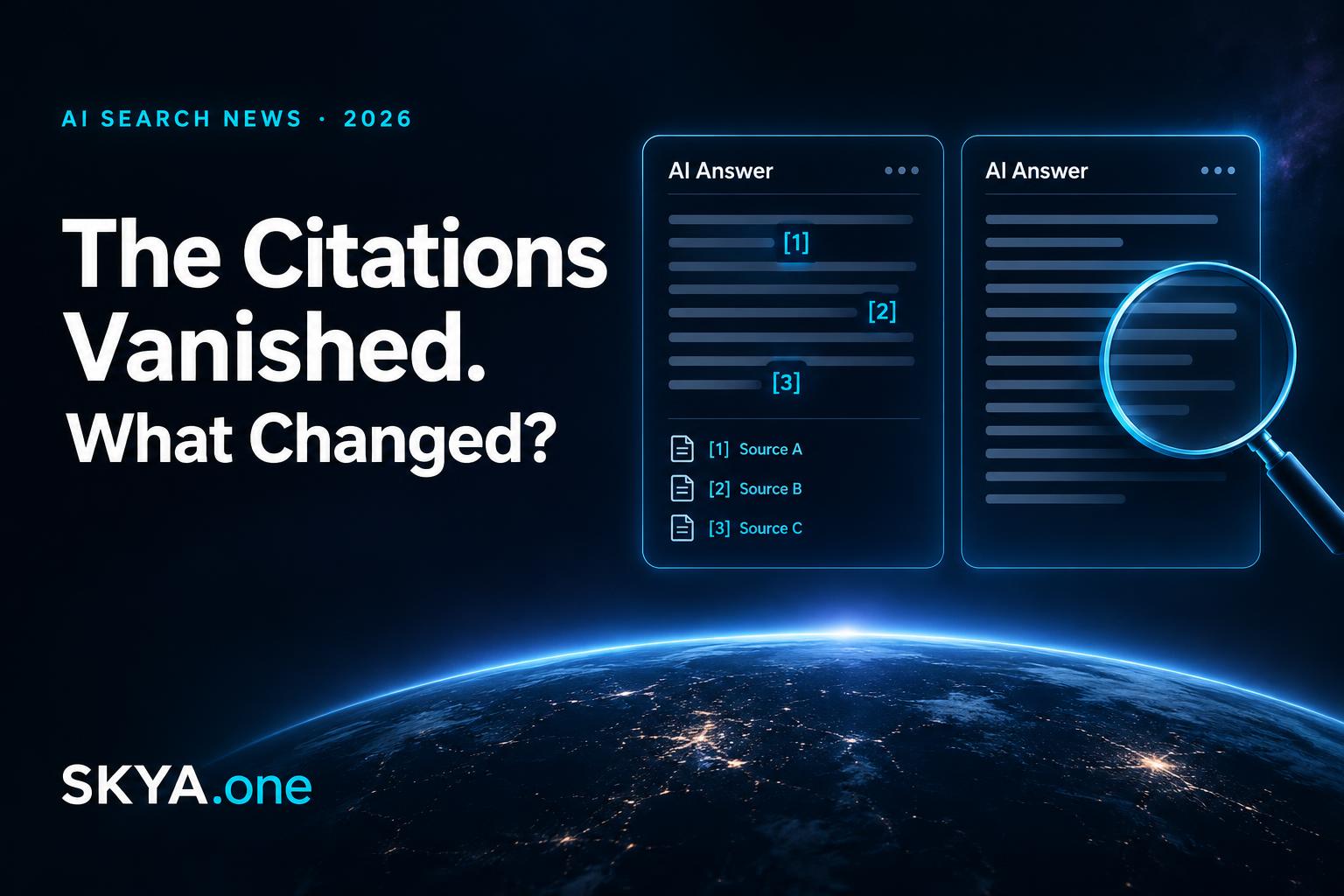
Gemini 3.8 Flash arrived in Google AI Mode on September 2, 2026. By September 3, SEO professionals saw answers with no links or citations. Google's Robby Stein said it was not working as intended and promised a fix. The client's pages had not changed. An AI brand monitoring tool must read the answer daily, because the model behind it can change.
What Happened, Day by Day
Search Engine Land reported the launch on September 2. Search Engine Roundtable documented what followed. The table keeps each claim next to its source, because only some of it came from Google.
| Date (2026) | What happened | Who said it |
|---|---|---|
| September 2 | Gemini 3.8 Flash arrived in AI Mode. Stein called it "our most intelligent workhorse model yet." | Google (via Stein on X) |
| September 3 | Gagan Ghotra ran top-of-the-funnel searches and found none showed links or citations. Glenn Gabe compared it with the default model and agreed. | Independent SEO professionals |
| September 4 | Stein replied: "This isn't working as intended, and we'll roll out a fix soon." | Google (via Stein) |
| September 4 | Gabe reported the model was providing links again. He called it a bug where "there were barely any links being provided." | Gabe, not a Google announcement |
Two points need care. First, the fix was reported by an independent observer. Google had promised a fix, but the article does not show an official announcement that it shipped. Second, Ghotra saw no links in his test searches. Gabe described "barely any". Report the range, not one number.
Who Could See the Change
This detail shapes how any tool could have seen it. Search Engine Land says the model was available in AI Mode to Google AI Pro and Ultra subscribers, initially in English. Users tap the plus icon to pick it from a model dropdown. Search Engine Land expects Google to extend it to all searchers later. That expectation is the author's, not Google's.
| Fact | Why it matters to an agency |
|---|---|
| Available to Pro and Ultra subscribers first | Not every buyer saw the same answer on the same day |
| Chosen from a model dropdown | One assistant can run more than one model at once |
| Initially in English | Other languages were not covered at the start |
| Reported by searchers, then acknowledged | The signal started outside any tool |
Hold on to the second row. "Google AI Mode" is not one fixed thing. A model choice sits inside it, and a model choice can change what an answer links to.
What Changed and What Did Not
The lesson is easy to miss, so here it is in a table. Nothing on a client's website changed during these days. What changed was the system that reads the website.
| Item | Changed? | Effect on the client |
|---|---|---|
| The client's pages | No | Same content, same schema |
| The client's rankings in classic search | Not part of this event | A rank report measures something else |
| The model behind one AI Mode option | Yes | Answers carried fewer links or none |
| Citations in those answers | Yes, for a short window | Fewer places for a buyer to click through |
A rank report would not flag this. A traffic report might show a dip days later with no clear cause. Only a reading of the answer itself shows what a buyer saw. That is the gap daily readings exist to close.
Picture a client that wins steady citations in AI Mode each week. During a window like this one, the client's citation count falls to zero in the readings. The agency checks the pages and finds no change. Without a dated reading, the agency has no way to tell a site problem from a platform change. This case is illustrative.
Why Citations Matter More Than the Mention
A mention tells a buyer your client exists. A citation tells the buyer where to go next. When links vanish, a buyer can still read the answer, but cannot click through to the client. For a client that sells online, that path is the point of being in the answer.
| Answer type | What the buyer sees | What it means for the client |
|---|---|---|
| Mention with a link | The client's name and a way to visit | A path to the site |
| Mention with no link | The client's name only | Awareness, but no path |
| No mention, link to a rival | A rival with a path | A lost visit |
| No mention, no link | Neither | No presence |
Reports that count only mentions would have missed the drop in links during this window. A report should log the mention and the citation as two separate facts. It should also log whether the answer was correct. SKYA's guide to AI hallucination monitoring over time covers the accuracy side.
Site Problem or Platform Change?
Agencies lose hours on this question. A short test separates the two causes. The table shows what each cause usually looks like in daily readings.
| Signal | Points to a site problem | Points to a platform change |
|---|---|---|
| Which assistants moved | One assistant, or pages tied to one fix | Many clients move at once on one surface |
| Timing | Follows a site release | Follows a model or feature launch |
| Other clients | Only this client moved | Several clients moved together |
| Recovery | Returns after a page fix | Returns with no site change |
The third row is the most useful for agencies. A multi-client workspace shows the pattern fast. If six clients lose citations on one surface on the same day, the cause is rarely six separate site problems.
Keep the evidence from the quiet days too. A baseline from before the change lets you say what was lost and when it returned. Without it, you can only say that something felt different. Clients pay for the first kind of statement, not the second.
What an AI Brand Monitoring Tool Must Do
An AI brand monitoring tool should answer one question every morning: what did the assistants say today, compared with yesterday? Six requirements make that possible.
| Requirement | Why it matters | How SKYA handles it |
|---|---|---|
| Reads daily, not monthly | This change lasted days, not weeks | Daily readings with history |
| Stores the answer text | You can see the links that vanished | A stored reading behind every number, with an evidence panel |
| Covers Google AI Mode by name | It is where this change appeared | Google AI Mode is one of nine assistants read daily |
| Compares across assistants | One surface may move while others hold | ChatGPT, Gemini, Perplexity, Claude, Google AI Overview, Google AI Mode, DeepSeek, Grok and Copilot |
| Admits what it cannot read | An invented number misleads the client | No answers read means no figure. A run that measured nothing gives its credit back |
| Reports by client | Agencies must explain a dip fast | Multi-client workspaces and white-label PDF reports |
SKYA publishes how every number is calculated. AI visibility tracking only works when readings are stored and dated. The same idea runs through its note on why a client is judged by five AIs at once.
A Limit Worth Asking Every Vendor About
No tool sees everything. The Gemini 3.8 Flash case shows why. The model was an option for subscribers, chosen from a dropdown. A daily reading sees the answer that the surface it reads returns. Whether that reading would have shown this exact change depends on which model option the reading used.
That is not a reason to distrust readings. It is a reason to ask precise questions. SKYA's reading shows the answer that came back, stored and dated. It does not claim to show every variant that every subscriber could pick. Say that plainly to clients.
| Question for any vendor | What a good answer looks like |
|---|---|
| Do you read Google AI Mode separately from AI Overviews? | Yes, and the two are labelled separately |
| Do you store the answer text and the links in it? | Yes, and you can open each stored answer |
| Can you show me a change over time for one question? | Yes, as a dated history |
| What can you not read? | A clear list, not "everything" |
Five Steps for Agencies
-
Pick ten buyer questions per client that you want answered in Google AI Mode. Store the first reading as a baseline.
-
Read daily. Set the report to flag a drop in links or citations.
-
When a drop appears, check other clients first. A pattern across clients points to the platform.
-
If only one client moved, check the pages. Schema markup for AEO is a good place to start.
-
Tell the client what you saw, with the stored answer attached. Do not guess at the cause. This is where AI visibility tracking earns its keep.
Solid AI visibility tracking gives you the dated evidence to run this routine. Without it, every dip becomes a debate.
What to Tell Clients
| Say | Avoid |
|---|---|
| A new model option in Google AI Mode showed fewer links for a short time. Google said it was not working as intended. | Google broke your citations. |
| Your pages did not change. We have the stored answers from before and after. | Your site has a problem. |
| Model changes happen often across assistants. That is why we read daily. | This will never happen again. |
| We watch the trend over weeks, not one day. | A single day proves the trend. |
This case is small, but the pattern is large. Assistants change models often. SKYA has covered the same pattern around GPT-6 Astra and Claude Opus 5.5. Each launch changes what a client looks like in an answer. A daily reading is the only record of the before and after.
Frequently Asked Questions
What happened with Gemini 3.8 Flash in Google AI Mode?
Gemini 3.8 Flash arrived in AI Mode on September 2, 2026. By September 3, SEO professionals reported answers with no links or citations. On September 4, Google's Robby Stein said it was not working as intended and that a fix was coming.
Did Google fix the missing links?
Google said a fix was coming. Glenn Gabe then reported that the model was providing links again. That report came from Gabe, not from a Google announcement.
Can a model change affect what AI says about my client?
Yes. A model change can alter the links, citations and wording of an answer even when the client's pages stay the same. The Gemini 3.8 Flash case shows that for citations.
What is an AI brand monitoring tool?
An AI brand monitoring tool reads what AI assistants say about a client and records whether it is named, cited and accurate. SKYA does this daily across nine assistants and stores the answer behind every number.
How do I monitor citations in Google AI Mode?
Choose ten buyer questions, read the AI Mode answers daily and store the answer and its links each time. Compare each day with the last. SKYA's free AI Visibility Scan gives a first report in about two minutes with no sign-up.
Make AI Mention Your Brand. Start a 7-day free trial. No card required.

Written by
SKYA Editorial Team
The SKYA Editorial Team publishes field-tested research on Answer Engine Optimization, Generative Engine Optimization and AI Visibility. Every article is reviewed by senior practitioners from the SKYA product and research groups before publication.
Related posts
Keep exploring the SKYA Journal.