On this page8
- Why Google ranking no longer guarantees AI visibility
- Three reasons your brand is not showing up in AI answers
- What changes every time a frontier model ships
- Check where you actually stand today
- What agencies specifically should watch for
- What to actually do this week
- Why this will keep happening
- Frequently asked questions
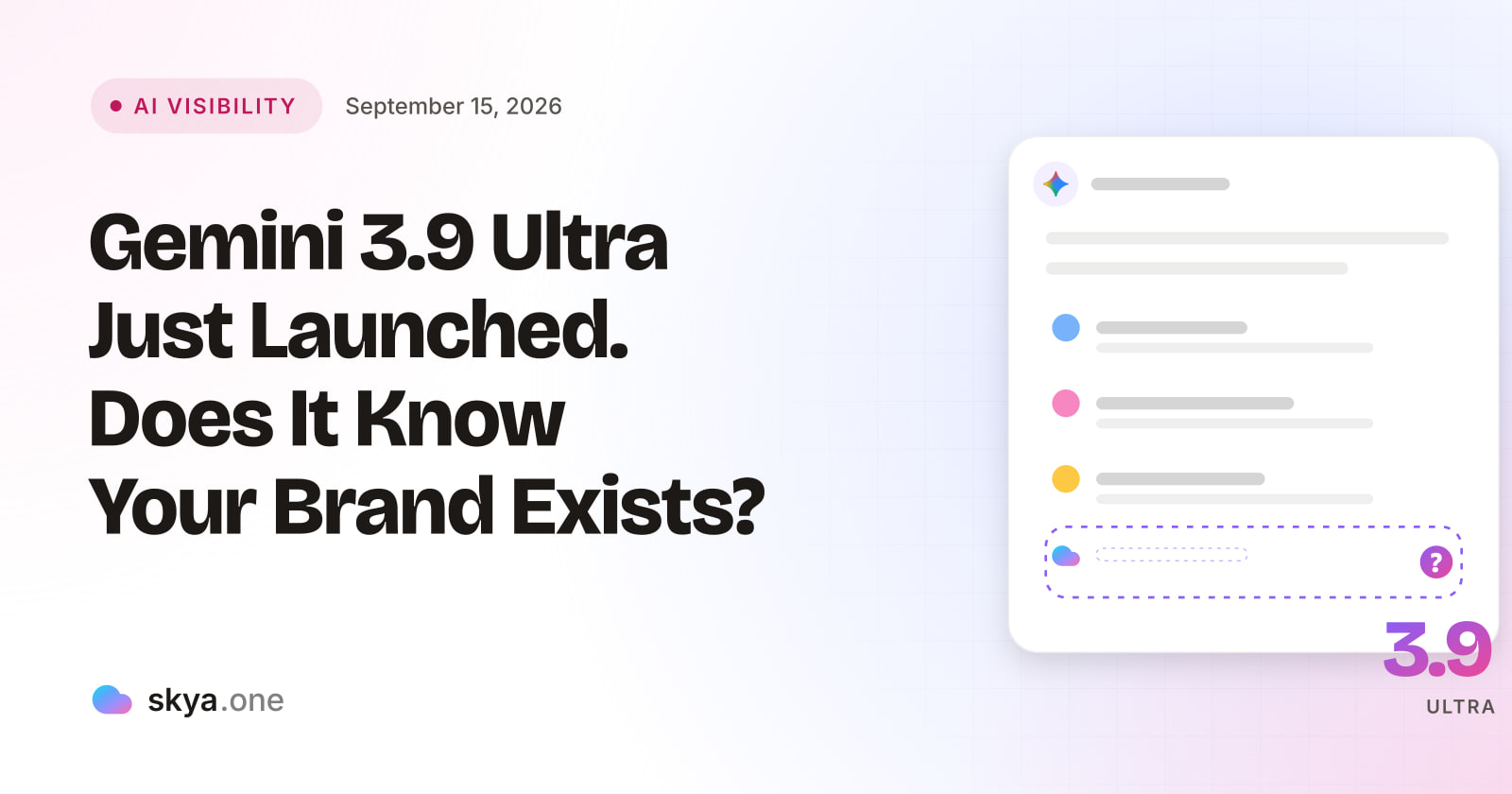
Quick Answer Probably not, and here is why. Gemini 3.9 Ultra builds answers from training data, retrieval context and live web signals. If your brand has never been described clearly and consistently anywhere the model can read it, there is nothing for it to pull from. Ranking well on Google does not fix this, because AI search runs on a different set of rules.
Google DeepMind launched Gemini 3.9 Ultra with native video understanding and real time multilingual reasoning, setting new highs on MMLU and GPQA. Within days it was fielding millions of daily queries, and a large share of them were buying questions. "Best CRM for a small team." "Most reliable AI visibility tool." "Tools like Profound for agencies." These used to route through a Google search box. Now they route through a model that synthesizes one answer instead of ten blue links.
Why Google ranking no longer guarantees AI visibility
This shift is not a guess anymore. Gartner has predicted that traditional search engine volume will drop 25% by 2026 as people turn to generative AI tools instead of typing queries into Google. Whether the exact number lands precisely on target or not, the direction is not in question. More buying research is happening inside a chat window, and less of it is happening on a results page.
A compilation of 2026 SEO statistics reports that Google's AI Overviews already appear in roughly 25.8% of US searches, and that 58.5% of all Google searches now end without a click at all, climbing to 77% on mobile. People are getting their answer directly in the search interface or inside a chat model, and never visiting a website to confirm it. If your brand's information only lives on your own site and nowhere else, you are betting everything on a click that increasingly does not happen.
A brand ranking first on Google can be completely absent from Gemini's answer to the exact same question. Traditional SEO signals like backlinks, domain authority and keyword density do not map cleanly onto how a language model decides who to name. Gemini weighs clarity and citability more heavily. It wants a clean, quotable fact it can lift and repeat with confidence. A page full of persuasive marketing copy, with the actual facts buried three paragraphs in, gives the model very little to work with.
Three reasons your brand is not showing up in AI answers
The first reason is structural. Your content answers questions in flowing prose instead of stating facts plainly. Language models pull discrete, quotable claims, not paragraphs of narrative buildup. A sentence like "SKYA tracks brand mentions across 13 AI agents spanning ChatGPT, Gemini, Perplexity and Claude" is easy for a model to lift directly into an answer. A page that spends three sentences setting the scene before getting to the point gives the model nothing clean to grab.
The second reason is technical. Most sites still do not have an llms.txt file. This is the modern equivalent of a robots.txt file, except it is built for AI crawlers rather than search engine bots. It tells a model which pages on your site are authoritative and how your content is structured. Skipping this file is not fatal on its own, but it removes one more signal that could tip a close call in your favor.
The third reason is about proof. If the only place your brand's claims exist is your own homepage, that is a single, unverified source. Models weigh corroboration heavily. A claim repeated across a review site, a comparison page and a community discussion carries far more weight than the same claim appearing only where you wrote it yourself.
What changes every time a frontier model ships
Each release effectively reshuffles who gets named. Gemini 3.9 Ultra is more confident than earlier versions, and that confidence shows up as a willingness to name a specific brand instead of hedging with "there are several options you could consider." That is good news if you are the brand it names. It is a quiet risk if you are not, because you may not find out until a prospect mentions it in a sales call, or does not mention it at all.
Check where you actually stand today
Do not guess at this. Run the real questions your buyers would ask directly into Gemini, ChatGPT and Perplexity. "Best AI visibility platform for agencies." "How to track brand mentions in ChatGPT." "Tools like Profound." Screenshot what comes back each time. If you are not named in the top few answers across a spread of fifteen or twenty real buyer questions, you have a visibility gap, not a content quality problem you can fix with a blog post alone.
This is exactly what continuous AI visibility tracking is built to solve. Instead of an occasional manual check, it runs your real buyer questions across every major model on a recurring schedule, so you catch the moment a model update like Gemini 3.9 Ultra changes your standing, rather than finding out from a stalled deal three months later. SKYA's AI Search Intelligence platform monitors brand mentions across ChatGPT, Gemini, Perplexity, Claude and Google AI Overviews using 13 dedicated agents, with auto refresh tracking that catches shifts as they happen rather than weeks after the fact.
What agencies specifically should watch for
If you manage AI visibility for multiple clients, a single model update can quietly shift standing across all of them at once, and a manual check per client per month simply cannot keep pace. Multi client workspaces let one team track visibility across up to 15 client projects from a single dashboard, which matters a lot more the moment a release like Gemini 3.9 Ultra lands and every client's competitive picture moves at the same time.
What to actually do this week
Start by checking whether a single page on your site states plainly, in one or two sentences, exactly what you do and who it is for. Then check your footprint beyond your own domain: review sites, comparison pages, community threads, anywhere a third party might describe your product. Then set up ongoing tracking so the next model release does not catch you off guard.
If your concern runs deeper than simple absence, if you are worried a model might be describing your brand incorrectly rather than just skipping you, that is a related but separate problem worth checking too.
Why this will keep happening
Frontier model releases are not slowing down. Gemini 3.9 Ultra, Claude Fable 5.2 and OpenAI's Astra Pro all shipped within a matter of weeks of each other, each with its own retrieval logic and its own confidence thresholds. Every one of those releases is a small, quiet re-ranking event for who gets mentioned in AI search and who does not. Brands that treat AI visibility as a project they did once, wrote a few pages, and moved on from, will keep getting blindsided by these shifts. Brands that watch it continuously will catch the change within days and adjust before it ever costs them a deal.
The bottom line is simple. Gemini 3.9 Ultra just proved, again, that AI search moves faster than a quarterly content calendar. The brands that win here are not necessarily the ones with the most content. They are the ones whose facts are clean, corroborated and being watched.
Frequently asked questions

Written by
SKYA Editorial Team
The SKYA Editorial Team publishes field-tested research on Answer Engine Optimization, Generative Engine Optimization and AI Visibility. Every article is reviewed by senior practitioners from the SKYA product and research groups before publication.
Related posts
Keep exploring the SKYA Journal.