On this page9
- The safe corner of search stopped being safe
- Read the 83% with care
- Who gets to describe your client now
- Two risks, and only one has a number
- Branded answers and category answers need different goals
- A one-hour weekly check for branded answers
- What an AI brand monitoring tool has to capture
- What to tell the client this week
- Frequently asked questions
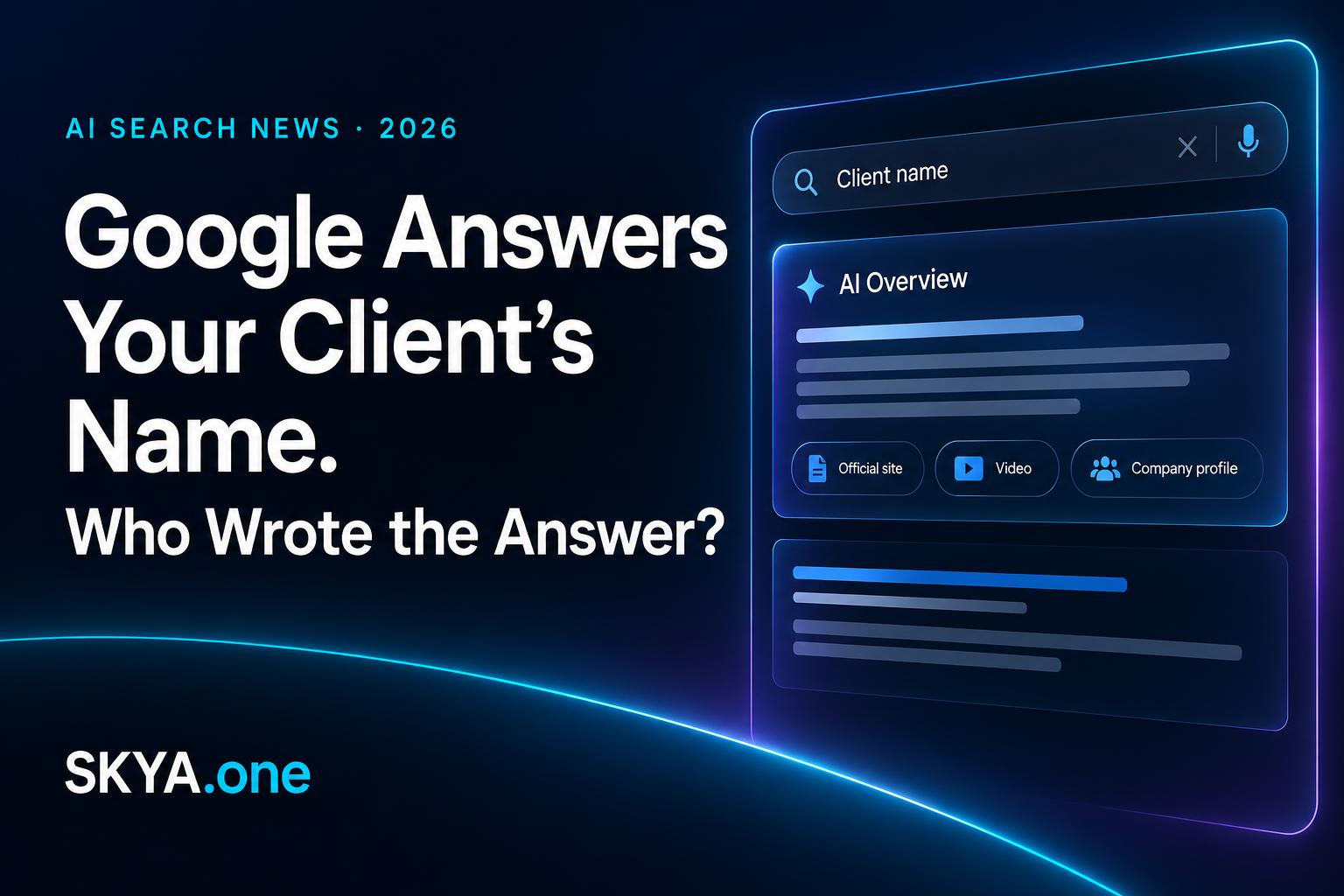
Google's AI Overviews now appear on most branded searches. Ahrefs measured 82.91% of US desktop branded results on September 29, 2026, and a 73.3% average for September. Google often answers a client's own name search before the client's website does. Wikipedia, YouTube and LinkedIn supply much of the sourcing. Agencies should read those answers every week, client by client.
The safe corner of search stopped being safe
Branded search was the quiet line in every report. A client searched its own name, found its own site first, and nobody worried. That comfort had a data point behind it. In November 2025, Ahrefs found AI Overviews on 13.1% of branded queries and 24.9% of non-branded ones. Branded looked protected.
That picture is gone. In a study published October 2, 2026, Ahrefs analyzed 232.8 million US desktop search-result crawls from July to September. The branded share rose every month.
| Month | Branded keywords with an AI Overview | Non-branded keywords with an AI Overview |
|---|---|---|
| July 2026 | 61.3% | 73.5% |
| August 2026 | 65.1% | 74.7% |
| September 2026 | 73.3% | 78.3% |
The gap between the two groups fell from 12.2 points in July to 5 points in September. Ahrefs notes that the 2025 and 2026 studies used different samples, so read the comparison as direction, not as a clean before and after. The direction still matters. Google stopped treating a client's name as off limits.
Read the 83% with care
The headline figure is real, and it is narrow. On September 29, 2026, AI Overviews appeared on 82.91% of US desktop branded results in the dataset. That is one day. The September average was 73.3%. Quote either number without its scope and a client will hear a claim the data does not make.
Three limits matter for agency reporting.
First, the data covers US desktop. It says nothing about mobile, the EU or India, where your clients may sit.
Second, presence is not citation. An AI Overview showing on a name search does not mean it names the client or links to the client's site.
Third, Google changes its triggers often. Ahrefs says so in its own write-up. A number that holds today can move next month.
None of this shrinks the finding. It tells you to check your own client list instead of trusting a headline.
Who gets to describe your client now
A classic results page gave a client control over two things: the title and the description under the blue link. An AI Overview replaces that with a paragraph Google assembles from other pages. The client can edit some of those pages and not others.
Ahrefs ran a second, separate sample: exact-name searches for 100 major names from Interbrand's Best Global Brands 2025 list, checked weekly. On July 1, five of 98 usable results showed an AI Overview. By September 30, 63 of 100 did. Of those 63, 48 sat in position one. That is 76.2%, with an average position of 1.49.
Then Ahrefs looked at the sources inside those answers.
| External source | Share of 57 AI Overviews citing it |
|---|---|
| Wikipedia | 71.9% |
| YouTube | 38.6% |
| 22.8% | |
| Yahoo Finance | 15.8% |
| 10.5% | |
| Walmart | 7.0% |
Read that table for control, not for popularity. Wikipedia is the closest thing to a neutral reference, though it runs on its own editing rules. YouTube and LinkedIn are different. A client owns its channel and its company page. It does not own the third-party videos and posts that can sit beside them in the answer. Ann Smarty, quoted in the Ahrefs piece, warned that unofficial videos cited this way may carry outdated product information.
The same data has good news. Only 2 of 58 readable answers discussed competitors, and one competitor-owned site appeared across 57 source lists. In this sample the threat is not a rival hijacking the answer. It is stale or unofficial facts speaking for the client while nobody watches.
One caution on the sample. These are 100 of the largest global names. A regional school, a local clinic or a mid-size software client has a thinner web footprint. Nobody has published how their branded answers compare. That gap is a reason to run the check, not a reason to assume safety.
Two risks, and only one has a number
Branded AI Overviews create two separate risks. Agencies tend to measure the wrong one.
| Risk | What is known | What is not known |
|---|---|---|
| Narrative control | 76.2% of big-name Overviews sit in position one. Wikipedia, YouTube and LinkedIn are the most common outside sources. | How often the answer is wrong or outdated for a given client. |
| Click loss | Ahrefs' earlier study found a 58% lower click-through rate for the top-ranking page when an Overview is present. | This study publishes no branded click figure. Ahrefs says clicks are probably not the main concern for branded queries. |
A rank tracker reports neither risk. It will show the client in position one while a paragraph above that result tells the buyer something different. Narrative control is the risk you can check this week, because it only needs someone to read the answer. Click loss needs the client's own Search Console data, filtered to branded queries and compared across the weeks before and after an Overview appeared.
Branded answers and category answers need different goals
A category question such as "best CRM for a small agency" is a contest. The client wants in, and rivals want the same spot. A branded question is a defense. The buyer has already chosen to look at the client, and the answer decides whether the next click confirms that choice or doubts it.
That difference changes what you measure. For category answers, track whether the client is named and in which position. For branded answers, track whether the answer is correct, current and sourced from pages the client can edit. A client can win every category answer and still lose the name search because an old video states the wrong price.
Agencies often fold both into one visibility score. That hides the branded problem. A high score built on category wins can sit beside a branded answer that is a year out of date. Report them as two separate lines, with a different owner for each. Category answers belong to the content team. Branded answers belong to whoever controls the client's official facts, and that is usually someone on the client side.
This is also where client conversations get easier. Nobody argues about whether the client's own pricing page should be the source of the client's price. Everyone agrees. The branded line in your report gives the client a clear, small job: keep the official pages current and let you verify that Google's answer follows.
A one-hour weekly check for branded answers
You do not need an AI brand monitoring tool for the first ten queries. You need a routine. This one fits inside an hour per client. Start with the clients where a wrong answer costs money: pricing, fees, availability and safety claims.
| Step | What to do | Why |
|---|---|---|
| 1 | List the client's branded queries: name, name plus pricing, name plus reviews, name plus login, name against a named competitor. | Ten queries is enough to start. |
| 2 | Run each query on desktop and mobile, from the client's main market. | Overviews vary by location and device. |
| 3 | Mark whether an AI Overview appears and in which position. | Position one carries the most risk. |
| 4 | Check each claim against the client's facts: prices, locations, features, dates, leadership. | Log wrong and outdated lines separately. |
| 5 | List the cited sources and sort them by who can edit them: own site, official channel, Wikipedia, third party. | This shows where a fix is possible. |
| 6 | Fix the source, then log the date and re-check next week. | The answer follows the sources. |
Step 6 is the part most teams skip. You cannot edit an AI Overview. You can edit the pages it reads. Replace the outdated video description, correct the company page, update the pricing page, and watch whether the answer follows. If it does not move, that is also a finding for the client report. For the trigger-rate and citation-position side of this work, see how to track AI Overview trigger rate and citation position.
What an AI brand monitoring tool has to capture
A spreadsheet handles ten queries for one client. It breaks at fifty clients and nine assistants. At that point an AI brand monitoring tool earns its cost, but only if it captures the right things. Use this list when you compare options.
| Requirement | Why it matters |
|---|---|
| Full answer text | A yes or no on mentions hides wrong claims. |
| Cited sources per answer | It shows which pages shape the paragraph. |
| History per query | AI visibility tracking without history cannot date a change. |
| Several clients in one workspace | Agency time goes to reading answers, not switching logins. |
| Google plus other assistants | The same client name gets asked in ChatGPT, Gemini and Perplexity too. |
Branded AI Overviews are one surface. Buyers ask the same name question in several places, and each place can answer differently.
SKYA reads nine assistants every day, including Google AI Overview and Google AI Mode, and audits the answers for claims that are wrong about a client. Its history view lets you replay a client's visibility across a 90-day timeline. That turns "the answer changed" into "the answer changed on this date, after this source changed." A client report needs that second sentence. SKYA treats AI visibility tracking as a dated record, not a one-time score. For the wrong-claim side, read what counts as an AI hallucination about a client. For the wider mention picture, mention monitoring across web, social and AI answers covers the rest.
What to tell the client this week
Skip the 83% headline. Say that Google now shows an AI-written answer on a large share of name searches, that its sources are often third-party pages, and that you have started checking the client's answers weekly. Then show one real answer, one cited source and one fix.
That is a smaller claim than the headline, and a more useful one. Branded search is no longer a corner you can leave unwatched. Make it a standing line in the weekly report, and attach the log from your AI brand monitoring tool or your spreadsheet so the client sees dates, not opinions.
See what Google's AI says when someone searches your client's name. Start a 7-day free trial. No card required.
Frequently asked questions
Do AI Overviews appear on branded searches?
Yes, and more often every month. Ahrefs found AI Overviews on 61.3% of US desktop branded keywords in July 2026, 65.1% in August and 73.3% in September. On September 29 the daily rate reached 82.91%. These figures cover US desktop only.
Do AI Overviews reduce clicks on branded searches?
Nobody has published a branded click figure yet. Ahrefs' earlier study found a 58% lower click-through rate for the top-ranking page when an AI Overview is present, but its new branded study does not measure clicks. Check your client's Search Console data for branded queries before you promise a number.
Which sources does Google cite most in branded AI Overviews?
In Ahrefs' sample of 57 big-name Overviews with source lists, Wikipedia appeared in 71.9%, YouTube in 38.6% and LinkedIn in 22.8%. Competitor-owned sites almost never appeared. Only one showed up across the 57 lists.
How do I check what Google's AI says about my client?
Search the client's name, plus pricing, reviews, login and a named competitor. Record whether an Overview appears, read each claim against the client's facts, and list the cited sources. Repeat weekly. An AI visibility tracking workflow does the same job at scale and keeps the history.
Can I fix a wrong branded AI Overview?
In practice the reliable lever is the source pages, not the answer. Correct the client's own pages, update official YouTube and LinkedIn profiles, and check that Wikipedia facts match published sources. Then re-run the query and log whether the answer followed. An AI brand monitoring tool helps here because it records the date of each change.

Written by
SKYA Editorial Team
The SKYA Editorial Team publishes field-tested research on Answer Engine Optimization, Generative Engine Optimization and AI Visibility. Every article is reviewed by senior practitioners from the SKYA product and research groups before publication.
Related posts
Keep exploring the SKYA Journal.