On this page12
- What Actually Happened in September 2026?
- Why Are Rank Trackers Struggling?
- A Short Timeline
- Do Rank Tracking Tools Agree With Each Other?
- The Five-Check Triage
- What This Means for AI Visibility Tracking
- How to Alert on Drops Without False Alarms
- A Measurement Stack That Survives Collection Problems
- What to Tell a Client
- Four Mistakes to Avoid
- The Short Version
- Frequently Asked Questions
Quick Answer Both can be true. Search observers recorded sharp ranking movement on September 23 and 24, while tracking providers separately reported reduced collection after Google changed how search results are delivered. Google then confirmed a global spam update on September 24. Before reporting a loss, compare the affected pages in Search Console and analytics, check your tracker's collection status, and confirm the movement with a second source.
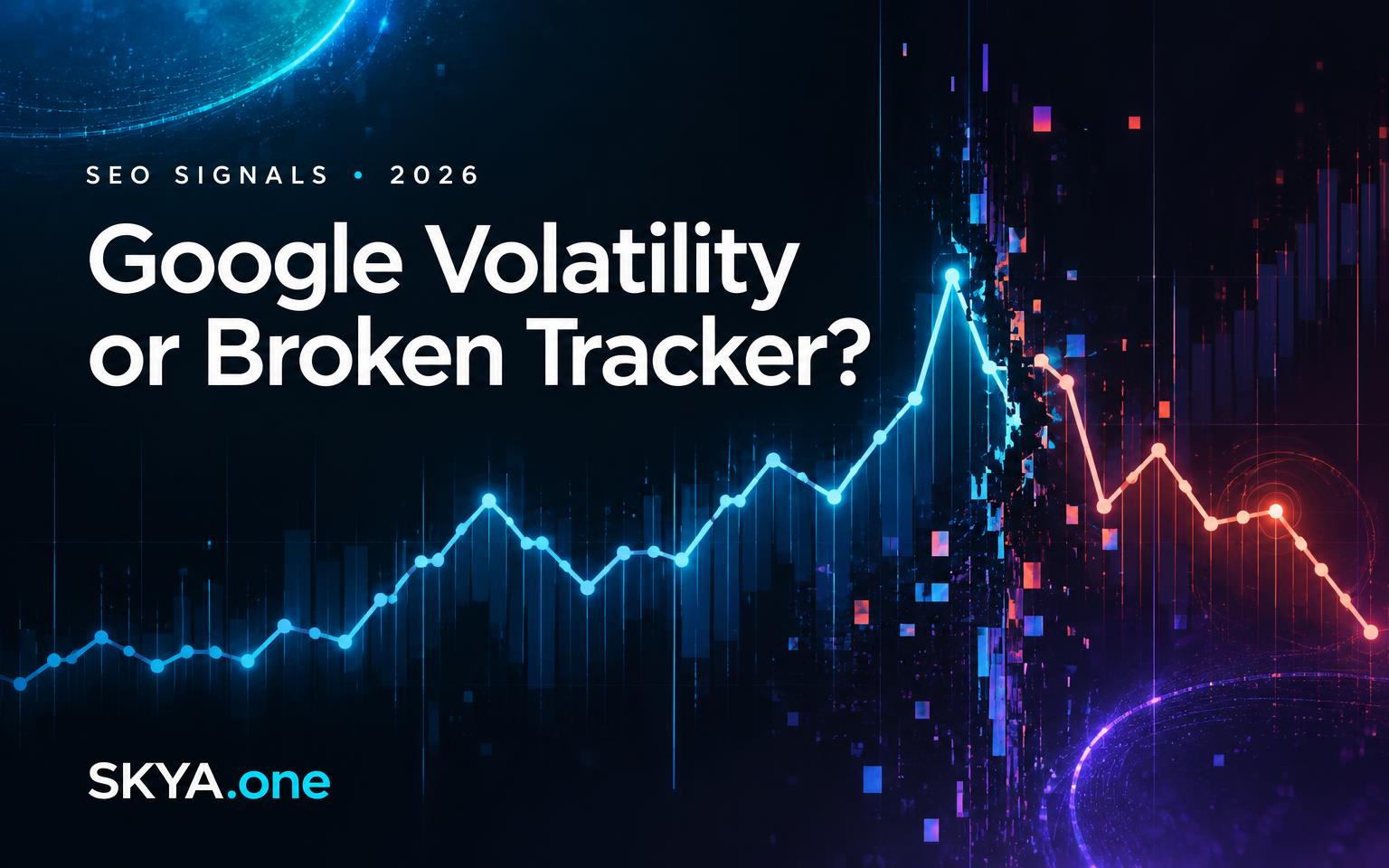
A ranking chart can fall for two very different reasons: your pages lost visibility, or the tool collected less reliable data. September 2026 created both conditions at once.
Search Engine Roundtable reported significant ranking volatility on September 23 and 24. Later on September 24, Google confirmed a global spam update that could take up to two weeks to roll out. Separately, tracking providers reported that Google's anti-automation changes were reducing their ability to collect results.
That combination creates a reporting hazard. A downward line can reflect a real ranking change, a collection gap, or both. Here is a five-check process for separating them before you brief a client or change a campaign.
What Actually Happened in September 2026?
Three events matter.
First, observers reported unusual ranking movement from September 4 through 13, followed by another burst around September 15. Second, new volatility appeared on September 23 and 24. Third, Google confirmed the September 2026 spam update on September 24 at 9:15 a.m. Pacific time.
At the same time, rank tracking became harder to measure. On September 18, Search Engine Roundtable reported that one tracking provider had lost about 80% of the data it could collect. Another provider's status notice said Google had changed how results were delivered and that collection was running at a reduced rate.
The 80% figure is one company's observed data loss, not an industry-wide benchmark. It does not mean every tracker lost 80% of its coverage. It does prove that a sudden gap in a third-party chart should not be treated as a ranking loss without confirmation.
Why Are Rank Trackers Struggling?
In August, Google confirmed that it was rolling out google.com/goto passthrough links in search results. Instead of exposing the destination directly in page markup, a result can point through an encoded Google address that resolves after a click.
Google's public confirmation described the change as part of its technical measures against evolving forms of abuse. The company did not identify rank trackers specifically.
The practical effect is more work for automated collection. One provider said that resolving all links across five pages of results could require 500 to 1,000 requests because the destination could not be decoded locally and lightweight header requests were refused. That estimate describes the provider's implementation, not a universal request count for every tracking system.
The result is simple: collection can become slower, more expensive, or incomplete even when a website's actual rankings have not changed.
A Short Timeline
| Date | Event | What it means |
|---|---|---|
| September 2025 | Google stopped supporting the old 100-results parameter | Collecting deep result sets became more expensive |
| Early July 2026 | Public reporting documented tests of google.com/goto links | Direct destination URLs started disappearing from some result markup |
| August 26, 2026 | Google confirmed the passthrough-link rollout | The measurement change became official |
| September 13 to 18, 2026 | Providers reported lower collection success | Some tracker gaps may reflect missing data |
| September 23 to 24, 2026 | Search observers reported sharp volatility | Rankings were moving at the same time collection was unstable |
| September 24, 2026 | Google confirmed a global spam update | A real ranking system change was also in progress |
This timeline is why no single chart can diagnose the cause.
Do Rank Tracking Tools Agree With Each Other?
Not always. Providers use different collection methods, locations, refresh schedules, and recovery logic. One may record a change immediately, another may show it later, and a third may temporarily display missing results.
Volatility sensors have the same limitation. A spike across several independent sensors, combined with wider industry reports, is stronger evidence than a spike in one tool. It still does not prove that your pages were affected.
Use third-party data as an observation layer, not as the final source of truth for your own traffic.
The Five-Check Triage
Run these checks in order before sending a client report.
| Check | How to run it | What it tells you |
|---|---|---|
| Search Console | Compare clicks, impressions, and average position for the same pages and dates | Flat first-party performance under a falling tracker chart points to a collection issue |
| Tracker health | Read the provider's status page and inspect last-updated timestamps | Reduced collection or stale timestamps make the drop less trustworthy |
| Second source | Check the same URL and query set with an independent source | Disagreement means at least one source is delayed or incomplete |
| Manual spot check | Check five to ten priority queries from the same location and device | Confirms the current result, while allowing for personalization and location differences |
| Timing | Compare the change with the September update and collection windows | A move that aligns with an update and appears in first-party data is more likely real |
Record the date and outcome of each check. If two checks disagree, mark the report as unconfirmed instead of filling the gap with a confident explanation.
Search Console remains the anchor because it reports Google's own observations of your pages. It has a delay and does not show competitor rankings, but it can establish whether impressions and clicks changed. SKYA's unified Search Console and analytics guide explains how to connect pre-click and post-click evidence without relying on scraped result pages.
What This Means for AI Visibility Tracking
The same measurement problem can affect systems that observe AI Overviews in Google results. If a collection fails, a dashboard must distinguish between "not present" and "not measured."
That distinction matters. A missing citation is a finding. A missing reading is a data gap. Turning both into zero creates a false decline.
When evaluating AI visibility tracking, ask three questions:
- Does the system label failed or incomplete collections?
- Are gaps excluded from share-of-voice and trend calculations?
- Can every score be traced to a stored reading with a timestamp?
For a practical walkthrough of trigger rate, citation presence, and citation position, read SKYA's AI Overview rank tracking guide. For the wider measurement model, see AI visibility explained.
How to Alert on Drops Without False Alarms
An alert is useful only when it can separate a genuine loss from a collection failure.
- Require the drop to appear in two consecutive successful readings.
- Require a second signal, such as Search Console impressions, before sending a client alert.
- Store the provider-health state beside each reading.
- Suppress loss alerts during known collection incidents.
- Never convert a failed reading into zero.
Restraint is part of accuracy. An alert system that repeatedly reports false losses teaches teams to ignore the next real one.
A Measurement Stack That Survives Collection Problems
Build reporting in layers:
- First-party evidence: Search Console and analytics for what happened to your pages.
- Tracker evidence: Rank and AI visibility readings for market coverage and competitor context.
- Spot checks: A fixed set of priority searches recorded with date, location, and device.
- Change log: Site releases, content changes, tool incidents, and confirmed search updates on one timeline.
No single layer should trigger a client message by itself. The keyword rank tracker buyer's guide covers the collection, history, and alerting questions worth asking before choosing a platform.
What to Tell a Client
Keep the message factual:
Google confirmed a global spam update on September 24, while some tracking providers also reported collection problems. We checked your first-party data for the affected pages. Clicks and impressions are currently [up, flat, or down]. We are holding the ranking conclusion until two sources agree, and we will update you on [date].
If Search Console confirms a loss, say so and move to page-level diagnosis. Avoid promising a recovery date. The evidence can show what changed, but not when Google will change it again.
Four Mistakes to Avoid
- Reporting a tracker drop on the same day without a second source.
- Blaming every dip on a broad update when one page may have its own issue.
- Switching trackers during an incident and comparing the new baseline with the old tool's history.
- Treating a volatility sensor as a diagnosis. It shows movement, not the cause or the impact on your site.
The Short Version
September's movement was not imaginary. Google confirmed a spam update, and search observers recorded substantial volatility. But measurement was also under pressure, and some providers reported sharply reduced collection.
Confirm every drop with first-party data and a second source. Keep data gaps separate from zero results. Treat AI visibility tracking with the same discipline.
Make AI platforms mention your brand accurately. Start a 7-day free SKYA trial. No card required.
Frequently Asked Questions
Is there a Google ranking update happening now?
Google confirmed that the September 2026 spam update began on September 24 and could take up to two weeks to complete. Search observers also reported strong volatility on September 23 and 24. Check Google's Search Status Dashboard for the current rollout state before attributing a change to the update.
Why is my rank tracker showing a sudden drop?
The drop could reflect a real ranking change, a data-collection problem, or both. Compare the same pages and dates in Search Console, check the tracker's service status, and confirm a sample of queries with a second source before reporting the loss.
What are google.com/goto links?
They are Google passthrough links that can replace the direct destination address in search-result markup. Google confirmed the rollout in August 2026. For automated systems, resolving those links can require more work than reading a direct URL from the page.
Are all rank trackers affected in the same way?
No. Providers use different collection systems, refresh schedules, locations, and recovery methods. A collection change can affect one provider earlier or more severely than another, which is why cross-checking matters.
Does this affect AI visibility tracking?
It can affect systems that observe AI Overviews through Google result pages. Reliable AI visibility tracking labels missing readings as gaps, excludes them from scores, and never treats a failed collection as a confirmed zero.
Should I switch rank trackers now?
Not solely because of one unstable reporting window. A new tracker creates a new baseline that may be difficult to compare with the old history. First ask your current provider how it labels failed readings, then compare overlapping data from two systems before making a change.

Written by
SKYA Editorial Team
The SKYA Editorial Team publishes field-tested research on Answer Engine Optimization, Generative Engine Optimization and AI Visibility. Every article is reviewed by senior practitioners from the SKYA product and research groups before publication.
Related posts
Keep exploring the SKYA Journal.