On this page12
- What OpenAI Announced
- A Paid Slot and an Earned Mention Are Different Things
- How to Appear in ChatGPT Answers: The Earned Route
- Why the Split Matters for Reporting
- Questions to Ask Before Any Client Ad Budget
- Mistakes to Avoid While the Test Starts
- The Measurement Partners Measure Ads, Not Answers
- How to Check That Ads Do Not Change Answers
- What an AI Brand Monitoring Tool Must Do
- A Monthly Report With Two Ledgers
- What to Tell Clients
- Frequently Asked Questions
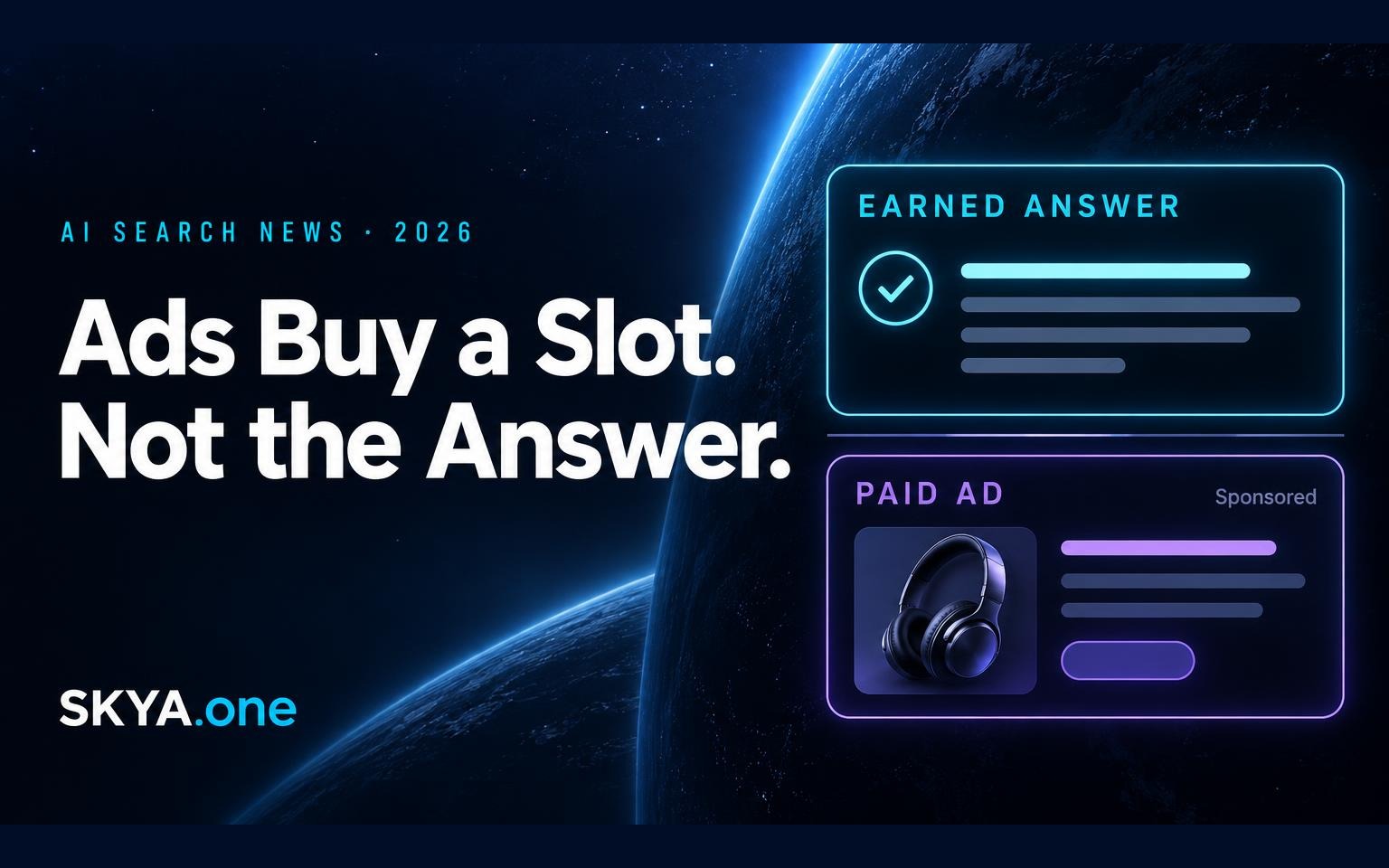
OpenAI will test a visual ad format in ChatGPT image generation later in October 2026. It also says advertising does not influence the answers ChatGPT provides. By OpenAI's own account, then, ads cannot buy a place in the answer. A mention is still earned work. Plan the paid and earned sides apart, and measure each one with its own data.
What OpenAI Announced
OpenAI announced the new format on October 5, 2026. Search Engine Journal covered it on October 6. The format shows image-based ads that give product inspiration or show how an offer fits into daily life. The test runs during image generation.
| Question | What the sources say |
|---|---|
| What is the format? | An image-based ad that shows product inspiration, usage or the experiences a product enables |
| Where does it appear? | During image generation, for Free and Go users |
| When does the test start? | Later in October 2026, in the US, with a small initial group of advertisers |
| How is it labelled? | “Ads will be clearly labeled, and remain separate from the image being created.” |
| What does OpenAI say about answers? | “As with our other ad formats, advertising does not influence the answers ChatGPT provides.” |
| Who can use it? | Search Engine Journal says most advertisers will not have access yet |
Search Engine Journal adds that, until now, ChatGPT ads have appeared below responses. It also says OpenAI has not shared targeting, pricing, creative requirements or reporting for the new format. Its advice is that most advertisers should not plan around it yet.
A Paid Slot and an Earned Mention Are Different Things
Clients often blend the two. Both put a client in front of a buyer inside ChatGPT. They work in very different ways. The contrast below is the one to teach in your next meeting.
| Feature | Paid ad | Earned mention in an answer |
|---|---|---|
| How it is won | An advertiser buys a placement | The assistant chooses to name or cite the client |
| Who controls it | The advertiser, within OpenAI's rules | No one directly |
| Labelling | Clearly labelled as an ad | Not labelled. It is part of the answer |
| Effect on the answer | None, per OpenAI | It is the answer |
| What drives it | Budget and targeting | Clear pages, accurate facts and trusted third-party sources |
| How to measure it | Ad reports and attribution tools | Daily readings of the answers themselves |
The fourth row is the key one. OpenAI states that ads do not influence answers. That is OpenAI's own claim, and the sources do not test it. Treat it as a statement to verify, which the section on checking independence below explains.
How to Appear in ChatGPT Answers: The Earned Route
If ads cannot buy a mention, the work is the same as before. A client has to be easy to find, easy to understand and easy to trust. Five steps cover most of it.
-
Write a plain page for each question a buyer asks. State the answer in the first sentence.
-
Keep facts consistent. Price, plans, locations and policies should match on every page and profile.
-
Add schema markup so assistants can read what each page is about.
-
Earn mentions on sources that assistants already cite. SKYA explains the pattern in how AI platforms cite.
-
Read the answers every day, fix wrong claims at the source and repeat.
Knowing how to appear in ChatGPT answers is mostly knowing which of these steps is weak for a given client. A daily record shows which question fails and why.
Why the Split Matters for Reporting
The new format will confuse reports if you let it. A client may see an ad during image generation and think the brand is now “in ChatGPT”. That is a paid impression, not a mention in an answer. Keep two ledgers.
| Event | Which ledger | Where the data comes from |
|---|---|---|
| An ad shown during image generation | Paid | Ad platform reports |
| A click or sale from that ad | Paid | Attribution partners |
| The client named in a text answer | Earned | Stored daily readings |
| A wrong claim about the client in an answer | Earned | Claim check on the stored answer |
Mixing the two ledgers makes both look better or worse than they are. A paid spike can hide a fall in earned mentions. An earned gain can look like an ad effect.
Questions to Ask Before Any Client Ad Budget
The test is small and the details are missing. A client who asks about it deserves a short, honest checklist.
| Question | Known today? | What to say |
|---|---|---|
| Can our client join the test? | Not for most advertisers | We will watch for wider access |
| What will it cost? | Pricing has not been shared | We cannot give a number yet |
| Who sees the ads? | Free and Go users, in the US, during image generation | Check whether your buyers fit that group |
| Will ads change the answers? | OpenAI says no | We will verify with dated readings |
| How will we measure results? | Partners were named, reporting was not detailed | We will wait for the format to be documented |
This table keeps the meeting short. Every row has a plain answer, and no row asks the agency to guess.
Mistakes to Avoid While the Test Starts
| Mistake | Result | Better move |
|---|---|---|
| Treating an ad view as a mention | The earned ledger looks inflated | Log ads and answers separately |
| Moving earned budget to ads too early | Pages and sources go stale | Keep the earned work running |
| Reading partner results as benchmarks | Wrong targets for the client | Use them only for their own test |
| Skipping the baseline | No proof of what changed | Save answers now, before any change |
The last row costs nothing and cannot be redone later. Saved answers from before the test are the only way to compare cleanly afterwards.
The Measurement Partners Measure Ads, Not Answers
OpenAI also named partners for the ads programme. Data integrations include Hightouch, Tealium and LiveRamp. Attribution partners include AppsFlyer, Triple Whale, Adjust, DV Rockerbox and Northbeam. Haus, Measured and WorkMagic run incrementality tests, which OpenAI calls early stage. DoubleVerify and Integral Ad Science are running brand suitability pilots without accessing private user conversations.
Search Engine Journal warns against reading partner results as benchmarks. In its words, those figures “measure different outcomes.” The point for an agency is simple. These tools describe ad performance. None of them is described as reading what ChatGPT says in an answer.
How to Check That Ads Do Not Change Answers
OpenAI says ads do not influence answers. You do not need to doubt it to check it. Good reporting verifies claims. A fixed set of questions and a dated record is enough.
-
Pick ten buyer questions per client now, before the ad test reaches your clients' markets.
-
Save the full answer text each day, with the date and the plan you used.
-
Note any day when ads appear in the session. Log them separately from the answer.
-
Compare who is named and cited before and after ads appear.
-
Report what you see and what you cannot see. Do not claim proof from one client.
A single client is a small sample. An agency with many clients holds a much richer record. If the answers stay the same across accounts, that supports OpenAI's statement. If they change, the record shows when.
What an AI Brand Monitoring Tool Must Do
An AI brand monitoring tool has to keep the earned ledger clean. Ask any vendor about the five items below.
| Requirement | Why it matters | How SKYA handles it |
|---|---|---|
| Keeps the answer text and date | You need a baseline from before the ad test | A stored reading behind every number, with an evidence panel |
| Reads many assistants daily | ChatGPT is one of several | Nine assistants every day: ChatGPT, Gemini, Perplexity, Claude, Google AI Overview, Google AI Mode, DeepSeek, Grok and Copilot |
| Checks claims | A mention can be wrong | A hallucination audit on every paid plan |
| Admits what it cannot read | A guessed number hides gaps | No answers read means no figure. A run that measured nothing gives its credit back |
| Reports by client | Agencies manage many accounts | Multi-client workspaces and white-label PDF reports |
SKYA publishes how every number is calculated. Because it works on the answers, it keeps the earned ledger apart from any ad report. A good tool should do the same.
A Monthly Report With Two Ledgers
Give the client one report with two clearly marked parts. The layout below keeps every number tied to its source.
| Section | Source | What the client learns |
|---|---|---|
| Paid: ad activity | Ad platform reports | What was shown, when and to whom |
| Earned: mentions | Daily answer readings | Whether the client is named and cited |
| Earned: accuracy | Claim check on stored answers | Which statements were wrong |
| Fixes made | Agency notes | Which pages and sources changed |
| Change over time | Stored history | Whether the answers moved after ads began |
The final row answers the question every client will ask. Did the ads change what ChatGPT says? With dated readings you can reply with evidence, not a guess.
What to Tell Clients
| Say | Avoid |
|---|---|
| OpenAI will test visual ads in image generation later this month. It says ads do not influence answers. | You can now pay to be in ChatGPT answers. |
| A paid ad and a mention in an answer are separate. We report them separately. | Our ad spend raised your mentions. |
| Most advertisers will not have access to the new format yet. We will not plan around it. | Every client should advertise in ChatGPT now. |
| We keep dated readings of the answers, so we can show what changed. | Trust the score. |
Frequently Asked Questions
Can ads help you appear in ChatGPT answers?
OpenAI says no. Its announcement states that advertising does not influence the answers ChatGPT provides. Treat this as a claim to verify with dated readings of your own questions.
What is OpenAI's new ChatGPT ad format?
It is an image-based ad that appears during image generation. OpenAI says it will begin testing later in October 2026 in the US, with a small initial group of advertisers, for Free and Go users.
How to appear in ChatGPT answers without ads?
Publish clear pages for buyer questions, keep facts consistent across pages, add structured data and earn mentions on sources that assistants cite. Then read the answers daily and fix wrong claims at the source.
Will every advertiser get the visual ad format?
No. Search Engine Journal reports that most advertisers will not have access yet, and that OpenAI has not shared targeting, pricing, creative requirements or reporting for the format.
What is an AI brand monitoring tool?
It reads what AI assistants say about a client and records whether the client is named, cited and accurate. SKYA does this daily across nine assistants and stores the answer behind every number.

Written by
SKYA Editorial Team
The SKYA Editorial Team publishes field-tested research on Answer Engine Optimization, Generative Engine Optimization and AI Visibility. Every article is reviewed by senior practitioners from the SKYA product and research groups before publication.
Related posts
Keep exploring the SKYA Journal.