On this page10
Quick Answer Google AI Overviews absorb the click for informational queries by answering above the results. You get the traffic back by becoming the cited source rather than the tenth blue link: answer the question in the first 100 words, structure the page into liftable blocks, earn third-party validation, keep the page current, and shift measurement from rankings to citation share. Recovery is a mix of content rewrites, technical fixes, authority work, and monitoring, not a single fix.
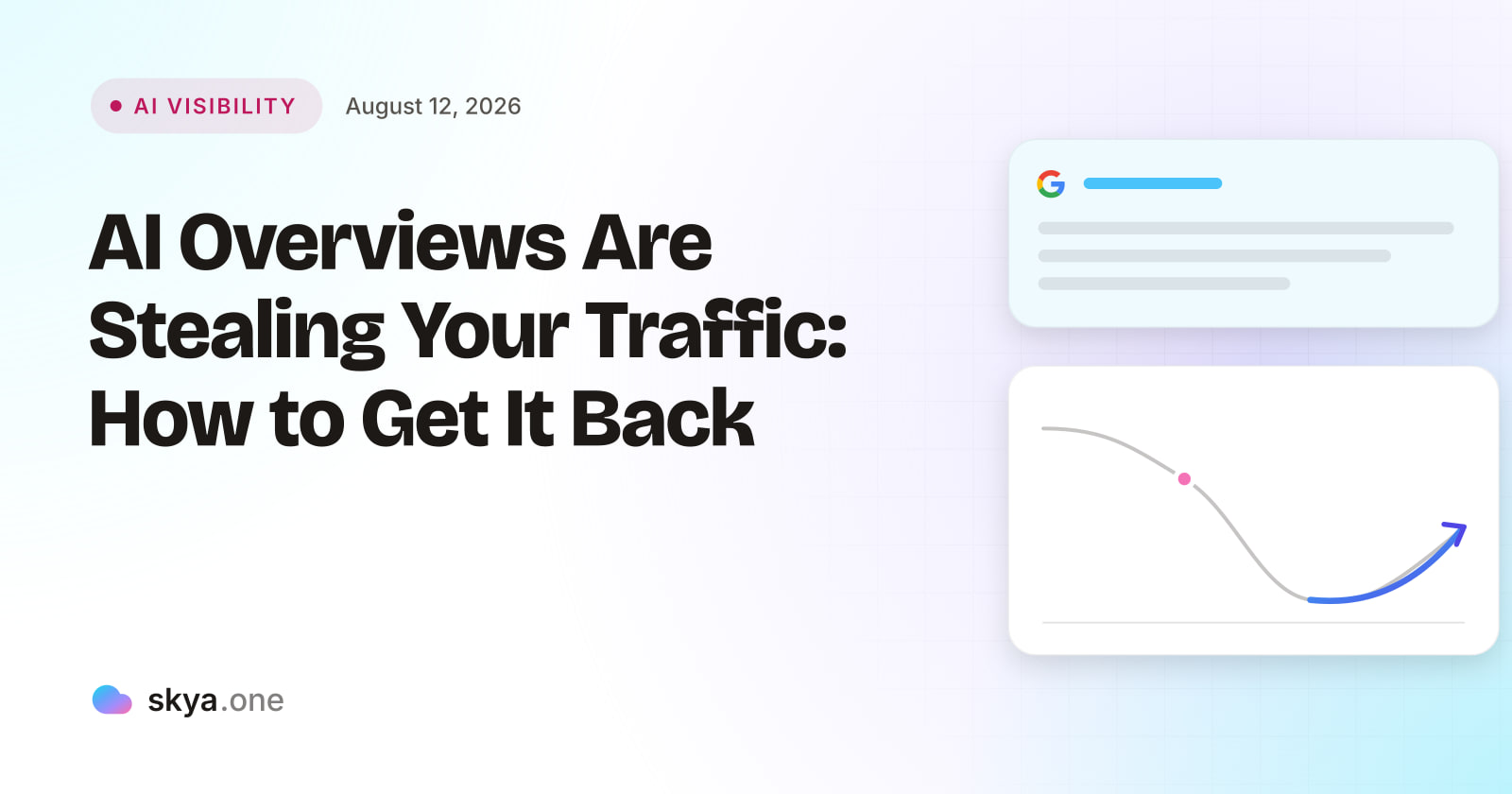
Rankings held. Impressions held. Clicks fell. That pattern has become the defining reporting problem of 2026, and it usually has one cause.
Google AI Overviews now answer a large share of informational queries directly on the results page. The user reads the summary, the summary cites three or four sources, and everyone else loses the visit.
The response is not to fight the format. It is to become the source the format quotes.
What Actually Changed
Traditional search rewarded position. AI Overviews reward extractability.
When Google assembles an overview, it does not simply lift the top-ranked page. It selects passages from multiple sources that answer the question cleanly and appear trustworthy. Studies through 2026 consistently show that many cited pages do not rank in the organic top ten at all.
That is the opening. A page that ranks seventh but answers precisely can be cited above a page that ranks first but buries its answer under 600 words of preamble.
The Four Metrics That Decide Citation
Across the pages that consistently earn AI Overview citations, four factors do most of the work.
Authority. Does the domain have credible standing on this topic, supported by third-party references, consistent entity signals, and demonstrated expertise?
Structure. Can the answer be lifted as a self-contained block without losing meaning?
Citations. Are claims supported by named, linkable sources rather than assertion?
Relevance. Does the page match the actual question behind the query, including its intent and specificity?
A page that is strong on all four gets cited repeatedly. A page that is strong on three gets cited occasionally. A page strong on one gets ignored.
Diagnose Before You Rewrite
Do not rewrite everything. Find the pages that lost clicks while holding position, because those are the pages losing to an overview.
The diagnostic sequence:
- In Search Console, filter for queries where impressions are flat or rising and clicks fell over the last two quarters.
- Check whether those queries trigger an AI Overview today.
- Note which sources are cited in that overview and what shape their answer takes.
- Compare your page to the cited source on answer position, block structure, evidence, and last update.
- Rank the affected pages by commercial value, not by traffic loss alone.
That last step matters. A page that lost 4,000 informational visits may be worth less than a page that lost 200 high-intent visits.
The Recovery Mix
Recovery work falls into four buckets, and the effort split matters as much as the tactics.
1. Content Rewrites
Move the direct answer into the first 100 to 150 words. Rewrite headings so each names a sub-question. Break long argument sections into blocks that stand alone. Add a comparison table or a definition block where the query implies a choice.
This is the highest-leverage bucket because it is fully in your control and takes days, not quarters.
2. Technical Fixes
Confirm the page is fetchable and that the answer exists in raw HTML rather than appearing only after scripts run, the same technical AEO checks that decide whether a page can be read at all. Check canonicals, redirect chains, and mobile rendering. Nothing else matters if the passage is not readable at fetch time.
3. Authority Work
Third-party validation is the slowest bucket and the hardest to shortcut. Original research, industry citations, expert contributions, and consistent entity signals across the web all raise the odds of being treated as a credible source.
4. Monitoring
Track which queries trigger overviews, which sources are cited, and whether your presence is improving. Without this you cannot tell whether a rewrite worked or the query simply changed.
Rewrite Patterns That Work
Certain formats get cited more often because they map cleanly to how overviews are assembled.
- Definition block. One paragraph, 40 to 60 words, that answers "what is X" without qualification.
- Numbered process. Discrete steps with a verb-led label, each independently understandable.
- Comparison table. Two or three options scored on the criteria the query implies.
- Data point with source. A specific number, the period it covers, and a linkable source.
- Direct FAQ. The literal question as an H3, answered in the first sentence beneath it.
Avoid the patterns that suppress citation: long scene-setting introductions, pronoun-heavy paragraphs that depend on earlier context, marketing claims without evidence, and content that mixes four intents on one page.
Change What You Report
If your dashboard only shows rankings and sessions, AI Overviews will look like an unexplained decline forever.
Add three measures alongside the existing ones. Citation share is the percentage of tracked overview-triggering queries where your domain appears as a source. Prompt coverage is how many of your priority questions surface your brand at all. Assisted conversions from AI referrers captures the traffic that does arrive, which is typically lower volume and higher intent.
Reframe the conversation with stakeholders early. Fewer informational clicks with stable pipeline is a different story from lost demand, and the data supports it if you collect it.
Recovery Timeline
Set realistic expectations. Content rewrites can change citation behaviour within two to six weeks once the page is recrawled. Technical fixes act on a similar timeline. Authority work compounds over two to three quarters and rarely shows a clean before-and-after.
Work in cycles: rewrite a batch, wait for recrawl, measure citation change, then decide whether the pattern is worth scaling, following the same monthly loop laid out in the AI search marketing strategy playbook.
Where SKYA Fits In
Manual checking does not scale past a handful of queries. Overviews vary by location, phrasing, and time.
SKYA tracks which of your priority queries trigger AI Overviews, which sources get cited, how that changes week to week, and which of your pages should be rewritten first. That turns a vague traffic decline into an ordered work list.
Final Thoughts
AI Overviews are not stealing traffic so much as reallocating it toward sources that answer clearly and prove their claims.
The brands recovering fastest are not the ones publishing more. They are the ones rewriting their most valuable pages to be liftable, keeping them current, and measuring citation instead of position. For the page-level craft behind that work, see the complete guide to optimising content for AI search, and for the foundation underneath it, the technical AEO guide.
Frequently asked questions

Written by
SKYA Editorial Team
The SKYA Editorial Team publishes field-tested research on Answer Engine Optimization, Generative Engine Optimization and AI Visibility. Every article is reviewed by senior practitioners from the SKYA product and research groups before publication.
Related posts
Keep exploring the SKYA Journal.