On this page10
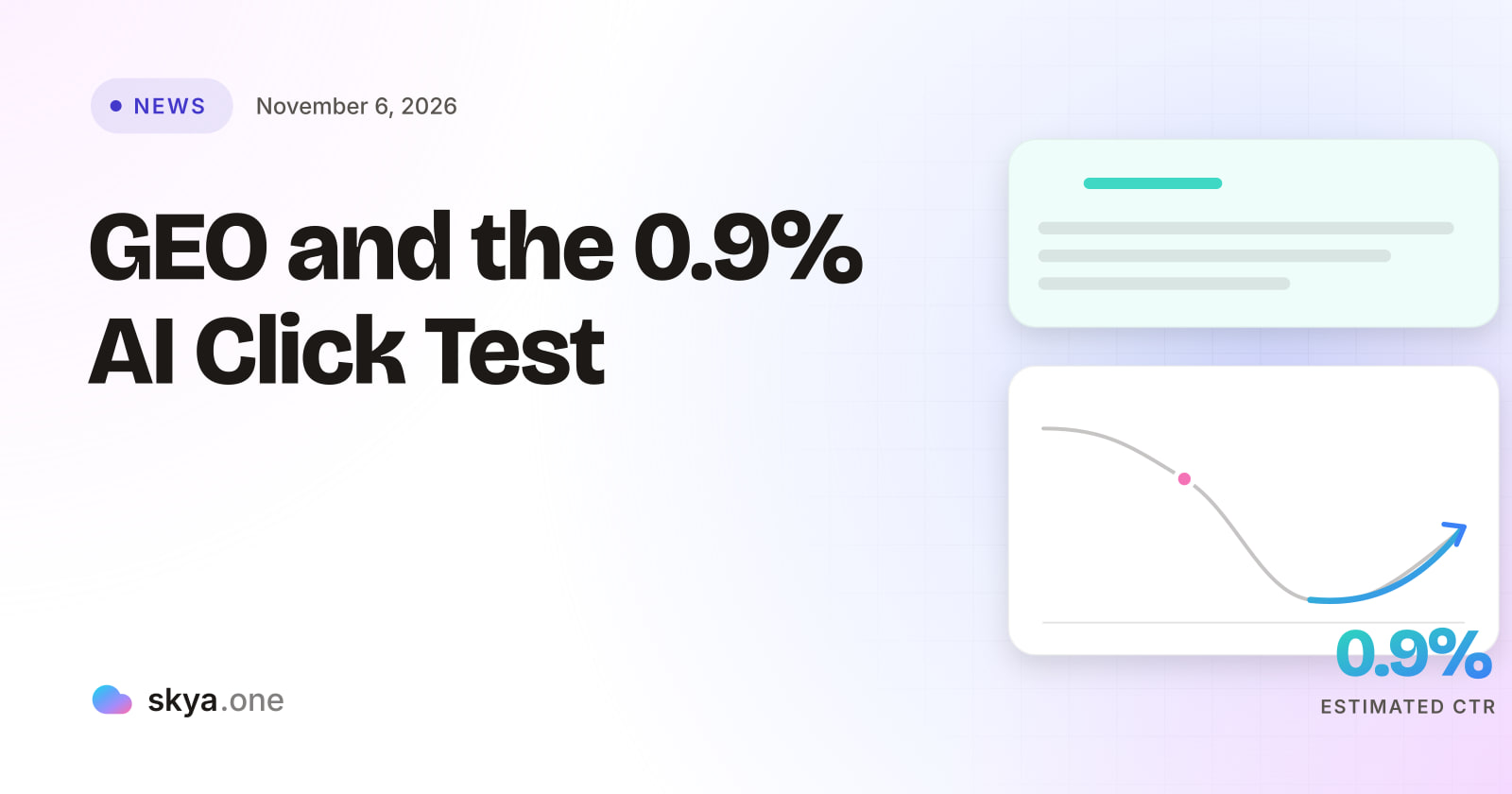
What is GEO in marketing? It is the work of getting a client named and cited inside AI answers. On October 30, 2026, Search Engine Roundtable reported a small test that estimates AI features earn about 0.9% click-through. It also found that opting out cut organic clicks. One site proves little, so read the result carefully before you quote it to a client.
What Is GEO in Marketing, Exactly?
GEO stands for generative engine optimization. SEO tries to rank a page in a list of links. GEO tries to get a client mentioned, cited and described correctly inside the written answer that an assistant gives. The assistant may be ChatGPT, Gemini, Perplexity or Google’s AI Overviews and AI Mode.
The two jobs overlap but they are not the same. A page can rank well and still be missing from the answer. SKYA covers the basics in its guide to generative engine optimization, and the difference from AEO in AEO vs GEO. The question here is narrower. If AI answers get so few clicks, is GEO worth doing?
What the Test Did
Barry Schwartz of Search Engine Roundtable reported the case study on October 30, 2026. SEO consultant Cyrus Shepard shared it on LinkedIn and called it a “small case study”. The article does not say when the test ran or how large the sample was.
| Detail | What the article says |
|---|---|
| Method | Shepard used Google’s opt-out controls to keep one site out of AI Overviews and AI Mode, then compared impressions, clicks and click-through rate for the periods in and out |
| The 0.9% figure | Estimated by taking the site’s overall clicks and impressions and subtracting the known AI impressions. In his words: “AI impressions had an estimated ~0.9% CTR” |
| Opt-out effect on AI | AI impressions fell to zero straight away |
| Opt-out effect on organic | Regular organic clicks also fell, which Shepard called the most surprising result |
| Share of impressions | AI impressions were about 8% of the site’s total |
| Google’s response | None in the article |
Where the Number Is Weak
Start with what 0.9% is. It is not a measured click rate. It is a remainder, found by subtracting one estimate from another. Any error in the AI impression count lands straight in the result. The article also gives no sample size and no dates. With one site, it is a single observation, and the author himself calls it small.
Next, the test design. Only this one site was excluded. AI Overviews kept appearing on the results page for everyone else. So the test does not compare a results page with AI answers against one without. It compares a site inside the AI layer with the same site outside it, while the layer stays on the page. That is a useful experiment. It is not the experiment the headline number suggests.
Then the surprising result. Organic clicks fell when the site opted out. Shepard’s explanation is what he calls a “Search SERP Halo Effect”: appearing in more places on a results page may lift clicks overall. That is a hypothesis. The article lists other moving parts. Average position across the site rose during the test, which Shepard credits to new posts and branded search. On the URLs with the most AI visibility, position dropped and then recovered when AI visibility returned. When several things change at once, one cause cannot be named.
Greg Sterling added a note in the comments. Near Media’s research suggests AI Overviews can build awareness of a client that sometimes leads to later searches and clicks, though not consistently. That fits Shepard’s idea, but it is a second opinion and not proof.
A careful reader would want four things before leaning on any of this: the sample, the dates, the size of the site and how much of its traffic came from searches for its own name. None of them is in the article. Until they appear, the case study is a prompt to test, not a result to cite. That is not a criticism of Shepard, who labeled it small himself. It is a reminder that a clean figure and a sound figure are different things.
What the Test Does Not Change
Suppose the 0.9% holds up for other sites. What follows? Not that GEO is pointless. The point is narrower. If AI answers send few clicks directly, then clicks from the answer are the wrong place to judge GEO. This is an inference, not a finding in the report.
So what is GEO in marketing worth if direct clicks are scarce? It is worth what it changes upstream: who gets named, how they are described and whether the description is true. Those effects are real even when the click is missing.
A buyer who reads an AI answer that names the client may never click that answer. They may search the client’s name an hour later, or ask a colleague, or arrive through a different route. Only the last of those shows up as a visit. The first two vanish from an analytics report. If the halo idea is right, the answer helps and the click count hides it.
The opposite error is just as easy. It is tempting to read the organic drop and tell clients never to opt out. One site, with several changes in play, cannot carry that advice. Opt-out is a business decision that deserves its own review. It does not belong in a recommendation based on one test.
How Studies Like This Get Misquoted
Expect this story to travel fast. A headline will say AI features get under 1% of clicks, and a second headline will say that opting out hurts. Both will drop the words that matter: “small”, “estimated”, “one site”. Agencies are quoted by clients, and a clean number is easy to repeat and hard to retract. The safer habit is to quote the limits first. Say that it was one site, that the figure was estimated by subtraction and that Google has not responded. Then say what you will measure instead. A client who hears the limits first will trust the rest of the report.
Clicks Are Not the Only Scoreboard
Agencies need metrics that match what the work does. Clicks measure a visit. GEO tries to change what a buyer believes before a visit. The comparison shows what each metric can and cannot say.
| Metric | What it shows | What it misses |
|---|---|---|
| Clicks from AI features | Direct visits from the answer | Buyers who read and did not click |
| Mention rate | How often the answer names the client | Whether the mention is accurate or favorable |
| Citation | Whether the answer links the client’s page as a source | How the assistant describes the client |
| Accuracy of claims | Whether the statements about the client are right | Whether anyone acted on them |
| Branded search over time | Whether more buyers look for the client by name | Which answer or AI platform caused it |
No single row tells the story. A client report needs several. That is the point of AI visibility tracking: a stored, dated record of what assistants say, set beside Search Console clicks and branded search.
A Fair Test for Your Own Clients
Do not copy the opt-out test. Run a safer one that answers the same question without risking a client’s traffic.
-
Pick ten buyer questions per client. Mix branded and non-branded ones.
-
Run each in Google, ChatGPT, Gemini and Perplexity. Save the full answer, with the date.
-
Mark each answer: client named, client cited, client absent or a rival named.
-
Pull Search Console data for the same pages and the client’s name searches over the same weeks.
-
Repeat every week for a month, using the same wording.
-
Compare mention rate with branded search and clicks. Report where they move together and where they do not.
Keep the wording fixed. If you change the words, you change the test. A month of weekly readings will not prove cause. It will show whether the client’s presence in answers and its branded demand tend to move together, which is more than a clicks-only report can show.
What Counts as Good AI Visibility Tracking
By hand, the test above works for ten questions. It fails at fifty across several clients. A strong tracker has to keep the answers, not only a score. Ask any vendor the five questions below.
| Requirement | Why it matters | How SKYA handles it |
|---|---|---|
| Keeps the answer text and date | You need to compare answers over time | A stored reading behind every number, with an evidence panel |
| Reads many assistants | Buyers use more than one | Nine assistants every day: ChatGPT, Gemini, Perplexity, Claude, Google AI Overview, Google AI Mode, DeepSeek, Grok and Copilot |
| Checks claims | A mention can be wrong | A hallucination audit on every paid plan |
| Admits what it cannot read | A guessed score hides gaps | No answers read means no figure. A run that measured nothing gives its credit back |
| Ties answers to traffic | Answers and visits need one story | GA4 and Search Console integration, multi-client workspaces and white-label PDF reports |
SKYA publishes how every number is calculated. Its page on daily AI answer readings shows what a stored reading looks like.
What to Tell Clients
Say that one small test estimated about 0.9% click-through on AI features, and that the author calls it small. Say that GEO is not judged by clicks from the answer alone, because buyers read answers and act later. Say that you will track mentions, citations and accuracy, and compare them with branded search and Search Console clicks. Avoid three lines: “AI answers get 0.9% of clicks”, “opting out hurts traffic” and “GEO does not work”. The study supports none of them.
Frequently Asked Questions
What is GEO in marketing?
GEO, or generative engine optimization, is the work of getting a client named, cited and described correctly inside AI answers from tools such as ChatGPT, Gemini, Perplexity and Google’s AI Overviews and AI Mode.
Do Google AI Overviews and AI Mode really get a 0.9% click-through rate?
One small case study estimated about 0.9% for one site. The figure is a remainder from subtracting estimates, the sample is small and Google gave no response. It is not a general rate.
Does opting out of AI Overviews reduce organic clicks?
In that one test, organic clicks fell after the opt-out. Several other factors changed at the same time, so the test cannot show cause.
Is GEO worth doing if AI answers get few clicks?
Yes, if you judge it by the right measures. Clicks from the answer are only one signal. Mentions, citations, accuracy and branded search show more of the picture.
What is AI visibility tracking?
It is the daily reading of what AI assistants say about a client, stored with dates and checked for wrong claims. SKYA reads nine assistants every day and keeps the answer behind every number.

Written by
SKYA Editorial Team
The SKYA Editorial Team publishes field-tested research on Answer Engine Optimization, Generative Engine Optimization and AI Visibility. Every article is reviewed by senior practitioners from the SKYA product and research groups before publication.
Related posts
Keep exploring the SKYA Journal.