On this page10
- What Happened When AI Overviews Reached France
- What the Five Sites Show
- What the Data Cannot Prove
- AEO vs SEO: Where Each One Earns Its Place
- How to Read a Drop That Comes With Steady Impressions
- Why Search Console Cannot Finish the Job
- A Two-Week Check for Every Client
- What to Ask Any Vendor
- What to Tell Clients
- Frequently asked questions
Sometimes. Search Console data from France shows AI Overviews cut clicks on some sites and left others alone. One site fell from about 750 to about 400 daily clicks. Two lost about two thirds of their click rate. Two lost almost nothing. The sample is small, so read it as a warning, not a rule. This guide shows how to check a client.
What Happened When AI Overviews Reached France
Google switched on AI Overviews in France on July 22, 2026. AI Mode, Search Live and a new search box launched the same day, according to Google’s launch post as reported by PPC Land. France is an EU market. Any agency with European clients should care about what came next.
Search consultant Glenn Gabe of G-Squared Interactive then looked at the data. He filtered Search Console to France. He compared clicks, impressions, click-through rate and average position before and after July 22. He used the Generative AI report to confirm that AI impressions had started. He reviewed five sites. Two sit in sensitive categories, the kind Google handles with extra care.
His results were not uniform. That is what makes them useful.
What the Five Sites Show
| Site | What changed after July 22 |
|---|---|
| Site 1 | Clicks fell from about 750 to about 400 a day. CTR fell from 2% to 1.1%. Impressions stayed stable. |
| Site 2 (sensitive category) | Clicks fell from about 80 to about 25 a day. A smaller second drop followed around August 10. |
| Site 3 (sensitive category) | CTR fell from 1.2% to 0.4%. A second drop came around August 13. |
| Site 4 | Little change. Gabe said it “saw no drop in clicks really based on AIOs rolling out.” |
| Site 5 | CTR dipped before launch, then recovered. |
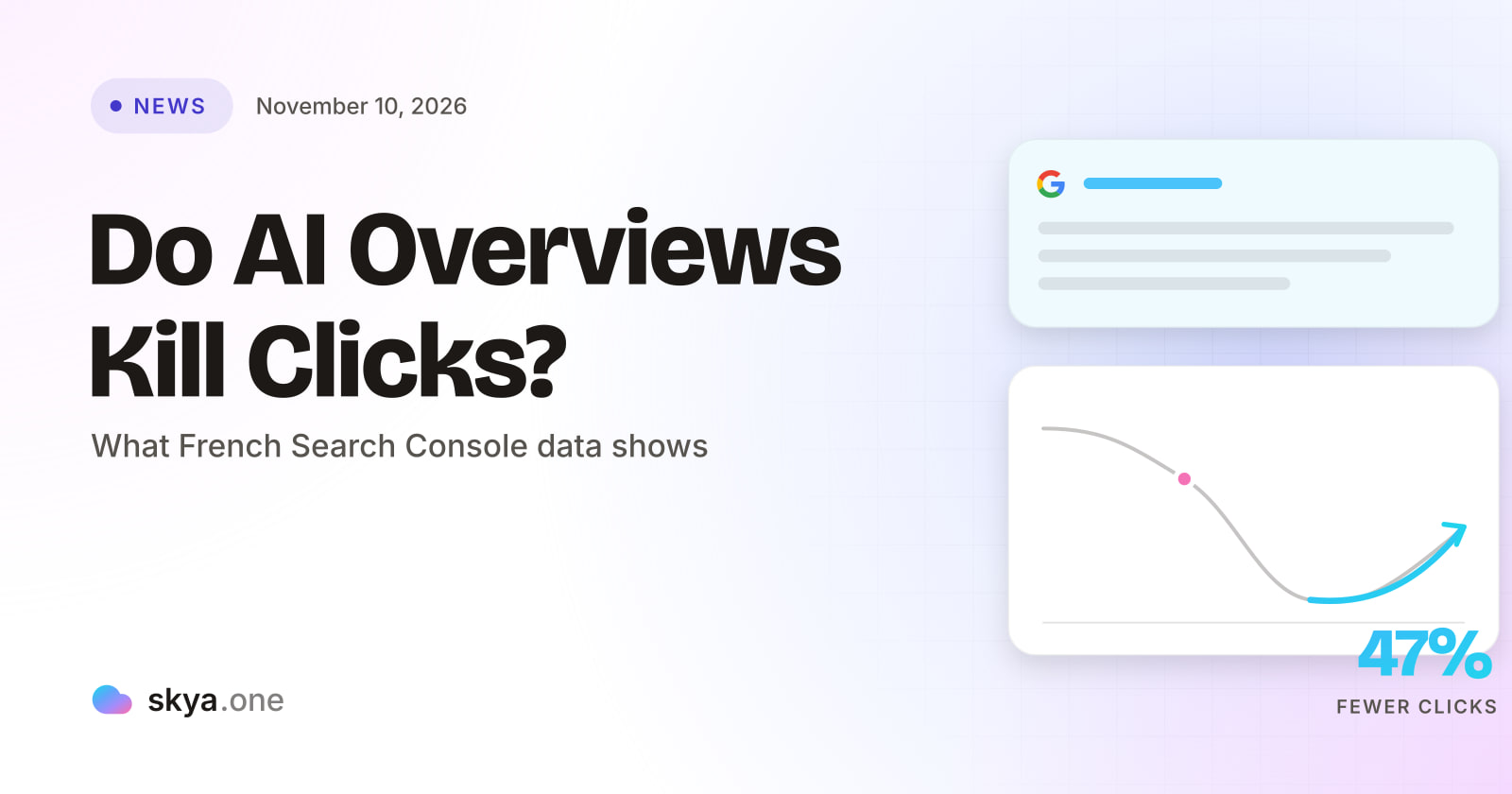
The pattern matters more than the percentages. Look at Site 1. Its impressions stayed steady while its clicks fell by roughly 47%. The page was still being shown. People simply clicked less. Gabe also saw Generative AI impressions on that site rise from near zero to about 2,400 a day by early November. Here is the inference, and it is only an inference: the page was being used as a source inside an answer, and the click went missing. The report does not show clicks from those impressions, so nobody can prove it.
Sites 4 and 5 deserve equal attention. If AI Overviews always cut clicks, they would have fallen too. The data does not say why they did not. Two explanations are plausible. Their queries may rarely trigger an overview. Or their visitors may want a page, not a summary. Neither has been tested here.
There is one more detail. Average position became erratic on the hit sites from launch day. Gabe calls it “the wobble”. His reading is that it reflects citations inside collapsed AI Overviews, which only register an impression when the answer is opened or visible. That is his interpretation, not a statement from Google.
What the Data Cannot Prove
Be strict with this evidence. It is five hand-picked sites. There is no control group and no year-over-year comparison. AI Mode and other features launched on the same day, so AI Overviews cannot be isolated. Some sites showed summer dips before launch, which could be seasonality. A spam update and ranking movement around August 12 and 13 overlap with the second drops. The Generative AI report shows impressions only, not clicks or queries. The link between lost clicks and AI Overviews rests on timing.
A larger study of French domains, covered by the same outlet, points the same way but at a smaller scale. Averages hide the spread. A site can sit in the unlucky group or the lucky one, and the average will not tell it which.
So the honest conclusion has two parts. The losses are real for some sites. Their size, and who gets hit, is not settled.
AEO vs SEO: Where Each One Earns Its Place
SEO still wins the visit when the searcher wants a page. AEO wins the mention when the searcher wants the answer. The French data shows the two moving apart. A rankings report would call Site 1 healthy. Its position held and its impressions held. Only the click line shows the damage.
That gap is the real lesson of AEO vs SEO. The two jobs now have different scoreboards. SEO is scored in rankings, clicks and sessions. AEO is scored in whether an AI answer names the client, quotes it correctly and links to it. A client that watches only the first scoreboard will miss the second one completely.
This does not mean abandoning SEO. Pages that rank still feed the answers. Assistants pull from the same open web. Strong pages are the raw material for a strong answer. What changes is the question you ask after the page is live: not only “did it rank” but “what does the answer say”.
How to Read a Drop That Comes With Steady Impressions
Not every fall in clicks is an AI problem. Before you blame an overview, rule out the usual causes. Check for a ranking loss on the main pages. Check for a seasonal dip in last year’s data. Check for a change in the page title or snippet. Check whether a spam or core update landed in the same window.
If those checks come back clean and the pattern is steady impressions with falling clicks, the answer layer becomes a fair suspect. Then test it directly. Search the client’s top queries. Note which ones show an overview. Note whether the client is cited, and whether the cited text is correct. A drop that lines up with queries that show an overview is stronger evidence than a drop that lines up only with a date.
Why Search Console Cannot Finish the Job
Search Console tells you something happened. It cannot tell you what the answer said. It does not show the wording of the overview. It does not show which sources were named beside your client. It does not show whether the claims were right. And it only covers Google, while buyers also ask ChatGPT, Gemini, Perplexity and others.
Gabe had to work from timing alone. That is a skilled workaround, and it is also a sign of the missing tool. This is the gap that AI visibility tracking fills. It reads the answers on a schedule, stores them with dates and lets you compare them over weeks. SKYA explains the method on its page about daily AI answer readings.
Stored answers also protect you in a client meeting. When a client asks why clicks fell, you can show the overview as it appeared that week. You can show who was cited and what was said. Without that record, you are guessing with a confident face.
A Two-Week Check for Every Client
-
Pull Search Console for the last 90 days. Filter to the client’s main market. Mark the date any new AI feature launched there.
-
Split the client’s queries into two groups: those where it needs clicks and those where it needs to be named.
-
Compare clicks and CTR before and after the launch date, with impressions beside them. Falling clicks with steady impressions is the pattern to flag.
-
Ask the client’s top ten buyer questions in at least three assistants. Save each answer with the date.
-
Compare each answer with the client’s facts. Mark every claim right, old, wrong or missing. Repeat after 14 days.
Keep the wording of the questions fixed. If you change the words, you change the test. For a client with several markets, run the check once per market. An overview shown in France can differ from one shown in Germany, so one market’s result cannot stand in for another.
If the check shows wrong claims, fix the source first. State the current facts in plain sentences, with dates, on one page of the client’s site. Add schema markup so machines read it cleanly. Then repeat the questions.
What to Ask Any Vendor
A tool for this job has to do more than count mentions. Ask any vendor the five questions below.
| Requirement | Why it matters | How SKYA handles it |
|---|---|---|
| Keeps the answer text and date | You must show what an answer said and when | Correct figures built from dated answer readings, with the answers themselves kept on view |
| Reads more than Google | Buyers use many assistants | Nine assistants every day: ChatGPT, Gemini, Perplexity, Claude, Google AI Overview, Google AI Mode, DeepSeek, Grok and Copilot |
| Checks claims, not only mentions | A named client can still be described wrongly | A hallucination audit on every paid plan |
| Admits what it cannot read | A guessed score hides gaps | No answers read means no figure. A run that measured nothing gives its credit back |
| Fits agency reporting | Clicks and answers belong in one report | Multi-client workspaces, GA4 and Search Console integration and white-label PDF reports |
SKYA publishes how every number is calculated. That matters because a score you cannot trace is a score you cannot defend to a client.
What to Tell Clients
Keep the message short and honest. Clicks can fall even when rankings hold. Some sites saw no loss at all. The cause is a new layer of answers above the results, and it needs its own measurement.
Then show the plan. First, the Search Console view of clicks against impressions. Second, a saved set of answers to the questions buyers ask. Third, a monthly note on what changed. This is the practical meaning of AEO vs SEO for a client: one scoreboard for visits and one for answers, reported together.
Avoid promising a recovery. The French data does not support one. Promise what you can deliver: a clear view of where the client stands and a record of how it moves.
Frequently asked questions

Written by
SKYA Editorial Team
The SKYA Editorial Team publishes field-tested research on Answer Engine Optimization, Generative Engine Optimization and AI Visibility. Every article is reviewed by senior practitioners from the SKYA product and research groups before publication.
Related posts
Keep exploring the SKYA Journal.