On this page12
- What Is Gemini Memory Summary?
- Who Gets It, and Where?
- How Memory Could Change What a Buyer Sees
- Why One Check No Longer Tells the Whole Story
- A Two-Week Check for Any Client
- What to Fix When Answers Differ
- Memory Is One Source of Variation Among Several
- Privacy Is Part of the Story
- What to Ask Any Vendor
- What Good Reporting Looks Like
- What to Tell Clients
- Frequently asked questions
Yes, but a single check is no longer enough. Gemini now has a Memory Summary page where users can see, edit and delete what it remembers about them. If assistants use that memory to shape answers, two buyers may see different replies to the same question. Measure a clean baseline, repeat it often, and read the spread, not one result.
What Is Gemini Memory Summary?
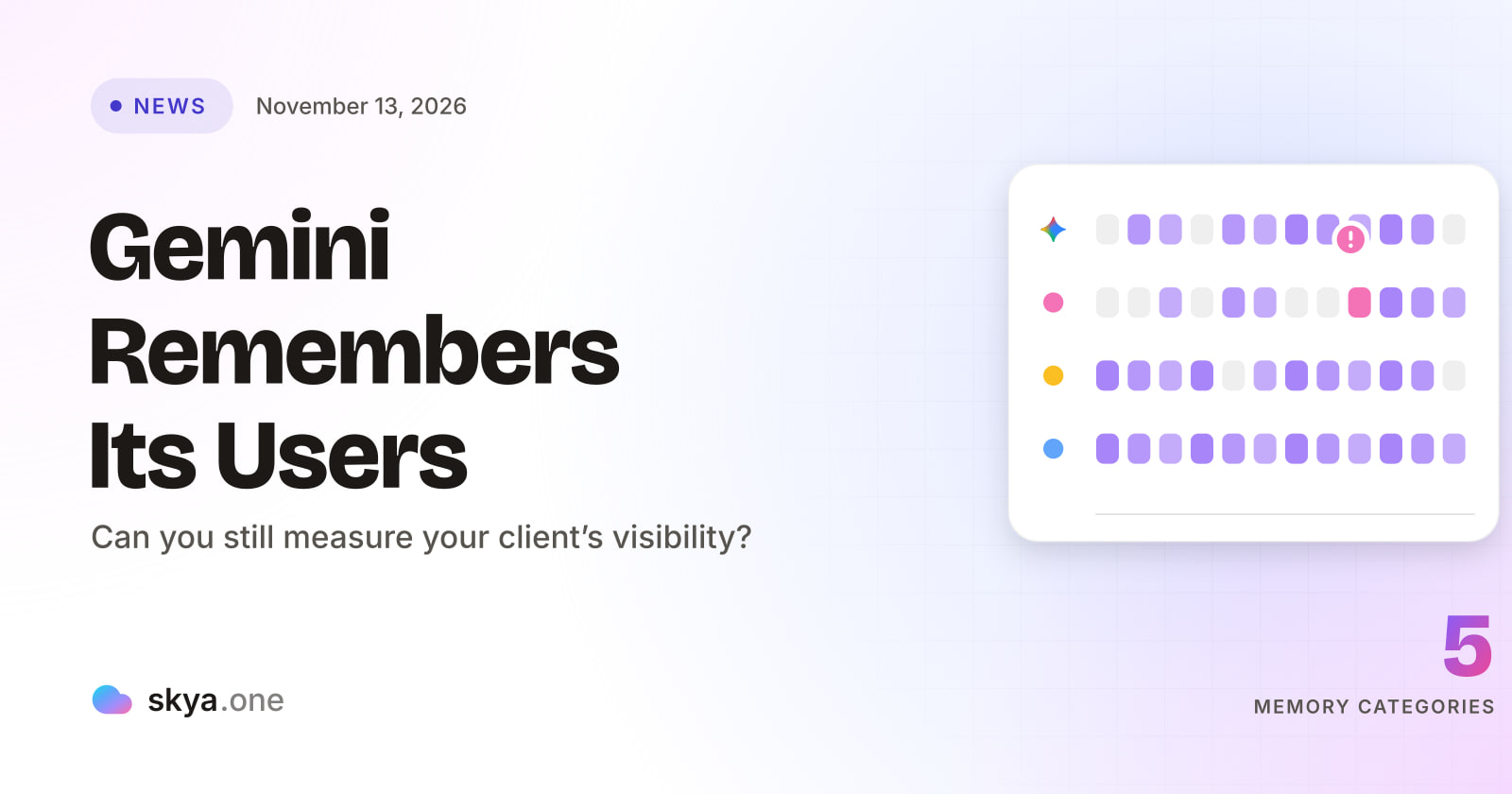
According to MobileSyrup, Memory Summary lets users view, edit and delete information Gemini holds about them. Saved details appear in five categories: The Essentials, Career and Professional Projects, Travel and Daily Gear, Media and Entertainment, and Fitness and Lifestyle. Each category lists bullet points. The Essentials, for example, can show where a user lives and what they do for work.
Users can also manage memory by talking to Gemini. The article gives the examples “Add to my memory that I speak Japanese” and “Remove my old phone number from your memory.” A pencil icon allows larger edits, and a menu shows when each item was added or changed.
Who Gets It, and Where?
| Question | What the report says |
|---|---|
| Who gets it? | Google AI subscribers, with Keep Activity and Memory turned on |
| Which language and region? | U.S. English only, per the article |
| Which device? | Web only for now. Mobile had not received it when the article ran |
| Does it change answers? | The article does not say whether or how it changes Gemini’s responses |
Treat that last row as the key fact. The page shows what Gemini remembers. The coverage does not show how much that memory changes what Gemini says about a business.
Europe is a separate story. The Decoder reported on April 29, 2026 that Google was rolling out Gemini memories to all users in Europe “in the coming weeks”. They are on by default and can be turned off in settings. Users can also import memories and chat history from other AI apps. Whether the new Memory Summary page reaches Europe is not stated.
How Memory Could Change What a Buyer Sees
Here is the inference, clearly labeled. Memory exists so that replies feel personal. A user who has told Gemini they run a small hotel may get different suggestions from a user who runs a law firm. A user whose memory says they prefer budget options may see cheaper suppliers first.
For a client, that raises three questions. Will the assistant name the client for a buyer whose memory points elsewhere? Will it describe the client with details taken from that buyer’s context? Will two buyers get two different descriptions of the same client?
No data in the reports answers those questions. Nobody has published how much memory moves brand answers. That is the honest state of knowledge, and a good agency says so instead of guessing.
What can be said is narrower and safer. Personalization adds a source of variation. Answers already differ from run to run. Now they may differ from person to person as well.
Why One Check No Longer Tells the Whole Story
Most visibility checks are simple. Someone opens an assistant, asks a question, and notes whether the client appears. That works as a first look. It has two weaknesses now.
The first is the account. A tester’s own memory may shape the answer, so the result reflects the tester as much as the market. The second is time. An answer on Monday may differ from one on Friday even with no memory involved.
The fix is not to stop checking. It is to check in a way that separates signal from noise. That is what AI visibility tracking is for. It asks the same fixed questions on a schedule, stores every answer, and shows how often the client appears across many runs. A pattern across fifty readings means more than one lucky or unlucky screenshot.
SKYA explains the stored-reading method on its page about daily AI answer readings.
A Two-Week Check for Any Client
-
Choose ten buyer questions. Write them once and never change the wording.
-
Use a clean session for the baseline. Where possible, use an account with memory off or empty. Note which settings were used.
-
Ask the ten questions on three different days in the first week. Save every answer with its date.
-
In week two, repeat the questions in at least two other assistants.
-
If you have a test account with memory switched on, ask the same ten questions there. Save those answers under a separate label.
-
Mark every claim right, old, wrong or missing. Count how often the client appears across all runs.
-
Compare the clean baseline with the memory-on answers. Report the gap, and report that it comes from one test account.
The last step carries a warning. One test account is one sample. It can show that memory can change an answer. It cannot show how often that happens for real buyers.
What to Fix When Answers Differ
Differences between runs are not always a problem. If the client appears in most runs and the facts are right, small wording changes are noise.
The problem is a wrong fact, or a client that shows up only some of the time. For that, work on the source. Put the current facts in plain sentences, with dates, on one page of the client’s site. Add schema markup so machines read the facts cleanly. Make sure public profiles agree with the site. Assistants that remember a user still draw on the open web for facts about a business. Clear, consistent sources help in every case.
Then repeat the questions. SKYA’s note on hallucination monitoring over time explains why a series of readings is the only fair way to judge the fix.
Memory Is One Source of Variation Among Several
It is easy to blame personalization for every difference. Resist that. Answers also change because of the model version, the question wording, the time of day, the location and the sources the assistant reads that day. Memory adds one more factor to a list that was already long, and a good AI brand monitoring tool keeps the others steady while it watches.
That is why the method matters more than the cause. If you fix the questions and repeat them, the noise from all these factors averages out. What remains is the client’s share of appearances across many runs. AI visibility tracking reports that share, and the share is the number that moves when you improve a page.
A useful rule of thumb is to compare like with like. Compare Monday’s answer with the next Monday’s answer, from the same setup, with the same wording. Do not compare a morning answer from one assistant with an evening answer from another and call the gap a trend.
Privacy Is Part of the Story
Memory Summary exists because users want control over what an assistant keeps. That has a consequence for agencies. Never test with a client’s real staff accounts or personal memory. Use clean test accounts, and keep them free of real names and private details.
It also affects the tools you choose. A vendor should say how it runs its checks and what data it stores. An AI brand monitoring tool that reads public answers to fixed questions does not need anyone’s personal memory. Ask the vendor to confirm that in writing before you put a client on it.
For EU clients, this point carries extra weight. Buyers in Europe may have memory on by default, and privacy rules there are strict. The safest approach is to measure the public answer, record the setup, and avoid any method that depends on real user data.
What to Ask Any Vendor
When answers can vary by person, the choice of AI brand monitoring tool matters more. Ask these questions before you buy.
| Requirement | Why it matters | How SKYA handles it |
|---|---|---|
| Runs fixed questions on a schedule | One-off checks are too noisy to trust | Daily readings across nine assistants: ChatGPT, Gemini, Perplexity, Claude, Google AI Overview, Google AI Mode, DeepSeek, Grok and Copilot |
| Stores every answer with a date | You need to show a trend, not a single result | Correct figures built from dated answer readings, with the answers themselves kept on view |
| Checks claims, not only mentions | A named client can still be described wrongly | A hallucination audit on every paid plan |
| Admits what it cannot read | A guessed score hides gaps | No answers read means no figure. A run that measured nothing gives its credit back |
| Fits agency work | Many clients, one report | Multi-client workspaces, GA4 and Search Console integration and white-label PDF reports |
Also ask how the vendor handles personalization. Does it run signed out? Does it state the setup it used? A vendor that cannot describe its method should not be trusted to report a trend. SKYA publishes how every number is calculated.
What Good Reporting Looks Like
A monthly report on personalized answers should be short and honest. Show the client’s share of appearances across all runs, not a single screenshot. Show the facts that were checked and how many answers got them right. Show what changed since last month, and say which fixes were made.
State the limits in the same report. Say how many assistants were read, how many runs each, and that the test used clean accounts. A client who sees the limits stated will trust the numbers more, not less. Good AI visibility tracking reports a range and a trend, because a single figure for a personalized answer would promise more than anyone can know.
When a client asks for one number, give the share of runs where the client was named, and give the date range beside it. That keeps the figure tied to evidence.
What to Tell Clients
Say what is known. Gemini now lets users see and edit what it remembers. Whether that memory changes answers about the client has not been measured. So the agency measures from a clean baseline, repeats the test, and reports how steady the result is.
Do not promise that personalization will help or hurt. Promise a method, and explain that AI visibility tracking is how it is applied. A method survives whichever way the evidence turns, and clients trust that more than a prediction.
Frequently asked questions

Written by
SKYA Editorial Team
The SKYA Editorial Team publishes field-tested research on Answer Engine Optimization, Generative Engine Optimization and AI Visibility. Every article is reviewed by senior practitioners from the SKYA product and research groups before publication.
Related posts
Keep exploring the SKYA Journal.