On this page13
- The Three Disciplines Defined
- The Hierarchy: How They Actually Relate
- Side-by-Side Comparison
- Where All Three Overlap
- Where SEO Diverges from AEO/GEO
- Where AEO Diverges from SEO
- Where GEO Diverges from AEO
- The Practical Question: How to Sequence Them
- Allocating Effort Across the Three
- What Each Discipline Does Differently with the Same Content
- The Honest Future: Convergence
- What to Read Next
- Frequently asked questions
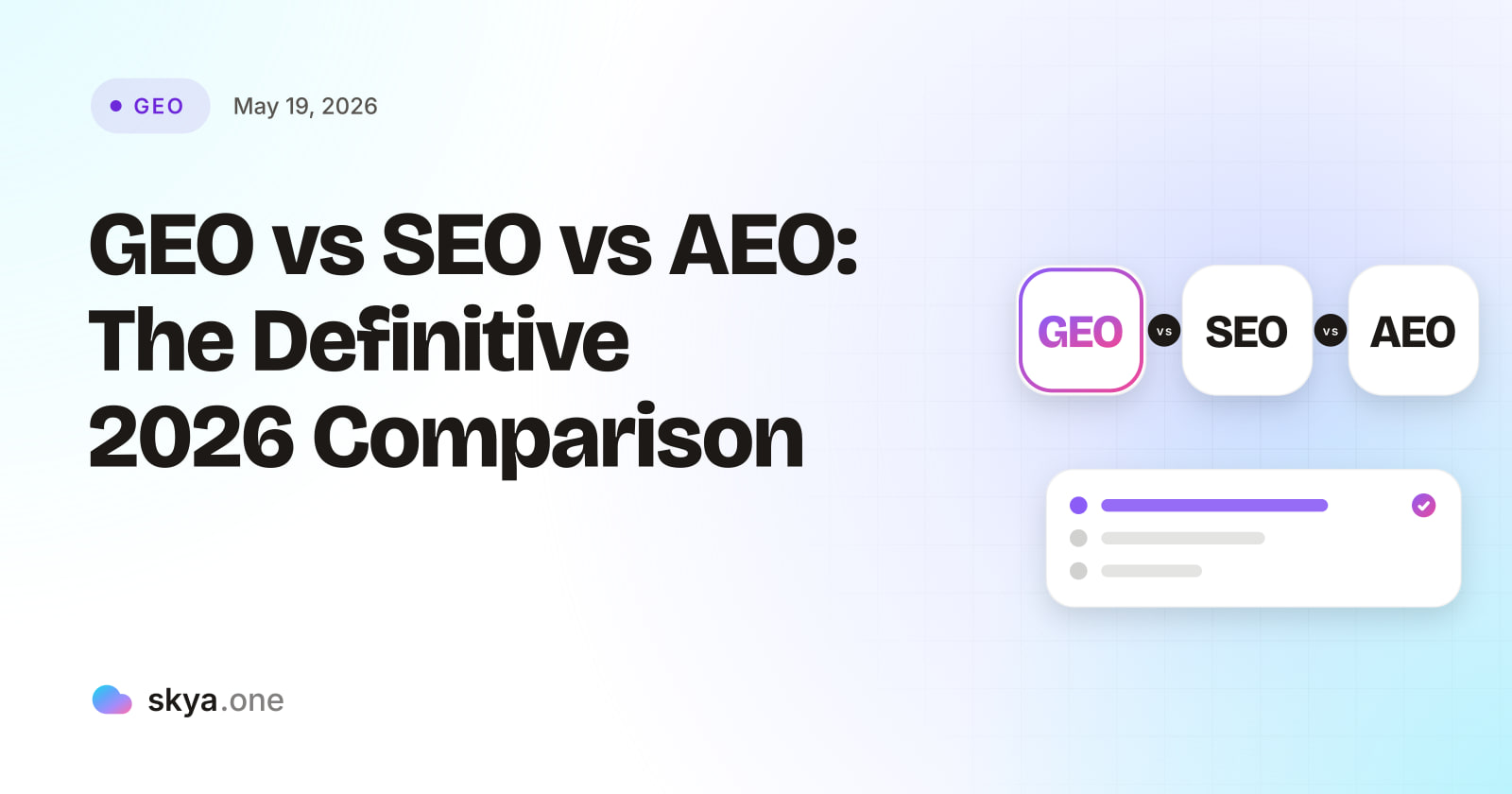
Quick Answer SEO (Search Engine Optimization) optimizes for ranked links on a search results page, primarily Google. AEO (Answer Engine Optimization) optimizes for being mentioned, cited, or recommended in AI-generated answers across ChatGPT, Gemini, Perplexity, Claude, and Google AI Overview. GEO (Generative Engine Optimization) is a subset of AEO focused specifically on AI experiences that synthesize answers from retrieved web content, Google AI Overview, ChatGPT Search, Perplexity, and Google AI Mode. All three share many foundational ranking factors but differ in execution tactics. The practical approach in 2026 is not to choose between them; it's to sequence them: SEO foundations first, an AEO layer second, GEO-specific tactics layered on top.
Three acronyms, lots of overlap, no industry consensus on where one ends and the next begins. If the SEO/AEO/GEO terminology is confusing, that's fair, the field is still settling on definitions, and most articles either treat them as identical or draw distinctions that don't hold up.
This guide is a rigorous three-way comparison. It defines each clearly, maps where they overlap, identifies what's genuinely different in execution, and gives a sequencing framework for thinking about them together.
The Three Disciplines Defined
SEO, Search Engine Optimization
The decades-old discipline of optimizing web content, technical structure, and authority signals so a page ranks well on search engine results pages, primarily Google and secondarily Bing.
Goal: Position on a SERP. Primary KPIs: Average position, organic impressions, click-through rate, organic traffic. Primary surfaces: Google, Bing.
AEO, Answer Engine Optimization
The discipline of optimizing for being mentioned, cited, or recommended in AI-generated answers across the primary AI assistant platforms: ChatGPT, Gemini, Perplexity, Claude, and Google AI Overview. AEO is the broader umbrella for AI-answer-surface optimization.
Goal: Mention or citation inside an AI-generated answer. Primary KPIs: Mention rate, citation rate, recommendation rate, share of voice. Primary surfaces: The major AI assistants, including chat-only modes.
GEO, Generative Engine Optimization
The term was formalized in a 2024 academic paper introducing Generative Engine Optimization as a framework for improving content visibility in generative engine responses. In practice, GEO is the subset of AEO specifically focused on generative AI experiences that retrieve from the live web, Google AI Overview, ChatGPT Search, Perplexity, and Google AI Mode. GEO emphasizes the synthesis layer: getting content cited inside an AI-written, web-grounded answer.
Goal: Citation in a generative-AI-synthesized answer. Primary KPIs: Citation rate in AI Overview, Perplexity citation rate, ChatGPT Search citation rate, share of voice on generative surfaces. Primary surfaces: Google AI Overview, ChatGPT Search, Perplexity, Google AI Mode.
The Hierarchy: How They Actually Relate
The cleanest way to picture the relationship:
- SEO is the foundation layer, it works for everything that retrieves from indexed web content
- AEO is the umbrella that includes everything optimized for AI-generated answers
- GEO is the AEO subset focused specifically on web-grounded generative experiences
In set terms: GEO is a subset of AEO; SEO and AEO share most foundations but optimize for different outcomes.
In practice, most teams treat AEO and GEO as synonymous. The distinction matters when getting tactical, different platforms weight signals differently, and "GEO for Google AI Overview" requires different work than "AEO for default-mode Claude."
Side-by-Side Comparison
| Dimension | SEO | AEO | GEO |
|---|---|---|---|
| Primary goal | Ranked link on SERP | Mention/citation in AI answer | Citation in web-grounded AI answer |
| Primary surfaces | Google, Bing | Major AI assistants | Google AI Overview, ChatGPT Search, Perplexity, AI Mode |
| Primary KPIs | Position, CTR, traffic | Mention rate, SoV | Citation rate, generative SoV |
| Content depth required | High | Higher | Highest |
| Schema importance | Important | Critical | Critical |
| llms.txt relevance | Not relevant | Increasingly relevant | Highly relevant |
| Brand entity weight | Strong but indirect | Direct | Direct and heavily weighted |
| Original research weight | Moderate | High | Very high (Perplexity especially) |
| Update cadence | Quarterly | Monthly | Monthly or faster |
| Time to visibility | Slowest, months | Faster on some platforms, slower on others | Can be fastest on web-grounded surfaces |
| Mature tooling | Yes (Ahrefs, Semrush, Google Search Console) | Emerging (SKYA and others) | Emerging |
| Discipline age | Decades | A few years | Newer still |
| Competition level | High | Moderate | Moderate to low |
| India market presence | Saturated | Open | Wide open |
Where All Three Overlap
The ranking factors that move all three disciplines simultaneously:
- Content quality and comprehensiveness, depth wins everywhere
- Authoritative backlinks, citation authority benefits SEO rankings and AI citation preference
- Schema markup, Article, FAQPage, HowTo, Organization, Person help all three
- E-E-A-T signals, Experience, Expertise, Authoritativeness, Trust matter across all of them
- Technical health, crawlability, mobile usability, Core Web Vitals
- Content freshness, recently-updated content tends to rank better and get cited more
- Topical authority, pillar and cluster architectures win across all three
This is why a brand can't pursue AEO or GEO while ignoring SEO. The foundation is shared. A weak SEO foundation tends to cripple both AEO and GEO performance regardless of how much AI-specific work sits on top.
Where SEO Diverges from AEO/GEO
SEO has tactics that don't help AEO/GEO:
- Aggressive exact-match anchor text, tends to be penalized by AI platforms more than by Google
- Thin keyword-targeted pages, little AEO value; AI platforms tend to cite the most comprehensive source
- Black-hat link tactics, AI platforms have absorbed quality-rater signals deeply
- Ranking-only KPIs without considering mention/citation, an incomplete picture in 2026
- Single-page optimization without cluster architecture, doesn't build the topical authority AI platforms favor
Where AEO Diverges from SEO
AEO calls for specific work SEO doesn't:
- Content structure for AI synthesis, Quick Answer blocks, question-format H2s, inverted pyramid within sections
- Cross-platform tracking, measuring across AI platforms with different behaviors
- Hallucination management, checking AI answers for wrong claims about a brand and fixing source data
- Share of voice measurement, relative competitive position, not absolute rank
- AI referral analytics setup, tracking AI-platform-driven traffic in GA4
For the deep dive, see our cluster article: AEO vs SEO: What's the Difference and Which One Matters Now?
Where GEO Diverges from AEO
GEO is more tactically specific than the broader AEO frame:
- llms.txt implementation, a markdown file at the domain root that gives LLMs a curated guide to a site (relevant to AEO broadly, but a GEO-specific tactical lever)
- Original primary research, Perplexity in particular tends to favor primary data over secondary commentary
- Google AI Overview optimization, heavily dependent on existing Google organic rankings (a GEO subdomain that requires strong SEO underneath)
- Multimodal content for AI Mode, diagrams, embedded video with transcripts, structured image alt text matter more for AI Mode than for chat-only AEO
- Web-grounded synthesis structure, content that can be lifted cleanly into a synthesized answer
For the foundational GEO guide, see our pillar article: What Is Generative Engine Optimization (GEO)? The 2026 Framework.
The Practical Question: How to Sequence Them
For a brand starting from zero or significantly behind, a workable sequence:
| Phase | Focus | What it builds |
|---|---|---|
| Phase 1, SEO Foundation | Technical health, schema, author bios, Google Business Profile, basic E-E-A-T | The base everything else depends on |
| Phase 2, Content Engine | Pillar pages plus cluster articles using the AEO content framework | Topical authority architecture |
| Phase 3, AEO Layer | Cross-platform tracking, hallucination checks, share of voice measurement | Cross-platform AI visibility infrastructure |
| Phase 4, GEO Tactical | llms.txt, original research, AI Overview optimization, multimodal content | Generative-engine-specific lifts |
| Phase 5, Optimization | Ongoing refresh cycles, competitor rising-threat detection, expansion | Sustained momentum |
Phases 1 and 2 are dual-purpose: the work serves the SEO foundation and sets up AEO/GEO. Phase 3 is the AEO-specific layer. Phase 4 is the GEO-specific tactical work on top.
Trying to do all three simultaneously without sequencing is a common reason brands stall, too many initiatives, none executed deeply enough to move the metrics.
Allocating Effort Across the Three
For a typical mid-market brand or agency client, a workable rule of thumb is that most organic-marketing effort still flows into shared SEO/AEO/GEO foundation work, content production, link earning, schema, E-E-A-T, and technical health, with a smaller, growing share going specifically into cross-platform AI tracking, hallucination checks, and GEO-specific tactics like llms.txt, original research, and multimodal upgrades. As AI search continues absorbing query share, that balance is likely to keep shifting toward AEO and GEO work over time, though the exact split will vary by brand and category.
What Each Discipline Does Differently with the Same Content
A practical illustration: imagine a 3,500-word guide titled "How to choose a CRM for a small business in India". Here's what each discipline does with that content:
SEO optimizes:
- Title tag and meta description for the target keyword
- H2/H3 structure for scannability and keyword distribution
- Internal links from related pages
- Backlinks earned via outreach
- Schema markup (Article)
- Image alt text for the embedded comparison table
AEO optimizes (additively):
- Above-the-fold Quick Answer block for chat extraction
- Question-format H2s for retrieval chunking
- FAQ section at the end with FAQPage schema
- Inverted-pyramid structure within each section
- Author bio with credentials and linked profiles
- A hallucination check on how AI platforms currently describe the brand, competitors, and CRMs in general
GEO optimizes (additively on top):
- Multimodal upgrade: embedded video walkthrough, comparison diagram with alt text
- Original primary research embedded (for example, a poll of small businesses on CRM use)
- Mention in the llms.txt curated content list
- Structured comparison table optimized for AI Overview extraction
- A refresh cadence with
dateModifiedschema updates
The same content piece can be optimized at all three levels, each layer compounds the next.
The Honest Future: Convergence
The trajectory worth understanding: GEO, AEO, and SEO are converging back into a more unified discipline. The fragmentation reflects how recent the AI-search shift is, but the underlying work overlaps enough that the three will likely merge further over time into something closer to a single "search optimization" discipline that outputs both ranked links and AI citations.
For now, the distinctions matter because the tactical work differs enough to justify separate framing. But strategists who understand the direction of travel will avoid the mistake of treating them as three separate budgets, they're three layers of one program.
The brands that get ahead are the ones executing an integrated approach: strong SEO foundations, layered AEO-specific tactics, GEO-specific tactical depth on the highest-leverage surfaces, all measured across the major AI platforms in addition to Google.
Run a free AI visibility audit on your brand → SKYA gives a baseline view across SEO, AEO, and GEO signals, mention rate across the major AI platforms, hallucination flags, a schema audit, and priority fixes to start with. Start free at skya.one →
What to Read Next
- What Is Answer Engine Optimization (AEO)? The Complete 2026 Guide, the AEO pillar
- What Is Generative Engine Optimization (GEO)? The 2026 Framework, the GEO pillar
- AI Visibility Explained, the brand-side framing pillar
- AEO vs SEO: What's the Difference and Which One Matters Now?, the two-way comparison
- How to Rank in Google AI Overviews (AIO): A 2026 Strategy
Frequently asked questions

Written by
SKYA Editorial Team
The SKYA Editorial Team publishes field-tested research on Answer Engine Optimization, Generative Engine Optimization and AI Visibility. Every article is reviewed by senior practitioners from the SKYA product and research groups before publication.
Related posts
Keep exploring the SKYA Journal.