On this page13
- What OpenAI Announced
- What the 7.7% Does and Does Not Mean
- Price: Why a Cheaper Model Matters
- OpenAI's Other Claims, With Care
- Three Questions a Benchmark Cannot Answer
- What This Could Look Like for a Client
- What AI Hallucination Monitoring Must Do
- How to Read Any Accuracy Claim
- Mistakes to Avoid After a Model Launch
- What Stays True Whichever Model Answers
- Five Steps Before the Model Reaches Chat
- What to Tell Clients
- Frequently Asked Questions
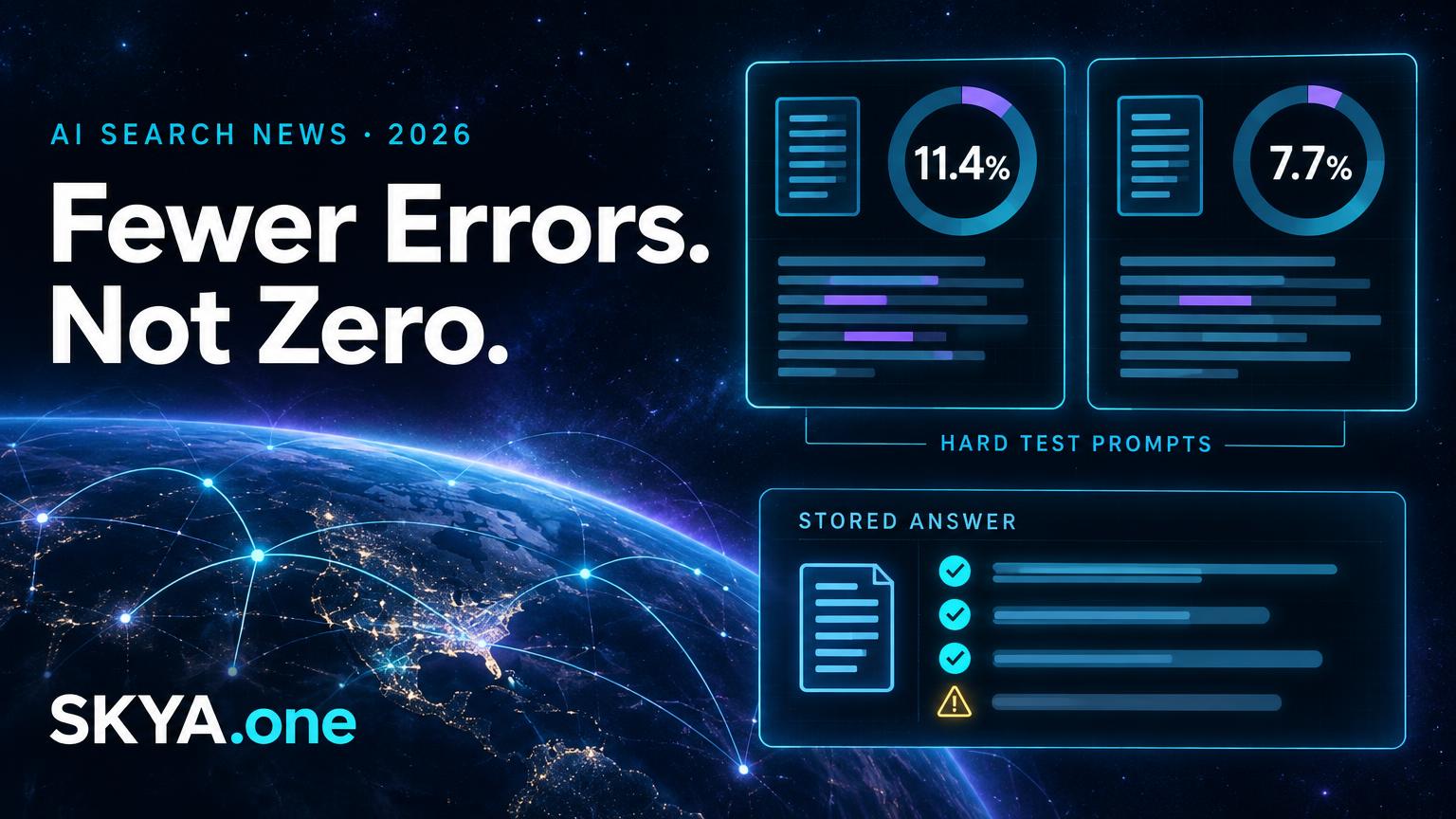
OpenAI launched GPT-6.1 Sol on September 29, 2026. OpenAI says the share of responses with a factual error fell from 11.4% to 7.7% at low effort, on prompts that caused errors before. That is better, not zero. AI hallucination monitoring must keep reading what assistants say about a client, whichever model answers. Each claim still needs a check.
What OpenAI Announced
OpenAI announced the model at its DevDay event on September 29, 2026. OpenAI's own announcement page lists the details. Press coverage of the launch, such as Unite.AI's report, matches the main facts.
| Item | What OpenAI says |
|---|---|
| Model | GPT-6.1 Sol, an upgrade to GPT-6 Sol |
| Headline claim | It "nearly matches GPT-6 Astra's intelligence on agentic coding" at lower cost |
| Where it runs | ChatGPT Work and Codex, for Plus, Pro, Business, Enterprise and Edu users |
| Regular chat | "Not yet available in Chat" |
| API | Available as gpt-6.1-sol |
| Coming next | An Ultrafast option in Codex, due within days |
The fourth row matters most for agencies. At launch, the model was not in regular ChatGPT chat. OpenAI gave no date for that. This post covers the launch as reported. Check OpenAI's page for any later change.
What the 7.7% Does and Does Not Mean
The factuality claim is the part of the launch that matters to anyone who cares what AI says about a client. Read it closely.
| Measure (OpenAI-reported) | Result | Condition |
|---|---|---|
| Responses with a factual error, GPT-6 Sol | 11.4% | Low effort, prompts that previously caused errors |
| Responses with a factual error, GPT-6.1 Sol | 7.7% | Low effort, prompts that previously caused errors |
| Gap to GPT-6 Astra | Within 1.9 points | At under one-fifth of the cost |
OpenAI states that these tests use prompts that previously caused errors, so they are not typical usage. That caveat is important. The 7.7% is not a rate for everyday questions. It is also not a rate for questions about a particular client.
Two readings are fair. First, the model appears to make fewer factual errors on a hard test set. Second, a hard test set still produced errors in about one response in thirteen. Nothing in the announcement says client-specific questions were tested at all.
Price: Why a Cheaper Model Matters
OpenAI also published prices for the GPT-6 family. The figures are per million tokens.
| Model | Input | Cached input | Output |
|---|---|---|---|
| GPT-6.1 Sol | $2.00 | $0.10 | $10.00 |
| GPT-6 Astra | $10.00 | $1.00 | $50.00 |
| GPT-6 Luna | $0.10 | $0.01 | $0.50 |
The next point is SKYA's reading, not an OpenAI claim. A model that nearly matches the top model at one-fifth of the price is cheaper to put inside products. Cheaper models tend to reach more places. More places can mean more answers about a client that no agency has read before. Treat that as a reason to plan, not as a forecast.
OpenAI's Other Claims, With Care
OpenAI reported several benchmark results. They are OpenAI's own numbers, so quote them as OpenAI's claims. This table shows a few that relate to cost and accuracy.
| Benchmark (OpenAI-reported) | Claim |
|---|---|
| Coding (DeepSWE v1.1) | Matches GPT-6 Astra at about one-fifth of the cost |
| Business workflows (AutomationBench) | 2.2 points above Opus 5.5 at medium effort, at about one-third of the cost |
| Science tasks (Terminal-Bench Science 0.1) | $5.47 per task, against $23.21 for Opus 5.5 and $23.80 for Astra. Astra still has the top score at 68.1% |
| Factuality | Errors fall from 11.4% to 7.7% at low effort on prompts that caused errors before |
These are not tests of what a model says about your client. A coding score tells you nothing about whether an assistant describes a client's pricing correctly.
Three Questions a Benchmark Cannot Answer
| What a client asks | What the benchmark shows | What answers it |
|---|---|---|
| Does the assistant name us? | Nothing | A daily reading of the answer |
| Is what it says about us correct? | An error rate on a hard test set | A claim check against the client's facts |
| Did that change after the model changed? | Nothing | Dated readings from before and after |
The third row is where daily readings earn their place. A new model does not change what is true about a client. It changes what an assistant says. Only a dated record shows whether that moved. SKYA covered the same point around GPT-6 Astra and brand mentions.
What This Could Look Like for a Client
The next case is illustrative. It is not measured data. Picture a client that dropped a service plan last quarter. Before the new model, an assistant sometimes listed the old plan. After it, the assistant lists the old plan less often, but still sometimes. A lower error rate on a benchmark did not remove the error for this client.
The agency that reads the answer daily sees both facts. It sees that the error is rarer and that it is not gone. It can then fix the page the assistant relies on.
What AI Hallucination Monitoring Must Do
Monitoring for hallucinations means reading each answer and checking every claim against the client's facts. Model launches make this more useful, not less. Five requirements apply.
| Requirement | Why it matters | How SKYA handles it |
|---|---|---|
| Reads the answer text | A wrong claim hides in a fluent answer | A stored reading behind every number, with an evidence panel |
| Checks claims against client facts | An error rate on a test set says nothing about one client | A hallucination audit on every paid plan |
| Reads daily with history | You need before and after | Daily readings kept as a history |
| Covers many assistants | Models change at different times | Nine assistants every day: ChatGPT, Gemini, Perplexity, Claude, Google AI Overview, Google AI Mode, DeepSeek, Grok and Copilot |
| Admits what it cannot read | An invented number misleads the client | No answers read means no figure. A run that measured nothing gives its credit back |
A good AI brand monitoring tool joins these five. SKYA publishes how every number is calculated. For the time dimension, see its note on AI hallucination monitoring over time, and its page on AI hallucinations.
How to Read Any Accuracy Claim
Every model launch brings a new accuracy number. Five questions keep you honest. The right column applies them to this launch.
| Question | Why it matters | This launch |
|---|---|---|
| Who ran the test? | Vendors choose their own tests | OpenAI |
| What prompts were used? | Hard sets and everyday sets give different rates | Prompts that previously caused errors |
| At what setting? | Effort level changes results | Low effort |
| Does it cover your subject? | A general rate says little about one client | The announcement does not mention client questions |
| Do you have your own before and after? | Only your own readings show your own change | Needs a baseline from before the rollout |
When a tool vendor shows an accuracy score, ask the same questions. An AI brand monitoring tool should show accuracy for your client's own claims, not an industry average. An average hides the one wrong price that costs a sale.
Mistakes to Avoid After a Model Launch
| Mistake | Result | Better move |
|---|---|---|
| Quoting 7.7% as general accuracy | A claim OpenAI itself does not make | Quote it with its conditions |
| Assuming chat users already have the model | Wrong expectations for the client | Check OpenAI's page for chat availability |
| Skipping the baseline | No before picture | Store answers before the rollout |
| Telling the client the problem is fixed | A promise nobody controls | Report what the stored answers show |
Each mistake has the same root. A headline number replaces a reading. Clients pay agencies to read, not to repeat headlines. Sound AI brand monitoring tool habits start with the stored answer and end with a dated note of what changed.
What Stays True Whichever Model Answers
Models change. The sources they learn from and look up change more slowly. An agency can work on those sources today, and the work should help whichever model answers next.
| Lever | Why it helps any model |
|---|---|
| Consistent facts across pages | It gives a model one version of each fact to repeat |
| A direct answer near the top of each section | It gives a model a clean block to lift |
| Structured data | It labels prices, locations and services for machines |
| Accurate third-party pages | They confirm the facts from an independent source |
No lever guarantees an outcome. Each one makes the right answer easier to find and easier to repeat. Then the daily reading shows whether the answer actually moved. Agencies that keep this order avoid arguing about models and spend their time on evidence.
Five Steps Before the Model Reaches Chat
-
Capture a baseline now. Read ten buyer questions per client in ChatGPT and the other assistants. Store each answer.
-
Check every claim against the client's facts. Mark each as right or wrong.
-
Fix the sources behind wrong claims. Schema markup for AEO explains which structured data fits which page.
-
Keep reading daily. When OpenAI adds the model to regular chat, compare the readings from before and after.
-
Report with stored answers. Show what was wrong, what was fixed and what changed.
OpenAI gave no date for the chat rollout at launch, so the baseline is the useful step. It costs little and it cannot be recreated later.
What to Tell Clients
| Say | Avoid |
|---|---|
| OpenAI released a new model that it says makes fewer factual errors on hard tests. It is not in regular chat yet. | ChatGPT now gets facts right. |
| Fewer errors is not zero. We still check what assistants say about you. | Hallucinations are solved. |
| We have a baseline from before the change, so we can show what moves. | We will know when it happens. |
| The benchmark is OpenAI's own and does not test questions about you. | The model is a third more accurate about your business. |
Frequently Asked Questions
What is GPT-6.1 Sol?
GPT-6.1 Sol is an OpenAI model announced on September 29, 2026 as an upgrade to GPT-6 Sol. OpenAI says it nearly matches GPT-6 Astra on agentic coding at about one-fifth of the price.
Is GPT-6.1 Sol available in regular ChatGPT?
Not at launch. OpenAI said it was available in ChatGPT Work and Codex and was "not yet available in Chat". OpenAI gave no date for chat access. Check its announcement page for updates.
Does GPT-6.1 Sol hallucinate less?
OpenAI reports the share of responses with a factual error fell from 11.4% to 7.7% at low effort. The tests use prompts that previously caused errors, so they are not typical usage.
What is AI hallucination monitoring?
AI hallucination monitoring reads what AI assistants say about a client and checks each claim against the client's facts. SKYA runs this daily across nine assistants and stores the answer behind every number.
How do I check what ChatGPT says about my client?
Write ten buyer questions, read the answers daily and store each one. SKYA's free AI Visibility Scan gives a first report in about two minutes with no sign-up.
Make AI Mention Your Brand. Start a 7-day free trial. No card required.

Written by
SKYA Editorial Team
The SKYA Editorial Team publishes field-tested research on Answer Engine Optimization, Generative Engine Optimization and AI Visibility. Every article is reviewed by senior practitioners from the SKYA product and research groups before publication.
Related posts
Keep exploring the SKYA Journal.