On this page11
- What Was Reported on October 12
- Why This Matters for a Client
- A Reply Is Not the Same as a Right Answer
- Which Questions Hide in the Gap
- How to Read an Answer for Gaps
- Five Steps for an Agency This Week
- Mistakes to Avoid With Gap Questions
- What AI Hallucination Monitoring Must Do
- A Report That Shows the Gaps
- What to Tell Clients
- Frequently Asked Questions
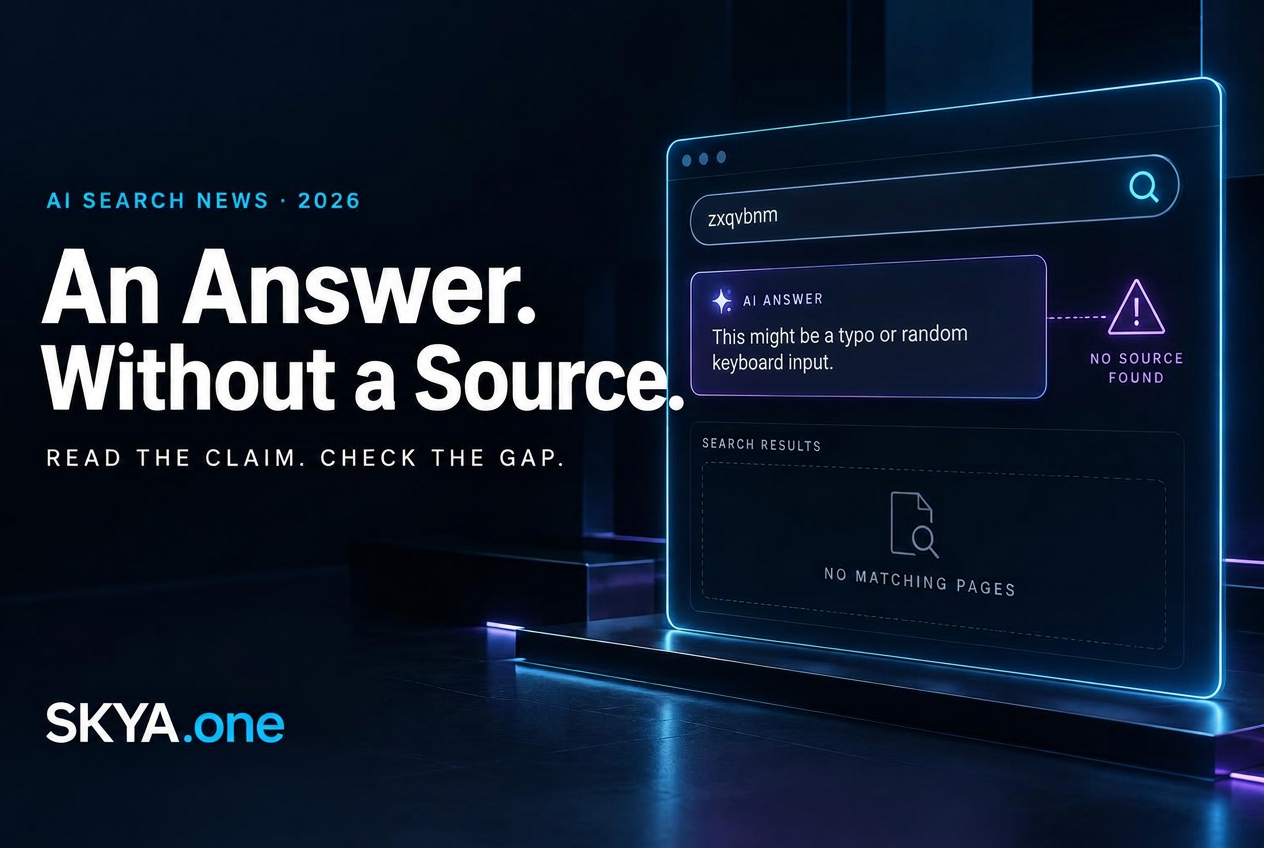
Google shows AI Overviews even when no web page matches a search. On October 12, 2026, Search Engine Roundtable reported that a made-up query got a reply calling it a typo or random keyboard input. The reply was polite, but it was still an answer. AI hallucination monitoring should cover rare questions, not only popular ones.
What Was Reported on October 12
Barry Schwartz of Search Engine Roundtable published the observation on October 12, 2026. He found that Google often shows an AI Overview when a search matches no specific pages, or when Google treats the query as a typo. For a made-up query, the AI Overview said: “It looks like your message might have been a typo or random keyboard input.” It then invited the searcher to say what they needed.
Schwartz says the behaviour is not new. He had seen it for some time but had not covered it. A reader flagged it on X, which prompted the post. The article gives no statement from Google.
| Question | What the report says |
|---|---|
| When does the AI Overview appear? | On typos and on searches that match no specific pages |
| What did the made-up query get? | A reply that it might be a typo or random keyboard input, plus an invitation to say what was needed |
| Is this new? | No. The author says he had seen it for some time |
| Did Google comment? | The article cites no Google statement |
| What is the author’s view? | “Sometimes, it is just better to say, you don’t know, but AI rarely will say that.” |
The report also notes that Google now labels some older search tools and widgets as AI Overviews. It links to an earlier article on a character counter for that point. That detail shows how broad the AI Overview label has become.
Why This Matters for a Client
The report is about nonsense input. The lesson is wider. Google is built to reply to any query, even one with no good page to cite. A client has many questions of that kind. Think of a new product name, a misspelt client name, a rare comparison or a question about one branch office.
The next point is an inference, not a finding from the report. When no page matches, an answer has no strong source to lean on. That is the setting where wrong statements are most likely to appear. For AI visibility tracking, this is the part of the map that popular-keyword reports never show.
| Query type | What the report shows | Open risk for a client (inference) |
|---|---|---|
| Typo of a client name | Google may treat it as a typo and still answer | The answer may describe the wrong business |
| Random or unclear input | A polite answer that asks what was meant | Low, but it shows that a reply always comes |
| Query with no matching pages | An AI Overview can still appear | The answer may rest on weak or old sources |
| Rare client question | Not covered in the report | Worth testing, because the same logic may apply |
A Reply Is Not the Same as a Right Answer
Schwartz makes a sharp point. AI rarely says it does not know. A search engine that returns no results tells the user something true. An answer engine that fills the gap hides that fact.
This is the contrast every agency should teach clients. Two kinds of answer can look the same on screen. One admits a gap. The other fills it. Only one of them is safe to leave unchecked.
| Feature | Answer that admits a gap | Answer that fills the gap |
|---|---|---|
| What the reader learns | No good information exists | Something exists, and here it is |
| Where the text comes from | Few or no sources | Weak sources or general patterns |
| Chance of a false claim | Low | Higher, and harder to spot |
| What the agency should do | Publish a page that fills the gap | Check each claim and fix the sources |
The last column deserves a second look. A filled gap reads well. It sounds sure. The reader has no signal that nothing solid sits behind it.
Which Questions Hide in the Gap
Most client reports track the questions a buyer asks often. The gap lives elsewhere. Build a short list of questions that have no clear page behind them today. Five groups are a good start.
| Group | Example | Why it may have no good page |
|---|---|---|
| New names | A product or service launched this quarter | Few pages mention it yet |
| Misspellings | A common wrong spelling of the client name | No page uses the wrong spelling on purpose |
| Narrow comparisons | The client against one rival for one use case | Nobody has written that exact page |
| Local detail | Opening hours or services at one branch | Local pages are thin or old |
| Changed facts | A price, plan or policy updated last month | Old pages still rank |
None of these needs a clever tool. It needs a list and a habit. Write the questions down, read the answers and keep them. The point is to learn which gaps Google fills for your client before a buyer does.
How to Read an Answer for Gaps
Sort each answer into one of four states. The sorting is simple, and it makes the report honest.
| State | What it looks like | What to do |
|---|---|---|
| Correct | Every claim matches the client’s own facts | Log it and move on |
| Filled gap | Claims appear that no client page supports | Fix or publish the missing page |
| Wrong | A claim contradicts the client’s facts | Find the source and correct it |
| Redirect | The answer asks what you meant or points elsewhere | Check that the client still appears when clarified |
The “filled gap” row is the new one. Older audits looked for wrong claims. A filled gap may not be wrong today. It is unsupported, so it can turn wrong without any change on the client side.
Five Steps for an Agency This Week
-
List ten questions about each client that have no clear page behind them. Use the five groups above.
-
Run each question in Google and in the other assistants. Save the full answer text with the date.
-
Mark each answer as correct, filled gap, wrong or redirect.
-
For every filled gap, publish a plain page that states the fact. Use clear headings and schema markup so the page is easy to cite.
-
Run the same questions again in a week and compare. Keep both versions.
The same-question, same-day method is what makes history useful. SKYA explains why in its note on AI hallucination monitoring over time. One check is a snapshot. A series shows whether a fix held.
Mistakes to Avoid With Gap Questions
Gap questions are easy to get wrong. Four habits cause most of the trouble.
| Mistake | Result | Better move |
|---|---|---|
| Testing only popular questions | Gaps stay hidden | Add ten gap questions per client |
| Treating a polite reply as a safe one | A filled gap goes unchecked | Check each claim in the reply |
| Fixing the answer instead of the source | The next run repeats the error | Publish or correct the page the answer relies on |
| Running the test once | No proof a fix held | Repeat the same questions and keep both readings |
The third row matters most. An agency cannot edit a Google answer. It can only change the pages and mentions the answer draws on. Treat every wrong or unsupported claim as a clue to a weak source.
Keep the language of the fix plain. A page that states one fact in one clear sentence is easier for any assistant to reuse than a long page that buries it. Dates help too, because they show which version of a fact is current.
What AI Hallucination Monitoring Must Do
Reading answers by hand works for ten questions. It fails at fifty questions across several clients and assistants. Good AI visibility tracking has to carry the load without inventing results. Ask any vendor about the five items below.
| Requirement | Why it matters | How SKYA handles it |
|---|---|---|
| Checks claims, not only mentions | A mention can be wrong | A hallucination audit on every paid plan |
| Keeps the answer text | A gap is visible only in the words | A stored reading behind every number, with an evidence panel |
| Covers many assistants | Each one fills gaps differently | Nine assistants every day: ChatGPT, Gemini, Perplexity, Claude, Google AI Overview, Google AI Mode, DeepSeek, Grok and Copilot |
| Admits what it cannot read | An invented score hides a gap | No answers read means no figure. A run that measured nothing gives its credit back |
| Fits agency work | Many clients, one report | Multi-client workspaces and white-label PDF reports |
SKYA publishes how every number is calculated. Its page on AI hallucination shows what the audit checks.
A Report That Shows the Gaps
Clients like clear pages. A simple layout keeps the story short. It also stops the report from hiding a filled gap behind a good average. Strong AI visibility tracking shows both the wins and the weak spots on one page.
| Section | Source | What the client learns |
|---|---|---|
| Common questions | Daily answer readings | Whether the client is named and cited |
| Gap questions | Daily readings of the list above | Where answers fill a gap |
| Accuracy | Claim check on stored answers | Which statements were wrong or unsupported |
| Fixes made | Agency notes | Which pages were added or corrected |
| Change since last month | Stored history | Whether the fixes held |
What to Tell Clients
| Say | Avoid |
|---|---|
| Google can answer even when no page matches. We test the questions where that may happen for you. | Google only answers when it is sure. |
| An answer that sounds sure may have no solid source behind it. We check each claim. | If Google shows an answer, the answer is right. |
| We keep the answer text and the date, so we can show what changed. | Trust the score. |
| This report came from one observation. We will re-test your questions and report what we see. | This is proven for every query. |
Frequently Asked Questions
Does Google show AI Overviews when no web page matches?
Often, yes. Search Engine Roundtable reported on October 12, 2026 that Google shows AI Overviews for typos and for searches that match no specific pages. The author says the behaviour is not new.
Can an AI Overview answer a made-up query?
The report says it can. A random query got a reply that said it might be a typo or random keyboard input, followed by an invitation to say what the searcher needed.
Why do AI answers rarely say they do not know?
The report makes that point as an observation, not a measured finding. In the author’s words, it is sometimes better to say you do not know, but AI rarely will. Treat any unsupported claim in an answer as something to check.
What should a client check first?
Start with questions that have no clear page behind them, such as new product names, misspellings of the client name and narrow comparisons. Save each answer and check every claim against the client’s own facts.
What is AI hallucination monitoring?
It is the daily reading of what AI assistants say about a client, with each claim checked against the facts. SKYA runs a hallucination audit on every paid plan and stores the answer behind every number.

Written by
SKYA Editorial Team
The SKYA Editorial Team publishes field-tested research on Answer Engine Optimization, Generative Engine Optimization and AI Visibility. Every article is reviewed by senior practitioners from the SKYA product and research groups before publication.
Related posts
Keep exploring the SKYA Journal.