On this page13
- What Happened
- How This Update Compares
- What the Early Data Shows, and Its Limits
- Reading the Window Day by Day
- A Ranking Drop Is Not a Lost AI Mention
- Two Ledgers, Two Questions
- A Seven-Step Triage for This Week
- Mistakes Agencies Make in an Update Window
- What AI Visibility Tracking Must Add
- A Report That Joins Both Ledgers
- Questions Clients Ask During an Update
- What to Tell Clients
- Frequently Asked Questions
Google finished its September 2026 spam update on October 8 after 13 days and 16 hours. It was the longest of this year’s four spam updates, and Google has not said what it targeted. A ranking drop and a lost AI mention are different problems. AI visibility tracking, read next to Search Console, is how an agency tells them apart.
What Happened
Google’s Search Status Dashboard lists the update as “September 2026 spam update (affecting Ranking)”. It began on September 24 at 09:15 Pacific time and ended on October 8 at 01:00 Pacific time. The status text reads: “The rollout was complete as of October 8, 2026.” Search Engine Journal reported the finish the same day.
| Detail | What the sources say |
|---|---|
| Start | September 24, 2026 |
| End | October 8, 2026 |
| Duration | 13 days and 16 hours, per Google’s ranking update history |
| Scope | Global and all languages, per Google at launch |
| Google’s launch estimate | “May take up to two weeks to complete” |
| What it targeted | Not stated on the dashboard or the documentation page |
Google’s spam updates documentation calls a spam update “a notable improvement to its automated systems for detecting spam.” Neither that page nor the dashboard says what this update targeted, or why it ran longer than the earlier ones this year.
How This Update Compares
| Spam update | Rollout time |
|---|---|
| March 2026 | 19 hours 30 minutes |
| June 2026 | 2 days 1 hour |
| August 2026 | 2 days 16 hours |
| September 2026 | 13 days 16 hours |
| August 2025 (for reference) | About 27 days |
Length alone tells you little. It does mean the window for confusion was long. A client who saw a dip anywhere between September 24 and October 8 may blame the update. Search Engine Journal warns against that: a dip during the window does not mean the update caused it.
What the Early Data Shows, and Its Limits
Search Engine Journal cites two third-party observations. Neither is a Google statement.
| Source | Observation | Caveat |
|---|---|---|
| Diib, 32,569 sites with Google Analytics | Median share of unpaid Google search visits fell from 34% to 31%. Sites losing half or more rose from 5% to 10% | Diib called it “an early read, not a verdict” |
| SEOmonitor | Many rank trackers showed changes from September 26 that searchers did not see | It tied this to incomplete or incorrect results returned to automated searches |
The second row is a useful warning. A tracker chart can move when real results did not. Do not report a ranking loss to a client from a third-party chart alone.
Reading the Window Day by Day
The dates matter more than the headline. Line your own data up against the timeline below before you write a word to the client.
| Date | What happened | Source |
|---|---|---|
| September 24 | Rollout began at 09:15 Pacific time | Google Search Status Dashboard |
| From September 26 | Rank trackers showed changes searchers did not see | SEOmonitor, via Search Engine Journal |
| October 8 | Rollout complete | Google Search Status Dashboard |
A drop that starts before September 24 cannot be blamed on this update. A drop that starts after October 8 is harder to tie to it. Many agencies skip this basic check.
A Ranking Drop Is Not a Lost AI Mention
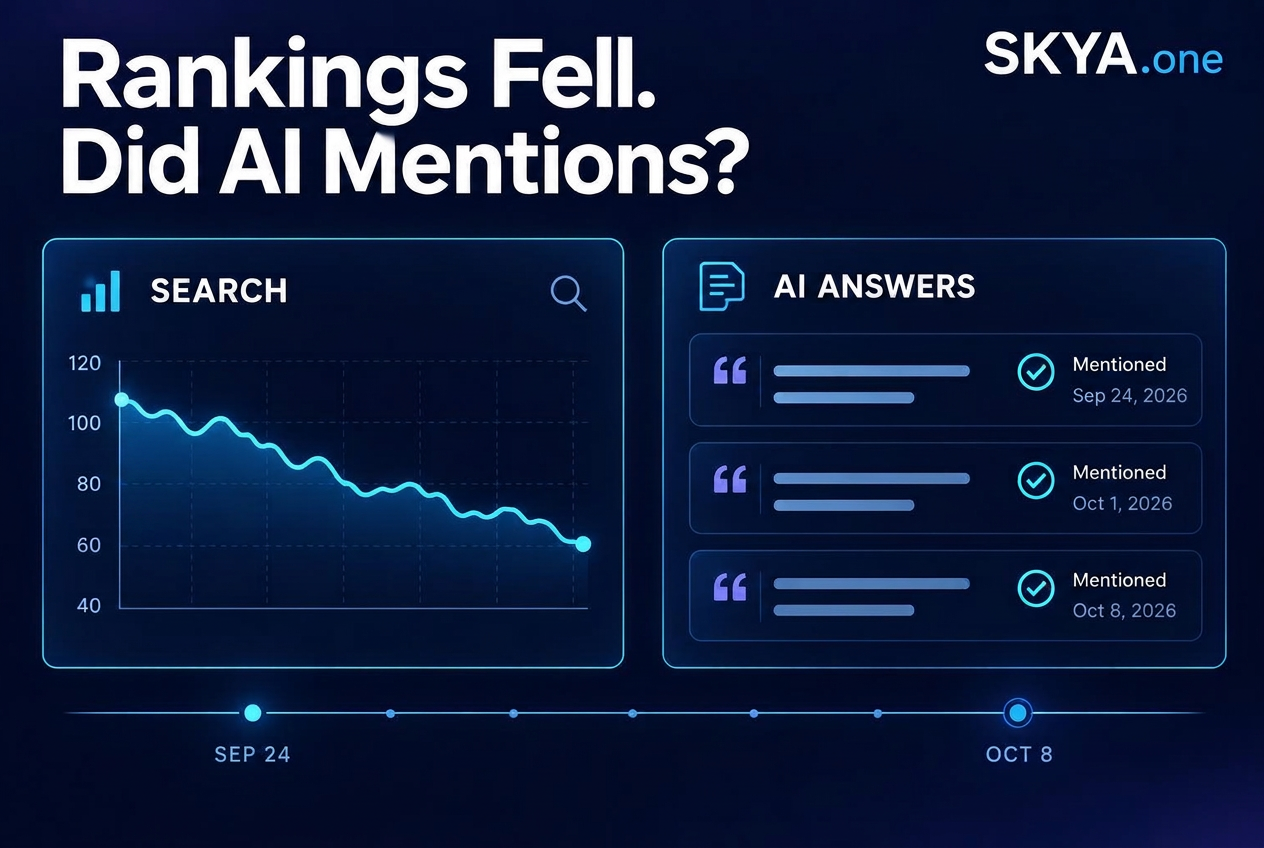
The sources describe a ranking update. They say nothing about AI answers. That gap is where agencies go wrong. A client can lose clicks and keep its place in AI answers. A client can also keep its rankings and vanish from an assistant. Different evidence answers each case.
| Symptom | Where to look first | What it points to |
|---|---|---|
| Impressions and clicks fall for several days | Search Console | A ranking change, possibly the update |
| Traffic falls but impressions hold | Search Console and analytics | Click behaviour changed, not the ranking |
| Client no longer named in an assistant | Stored daily answers | An AI visibility change, separate from rankings |
| Assistant states a wrong fact | Stored answers with a claim check | A source or accuracy problem |
| Only third-party charts moved | Search Console | Possibly tracker noise |
The right column is guidance, not a finding from the report. It keeps the first call honest: look at the right evidence before naming a cause.
Two Ledgers, Two Questions
The update is a clean case study in AEO vs SEO. One measures a position on a page. The other measures a mention inside an answer. SKYA covers the basics in its guide to the two disciplines.
| Feature | SEO ledger | AEO ledger |
|---|---|---|
| What it measures | Rankings, impressions, clicks | Mentions, citations and accuracy in answers |
| Main evidence | Search Console | Stored answer text with dates |
| Hit by a spam update? | It is a ranking update, per Google’s dashboard | Not stated in any source here |
| Typical lag | Days of data before a call is safe | Daily readings show a change at once |
| Report to the client as | A change in position or traffic | A change in what assistants say |
The third row matters most. Do not tell a client the update hurt their AI mentions. The sources do not say so. Keep AEO vs SEO separate in the report, and let each ledger speak for itself.
A Seven-Step Triage for This Week
-
Open Search Console and set the date range from September 10 to October 12. Note the dates of any drop.
-
Confirm the drop lasts several days and shows in both impressions and clicks. Search Engine Journal says that carries more weight than a brief wobble.
-
Check which pages and queries lost the most. Do not assume the whole site moved.
-
Read your stored AI answers for the same period. Mark whether the client was named, cited and correct each day.
-
Compare the two timelines. A fall in both on the same days is worth a closer look. A fall in one only points to one cause.
-
If you suspect a spam problem, review Google’s spam policies against the affected pages.
-
Write down what you saw and what you could not prove. Share that note with the client.
Step six has a long timeline. Search Engine Journal notes that fixes may help if Google’s automated systems recognise compliance, and that this can take months. Promise a process, not a date.
Mistakes Agencies Make in an Update Window
| Mistake | Result | Better move |
|---|---|---|
| Blaming the update for any dip in the window | The real cause goes unfixed | Check pages and queries first |
| Reporting from a tracker chart only | A loss that searchers never saw | Confirm in Search Console |
| Mixing ranking and AI mention results | A story that fits neither | Report each ledger on its own line |
| Promising recovery by a date | A broken promise | Describe the steps and the usual timeline |
The common thread is patience. An update window is noisy, and a calm note beats a fast guess. Record what changed, on which dates, for which pages. Then let the evidence build for a week before you name a cause.
What AI Visibility Tracking Must Add
Search Console shows what Google showed. It does not show what an assistant said. Good AI visibility tracking fills that gap and keeps a dated record. Ask any vendor about the five items below.
| Requirement | Why it matters | How SKYA handles it |
|---|---|---|
| Keeps the answer text and date | You need to line it up with the update window | A stored reading behind every number, with an evidence panel |
| Reads many assistants daily | A mention can fall in one and hold in another | Nine assistants every day: ChatGPT, Gemini, Perplexity, Claude, Google AI Overview, Google AI Mode, DeepSeek, Grok and Copilot |
| Sits beside analytics | The two ledgers must be read together | GA4 and Search Console integration |
| Admits what it cannot read | A guessed number hides gaps | No answers read means no figure. A run that measured nothing gives its credit back |
| Reports by client | Agencies manage many accounts | Multi-client workspaces and white-label PDF reports |
SKYA publishes how every number is calculated. Its AI visibility page explains the readings in more detail, and its note on AI search monitoring covers the daily routine.
A Report That Joins Both Ledgers
| Section | Source | What the client learns |
|---|---|---|
| Clicks and impressions | Search Console | What Google showed and what users did |
| Mentions and citations | Daily answer readings | Whether assistants name the client |
| Accuracy | Claim check on stored answers | Which statements were wrong |
| Update window note | Agency notes | Dates, changes seen and open questions |
| Fixes made | Agency notes | Which pages changed and when |
Questions Clients Ask During an Update
| Question | Plain answer |
|---|---|
| Did the update hit us? | We will know after we check Search Console for a lasting drop, not a short dip. |
| Why did my rank tracker move? | Some trackers showed changes that searchers did not see. We confirm in Search Console first. |
| Are AI answers affected too? | The sources do not say so. We read your answers separately and report what we see. |
| How long will recovery take? | Where a fix is needed, it can take months. We report each step. |
What to Tell Clients
| Say | Avoid |
|---|---|
| Google finished a spam update on October 8. We are checking your Search Console data before we link any change to it. | The spam update hit you. |
| Early third-party data shows the median share of Google visits fell across a sample of sites. It is not a Google statement and it is not about your site. | The median site lost three points, so you did too. |
| We read what assistants say about you each day. We report that separately from rankings. | Your AI mentions fell because of the update. |
| Recovery, where needed, can take months. We will report the steps we take. | You will recover by next month. |
Frequently Asked Questions
When did Google’s September 2026 spam update end?
Google’s Search Status Dashboard says the rollout was complete as of October 8, 2026. It began on September 24 and lasted 13 days and 16 hours, according to Google’s ranking update history.
Did the spam update affect AI Overviews or AI mentions?
The sources reviewed here do not say so. They describe a ranking update. Check your own stored answers and Search Console separately before linking any change to the update.
How can I tell whether my traffic drop came from the spam update?
Check Search Console. A drop that lasts several days and shows in impressions and clicks carries more weight than a short wobble on a third-party chart. A dip inside the window does not prove the update caused it.
What is the difference between AEO vs SEO reporting?
SEO reporting tracks rankings, impressions and clicks. AEO reporting tracks whether AI assistants name, cite and describe a client correctly. They use different evidence and should sit in separate parts of a report.
What is AI visibility tracking?
It is the daily reading of what AI assistants say about a client, kept with dates and checked for accuracy. SKYA reads nine assistants every day and stores the answer behind every number.

Written by
SKYA Editorial Team
The SKYA Editorial Team publishes field-tested research on Answer Engine Optimization, Generative Engine Optimization and AI Visibility. Every article is reviewed by senior practitioners from the SKYA product and research groups before publication.
Related posts
Keep exploring the SKYA Journal.