On this page12
- What the AlsoAsked Data Shows
- Why Ranking for a PAA Question No Longer Means Winning It
- What People Also Ask Questions Reveal About Buyer Intent
- Rank Tracking Reads the Position. AI Visibility Tracking Reads the Answer
- AEO vs SEO: Where the PAA Slot Sits Now
- A Five-Step PAA Audit for Any Client
- What to Record in Each Answer
- How to Write a Page an AI Answer Can Quote
- What SKYA Reads for PAA Questions
- What a Weekly Client Report Should Hold
- What to Tell Clients About PAA
- Frequently Asked Questions
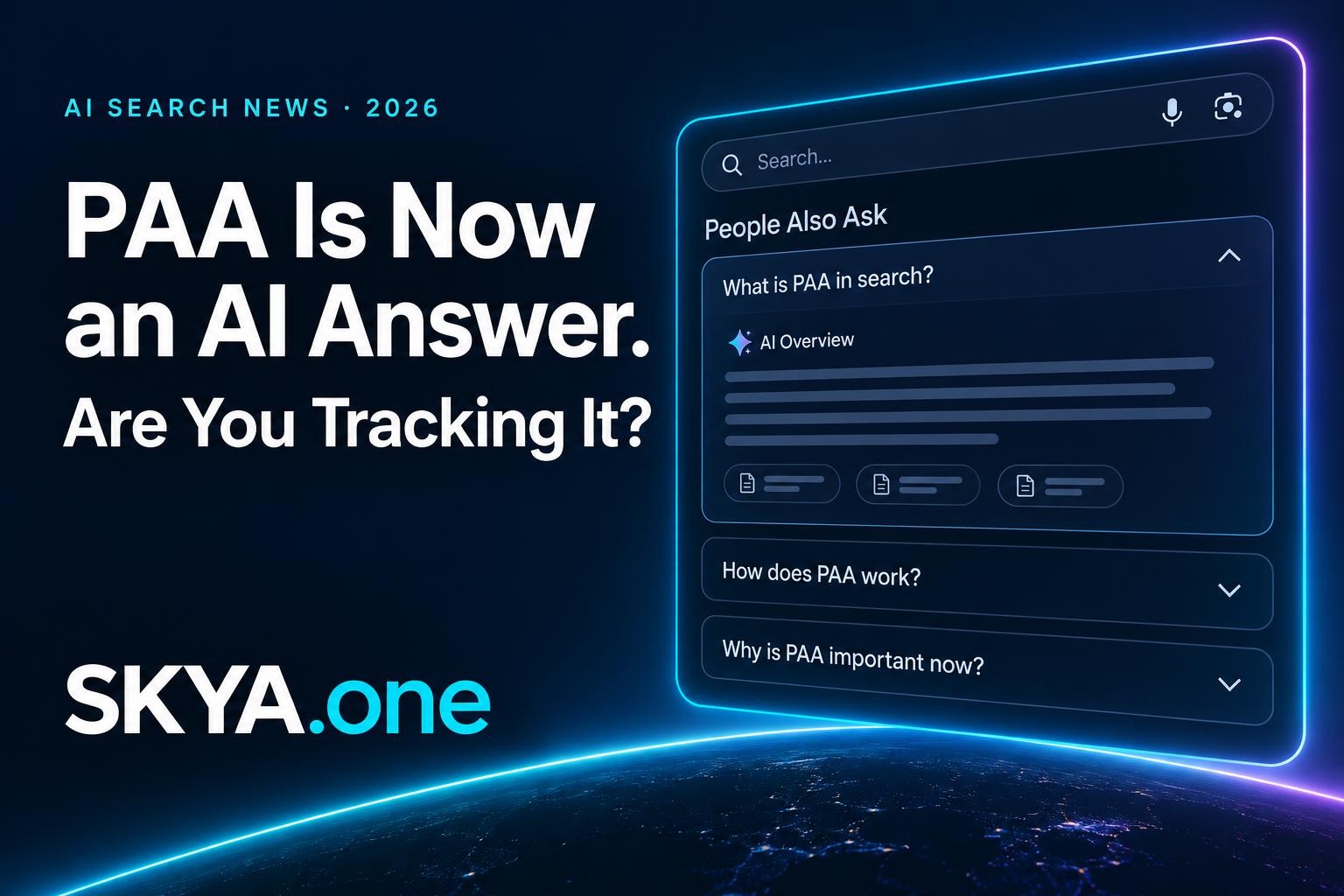
People Also Ask answers are now almost entirely AI-generated. AlsoAsked reports that 97% of the answers it sampled were AI Overviews in the first week of September, up from 86% in August. A page can rank for the question and be absent from the answer. A rank tracker cannot see that. AI visibility tracking reads the answer itself and stores it as evidence.
What the AlsoAsked Data Shows
Search Engine Roundtable reported on September 9, 2026 that Google now answers nearly all People Also Ask questions with AI Overviews. The report uses AlsoAsked data. That dataset is a sample of 19.2 million English-language answers from 2026.
Mark Williams-Cook, who shared the AlsoAsked figures, said 97% of People Also Ask answers in the first week of September were AI Overviews. The August figure was 86%. He added that 100% looked likely soon. The same report notes that the share was about 12% some 14 months earlier.
| Period | Share of PAA answers that were AI Overviews | Source |
|---|---|---|
| About 14 months before September 2026 | About 12% | AlsoAsked, via Search Engine Roundtable |
| August 2026 | 86% | AlsoAsked |
| First week of September 2026 | 97% | AlsoAsked, 19.2M English-language sample |
Read the number with care. It is one dataset, in English. Your clients’ markets and languages may differ. Treat 97% as a direction, then measure your own question set.
Why Ranking for a PAA Question No Longer Means Winning It
Buyers read answers. Agencies still report positions. The two stopped matching. In the old format, a People Also Ask box showed a short excerpt from one page, with its link. Rank for the question and you held the slot. Now the box shows an AI-written answer. That answer can draw on several pages, and the client’s page may be one of them or none of them.
| Before: excerpt answer | Now: AI-written answer | |
|---|---|---|
| What the user sees | A short excerpt from one page, with its link | An answer written by AI, labelled as an AI Overview |
| Who earns the click | The page whose excerpt was shown | Any page the answer cites, if the user clicks |
| What a rank tracker reports | The position of the page | The same position, silent on whether the client is named |
| What the client needs to know | Did we hold the slot? | Is the client named, is the claim true, which page was cited? |
An illustrative case shows the gap. It is not measured data. Picture a client that sells accounting software. Its page ranks fourth for a question about automating invoice reminders. The People Also Ask answer names two rivals and cites a forum thread. The position report shows green. The answer report shows the client missing. Only the second report matches what the buyer read.
In the first week, do three things. Pick ten questions per client. Capture today’s answers as a baseline. Agree with the client which two question groups matter most.
What People Also Ask Questions Reveal About Buyer Intent
Not every question carries the same weight. A buyer who asks what a service is sits at the start of a decision. A buyer who asks whether a provider is reliable sits near the end. The answer to each one shapes a shortlist. Group the questions before you track them.
| Question type | Example | What the answer decides |
|---|---|---|
| Definition | What is a patient portal? | Whether the client is part of the category at all |
| Comparison | Which option suits a small team? | Whether the client reaches the shortlist |
| Price | How much does it cost per month? | Whether the buyer sees a correct number |
| Trust | Is this provider reliable? | Whether the buyer sees the client as safe to pick |
Price and trust questions carry the most risk. A wrong number or a doubtful tone can cost a client the shortlist. Track those two groups first.
Rank Tracking Reads the Position. AI Visibility Tracking Reads the Answer
| Question | Rank tracking | Answer reading |
|---|---|---|
| What does it read? | The position of a page for a keyword | The words of the answer and the pages it cites |
| Does it show whether the client is named? | No | Yes |
| Does it show whether claims are accurate? | No | Yes, against the client’s real facts |
| How does it show change? | Positions move | Mentions, citations and answers move, stored daily |
| What does the client receive? | A rank report | A stored answer as evidence |
Both matter. Rank data shows whether classic SEO works. Answer data shows whether that work reaches the buyer.
The data behind rank tracking is also under strain. One agency recap reports Google changing how result links appear and serving different results to automated traffic. Read position data with care, and pair it with answer data you can store and show.
AEO vs SEO: Where the PAA Slot Sits Now
AEO vs SEO is not a choice between two jobs. SEO earns a page its place in the results. AEO shapes the page so an answer engine can lift a clean answer from it. People Also Ask now sits between the two. The question box is a search feature. The answer inside it is an AI answer.
| Layer | SEO job | AEO job |
|---|---|---|
| Question | Find the questions buyers ask | Turn each into a heading with a direct answer beneath it |
| Page | Make it crawlable, fast and relevant | Make each section stand alone so it can be lifted |
| Proof | Earn links and signals | State facts a reader can verify and mark them up with schema |
| Report | Position, clicks and impressions | Mentions, citations and answer accuracy |
For the full split, read SKYA’s guide to the complete AEO vs SEO comparison. To see every feature that now competes for the same screen, read SERP features in 2026.
A Five-Step PAA Audit for Any Client
-
Collect the questions. Pull People Also Ask questions for ten of the client’s core topics. Use real searches, not guesses.
-
Turn each question into a tracked prompt. Run it across assistants, including Google AI Overview and Google AI Mode. SKYA’s AI keyword research guide shows how to map questions to prompts.
-
Record the answer and the pages it cites. Note whether the client is named and whether a rival is.
-
Check accuracy. Compare every claim about the client with the client’s real facts. Flag each wrong claim for a fix.
-
Repeat weekly and report change with the stored answer attached. SKYA’s weekly monitoring workflow covers the cadence.
What to Record in Each Answer
| Signal | What to record | Why it matters |
|---|---|---|
| Mention | Is the client named? | An unnamed client is invisible to the buyer |
| Citation | Which pages does the answer cite? | Cited pages show which sources the engine used |
| Accuracy | Does each claim match the client’s facts? | A wrong claim reads as truth |
| Position | Where is the client named in the answer? | Early mentions get read first |
| Stability | Does the result hold across days? | One good day proves little |
Five signals turn a screenshot into a record. Add the date and the assistant name to each entry. A record with a date can be compared. A screenshot without one cannot.
How to Write a Page an AI Answer Can Quote
| Move | Why it helps | Example |
|---|---|---|
| Put the question in a heading | It matches how the question is asked | How long does onboarding take? |
| Answer in the first 40 to 60 words | It gives the answer engine a clean block | A direct answer, then the detail |
| Keep one idea per section | It lets a section stand alone | No section needs the one before it |
| State checkable facts | It cuts the room for wrong claims | Price, location, dates and named features |
| Add FAQPage schema | It labels the questions for machines | See SKYA’s schema markup guide |
No page can force an AI Overview to name a client. A page can make the right answer easy to lift and easy to verify. Then the readings show whether it worked.
What SKYA Reads for PAA Questions
SKYA treats each question as a prompt and reads the answers every day. SKYA’s page on AI visibility tracking explains the method. The table shows how each client need maps to a feature.
| Client need | What SKYA does |
|---|---|
| Track the question across engines | Prompt tracking across nine assistants, including Google AI Overview and Google AI Mode |
| Prove what was said | A stored answer behind every number, shown in an evidence panel |
| Avoid made-up numbers | No answers read means no figure. A run that measured nothing gives its credit back |
| Find the cause of a change | GA4 and GSC integration beside the AI readings |
| Report to the client | White-label PDF reports and multi-client workspaces |
| Start fast | A free AI Visibility Scan: about two minutes, no sign-up |
SKYA reads the answers assistants give. It shows what those answers say about a client and which pages they cite. That is the evidence an agency needs to explain a shift that no rank report can show. How every number is calculated is public.
What a Weekly Client Report Should Hold
| Section | Content | Example line (illustrative) |
|---|---|---|
| Headline | One sentence on what changed | Named in six of ten tracked questions, up from four |
| Evidence | The stored answers behind the headline | Two stored answers attached |
| Risks | Wrong claims found | One outdated price found in one answer |
| Fixes | Page changes made | Pricing page updated, direct answer added |
| Next step | What happens this week | Re-read the same ten questions |
Keep the report short and attach the stored answers. A client who can read the answer will trust the number. A client who sees only a number will ask where it came from.
What to Tell Clients About PAA
| Say | Avoid |
|---|---|
| Many People Also Ask answers are now AI-written. We track your questions and show you the stored answers. | You lost your People Also Ask ranking. |
| Here is where you are named and where you are not. | AI answers are always wrong. |
| We will report change weekly with the answer attached. | We will win the People Also Ask slot. |
The shift is real, and it will continue. Agencies that read the answer first can explain every change to a client. Agencies that read only positions will find out last. SKYA exists so the agency finds out first.
Frequently Asked Questions
What is People Also Ask?
People Also Ask is a Google search feature that shows related questions in an expandable box. Each question opens to an answer. In 2026 AlsoAsked data shows those answers are now mostly AI Overviews, not excerpts from a single page.
Are People Also Ask answers written by AI now?
Mostly, according to AlsoAsked. In a sample of 19.2 million English-language answers, 97% in the first week of September 2026 were AI Overviews, up from 86% in August. It is one dataset, so measure your own question set before you report a number to a client.
How do I get a client into an AI-generated People Also Ask answer?
Put each question in a heading, answer it in the first 40 to 60 words and keep every fact checkable. Add FAQPage schema and keep one idea per section. No tactic guarantees inclusion, so track the answers daily and fix what the readings show.
What is AI visibility tracking?
AI visibility tracking is the daily reading of what AI assistants say about a client. It records whether the client is named, whether the claims are true and which pages the answer cites. SKYA stores each answer as evidence across nine assistants.
Does ranking in Google still matter?
Yes. Ranking still drives clicks and gives a page its place in search. It no longer proves the client is named in the answer. Report both: position for classic search and stored answers for AI.
Make AI Mention Your Brand. Start a 7-day free trial. No card required.

Written by
SKYA Editorial Team
The SKYA Editorial Team publishes field-tested research on Answer Engine Optimization, Generative Engine Optimization and AI Visibility. Every article is reviewed by senior practitioners from the SKYA product and research groups before publication.
Related posts
Keep exploring the SKYA Journal.