On this page9
- What OpenAI announced on October 5
- Paid and earned, side by side
- Read the early results with a skeptic's eye
- Why paying does not fix an absence
- Questions to ask anyone selling you ChatGPT visibility
- How to appear in ChatGPT answers without paying
- Report ads and answers on separate lines
- Where SKYA fits
- Frequently asked questions
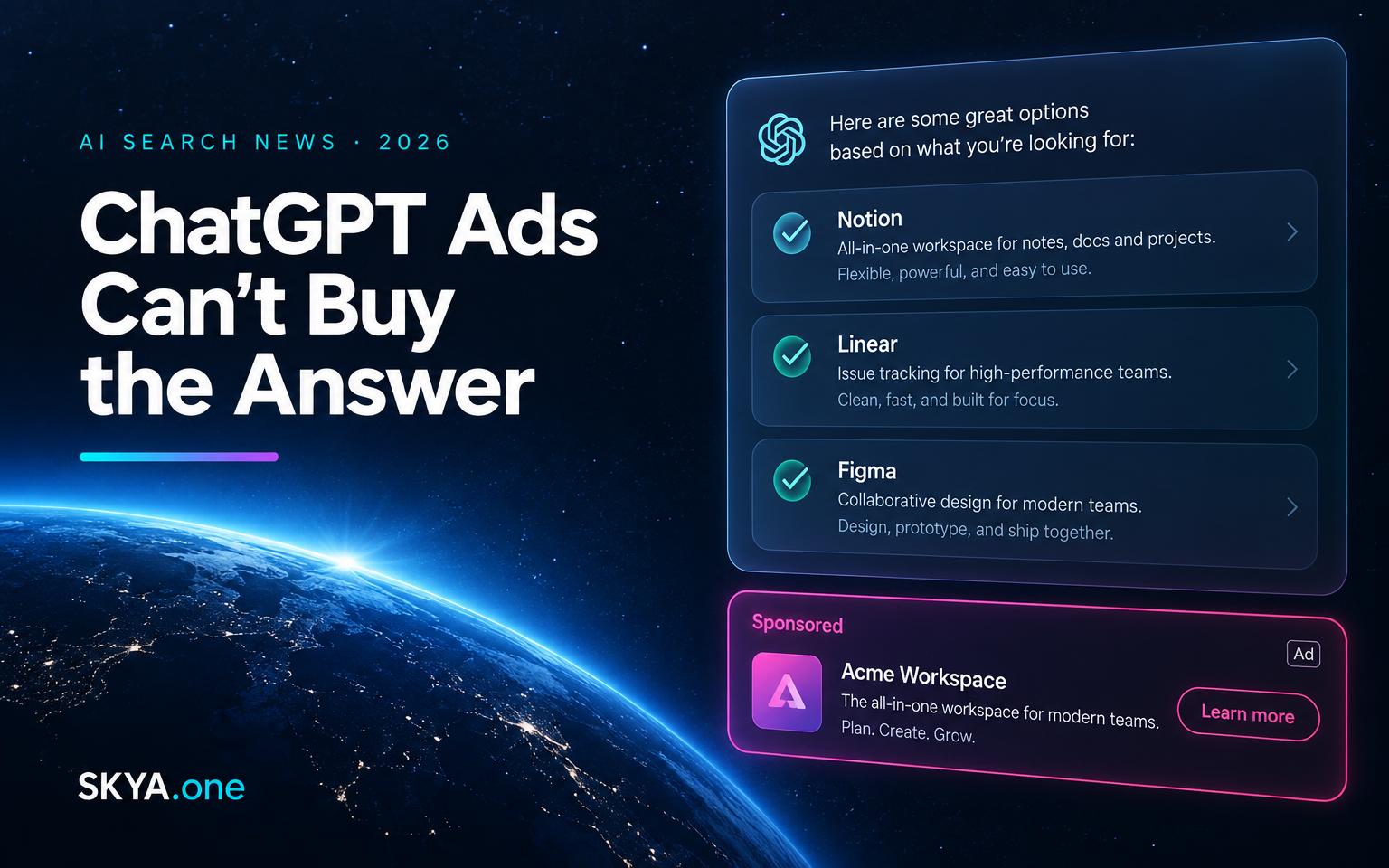
OpenAI says ads do not influence the answers ChatGPT gives. Take that at face value and a ChatGPT ad buys a labeled slot beside the answer, not a place inside it. How to appear in ChatGPT answers is still an earned problem, and nobody outside OpenAI has audited the line between the two. Marketers should know that before they spend.
What OpenAI announced on October 5
On October 5, 2026, OpenAI introduced a visual ad format for ChatGPT. Testing begins later this month in the US with an initial group of advertisers. The first placement sits beside image generation results for users on the Free and Go plans. OpenAI says the ads are clearly labeled, stay separate from the image being created, and do not influence the answers ChatGPT provides.
Most of the post is about measurement. OpenAI added conversion-data integrations with Hightouch, Tealium and LiveRamp, plus ten attribution partners that include AppsFlyer, Triple Whale and DV Rockerbox. It is working with Haus, Measured and WorkMagic on incrementality tests, and piloting brand suitability checks with DoubleVerify and Integral Ad Science.
Read that list as a signal. A channel that arrives with ten attribution partners is built to be reported on. The answers inside ChatGPT are not.
SKYA read the announcement and OpenAI's ads principles in full, so marketers do not have to rely on the headline. The rest of this post separates what OpenAI states from what anyone has verified.
Start with what the announcement does not say
A launch post is a sales document. SKYA reads launches that way, and part of SKYA's job as a marketing educator is teaching agencies and clients to do the same. Four gaps stand out.
Reach is not audience
OpenAI says ChatGPT serves 1.2 billion people each week. That is OpenAI's own figure, with no outside audit behind it in the post. It is also not the ad audience. The format is a US test, during image generation, for Free and Go users. OpenAI does not publish how many people that is.
Answer independence is a promise, not a finding
The claim that ads do not shape answers is the one that matters most to anyone doing earned work. The announcement offers no independent test of it. The DoubleVerify and Integral Ad Science pilots, as described, assess how brand safety standards are applied in a controlled environment. Brand safety is about where an ad may appear. It is not a check on whether an ad can sway a recommendation.
The proof is curated
OpenAI chose the three early results it published, and its own wording calls the incrementality work early.
The money question is missing
The post gives no pricing, no minimum budget and no audience size. A buyer cannot judge cost per acquisition claims without those.
None of this says the ads are bad. It says a marketer who repeats the headline without these gaps is repeating a pitch, not a fact. SKYA's aim is to make sure the audience can tell the difference.
Paid and earned, side by side
The two routes look similar from a distance. Up close they differ on almost every point that matters to an agency.
| Paid: ChatGPT Ads | Earned: a mention inside the answer | |
|---|---|---|
| Where it appears | In a labeled ad, separate from the answer | In the answer text itself |
| Who controls it | The advertiser sets creative, audience and bid | The model decides. The client controls only the quality of its sources |
| What buys it | Ad budget | Nothing buys it, if OpenAI's stated policy holds |
| Who sees it | Free and Go users in the US test | Anyone who asks, including paid-plan users |
| How it is measured | Conversion data, attribution partners, incrementality tests | Mention rate, position and accuracy across repeated prompts |
| What changes it | Budget, targeting and creative | Changes to the pages and profiles the model reads |
The "who sees it" row deserves a second look. OpenAI has said that Plus, Pro, Business and Enterprise subscriptions will not include ads. A client that sells to people who use ChatGPT through a work account may reach a few of them with an ad. For that audience the earned route is not a nice extra. It is the only route.
Read the early results with a skeptic's eye
OpenAI's announcement shares three early partner findings.
| Advertiser | What was reported | Reported by | What it does not tell you |
|---|---|---|---|
| WeightWatchers | Attributed cost per acquisition 15.3% lower than its blended paid-search benchmark | DV Rockerbox | Attributed figures depend on the partner's method. A blended search benchmark is not a like-for-like comparison. |
| Dose | Statistically significant lift, with 67% of incremental purchases from net-new customers | WorkMagic | One advertiser and one test. It is a share of incremental buyers, not total sales. |
| Portland Leather | 93% of visitors from ChatGPT Ads were new | Triple Whale | Visitors are not buyers. It says nothing about conversion. |
The three use three different yardsticks, so they cannot be stacked into one story. Two are measured by firms that earn their living from attribution, in a channel they now partner with. SKYA's advice to agencies is to wait for results from their own accounts before promising a client a cost per acquisition.
Before a client spends anything, settle three things. Is the client's market inside the US test? Which attribution partner already connects to the client's store or CRM? And what result would count as failure? Write the third answer down before the first impression runs.
Why paying does not fix an absence
Picture a buyer who asks ChatGPT for the best vendors in a category. The answer names three. Your client is not one of them. A labeled ad from your client may appear nearby, but the answer the buyer just read has already put three rivals on the shortlist.
That separation is the first item in OpenAI's published ads principles. OpenAI's own statement of those principles says answers are optimized for what is most helpful to the person asking, and that ads are always separate and clearly labeled.
So a client missing from answers has a problem that ad spend cannot reach. The fix lives in the sources.
Questions to ask anyone selling you ChatGPT visibility
Expect pitches. Some will blur paid placement and earned mentions on purpose, because the blur sells. SKYA publishes this list so anyone can use it on a vendor call, including vendors who sell against SKYA.
| Ask | A sound answer | A warning sign |
|---|---|---|
| What exactly am I buying? | A labeled ad placement, with the format named | "We get you recommended" with no mechanism |
| Beside the answer or inside it? | Beside, and clearly labeled | Any promise of a place inside the answer |
| Who will see it? | Plan tiers and markets stated | "Everyone on ChatGPT" |
| How do you measure the result? | Named partner, stated method, a threshold set in advance | One screenshot or one lucky prompt |
| Can you show repeated prompt logs with dates? | Yes, with several runs per prompt | A single run, undated |
Awareness is the real protection. A client who understands the difference will not be fooled by the blur, and will not blame the agency when an ad fails to change a mention it never could.
How to appear in ChatGPT answers without paying
OpenAI does not publish a formula for which names get mentioned. Anything that claims to be a guaranteed method is guessing. What an agency can do is run a controlled routine and fix what it finds. SKYA teaches this routine because it works without any software. Treat it as practice, not as a promise.
| Step | What to do | Why |
|---|---|---|
| 1 | Write the ten questions a buyer asks before choosing: category, comparison, price and "is it any good" questions. | These are the prompts that decide shortlists. |
| 2 | Run each prompt several times, on different days. | ChatGPT answers vary, so one run proves little. |
| 3 | Record whether the client is named, in what order, and whether the facts are right. | A mention with a wrong price is a different problem from no mention. |
| 4 | When ChatGPT shows sources, list them. | The sources show which pages shape the answer. |
| 5 | Make the client's facts consistent across its site, profiles and third-party listings. Put the direct answer in the first lines of each page. | Consistent, easy-to-lift facts are what a model can repeat accurately. |
| 6 | Re-run the same prompts and log the date. | A fix only counts if you can show the answer followed. |
If the client is missing entirely, the four-point diagnostic for why a client is not showing in ChatGPT is the next read. For the page-level fixes, the guides to building an llms.txt file and to schema markup for answer engines cover the mechanics.
One more point on how to appear in ChatGPT answers: the plan tier matters. A staged model rollout can show one buyer a newer answer while another still sees an older one. That is why a single check misleads, and why different plan tiers can return different answers for the same client.
Report ads and answers on separate lines
An agency that runs both will be tempted to merge the results. SKYA's position is firm: do not. They answer different questions.
| Report line | Metrics | Question it answers |
|---|---|---|
| ChatGPT Ads | Impressions, clicks, cost per acquisition, share of new customers | What did the spend produce? |
| ChatGPT answers | Mention rate, position, accuracy, share against named rivals | What does ChatGPT say about the client without being paid? |
There is a trap here. A client who starts ads may see mentions rise the same month and credit the ads. OpenAI states that ads do not influence answers, so the rise needs another explanation: a corrected page, a new listing, a model update. If the report merges the lines, nobody can tell which it was. If mentions rise and the independence claim turns out to be wrong, a merged report hides that too.
This is also why you need to track brand mentions in ChatGPT on its own schedule. Run the same prompt set weekly, keep the answer text, and note every change to the client's pages next to the date. A dated log is the only independent check a marketer has.
Where SKYA fits
SKYA's view is simple. Marketers should trust ChatGPT's stated policy and still verify it, because verification costs little and a wrong assumption costs a client's budget. A spreadsheet holds ten prompts for one client. It struggles at fifty clients and nine assistants. That is the point where SKYA is built to track brand mentions in ChatGPT and eight other assistants every day. It keeps the answer history per client and audits answers for claims that are wrong. For the prompt sets and cadence behind this, read the ChatGPT monitoring playbook.
The ad channel will get louder. Reports will fill with clicks and cost per acquisition. The question underneath will stay quiet: when a buyer asks ChatGPT about the category, does it name the client, and does it get the facts right? Money can answer the first half of a media plan. Only sources answer the second. SKYA keeps publishing readings like this because an informed audience asks better questions of every vendor.
Find out whether ChatGPT names your client before the ads start. Start a 7-day free trial. No card required.
Frequently asked questions
Do ChatGPT ads change what ChatGPT answers?
OpenAI says no. Its ads principles state that ads do not influence the answers ChatGPT gives, and that ads stay separate and clearly labeled. That is a stated policy, and the October 5 announcement offers no independent test of it. Check the same prompts before and after a client starts advertising.
Can a client pay to be recommended in ChatGPT?
A client can pay for a labeled ad. It cannot pay to be recommended inside the answer. OpenAI says answers are optimized for helpfulness, and ads sit apart from them. Be wary of anyone who promises a paid place inside the answer. Placement there depends on the sources the model reads and the facts they state.
Who sees ChatGPT ads?
The new visual ad format is being tested in the US, during image generation, for users on the Free and Go plans. OpenAI has said Plus, Pro, Business and Enterprise subscriptions will not include ads. Its placement guardrails also aim to keep ads out of sensitive conversations. OpenAI has not published the size of that audience.
How to appear in ChatGPT answers without ads?
Start with the questions buyers ask. Run them repeatedly, record whether the client is named and whether the facts are right, and fix the pages and profiles that carry wrong or missing facts. OpenAI publishes no ranking formula, so log every change and re-test. Treat results as evidence, not a guarantee.
How do I track brand mentions in ChatGPT?
Use a fixed prompt set, run it on a regular schedule, and store the full answer each time. Record whether the client is named, its position among named options, and whether the claims are accurate. Several runs per prompt show the variation. A monitoring platform automates this and keeps the history.

Written by
SKYA Editorial Team
The SKYA Editorial Team publishes field-tested research on Answer Engine Optimization, Generative Engine Optimization and AI Visibility. Every article is reviewed by senior practitioners from the SKYA product and research groups before publication.
Related posts
Keep exploring the SKYA Journal.