On this page10
- What Google Actually Changed
- Who Owns the Check?
- What Independent Research Shows
- What the Google Update Proves, and What It Does Not
- Start With the Client's Own Site
- A Five-Step Loop for Checking Client Answers
- Five Mistakes Teams Make When Applying Google's Rule to AI Answers
- What to Tell the Client
- What SKYA Does in This Loop
- Frequently Asked Questions
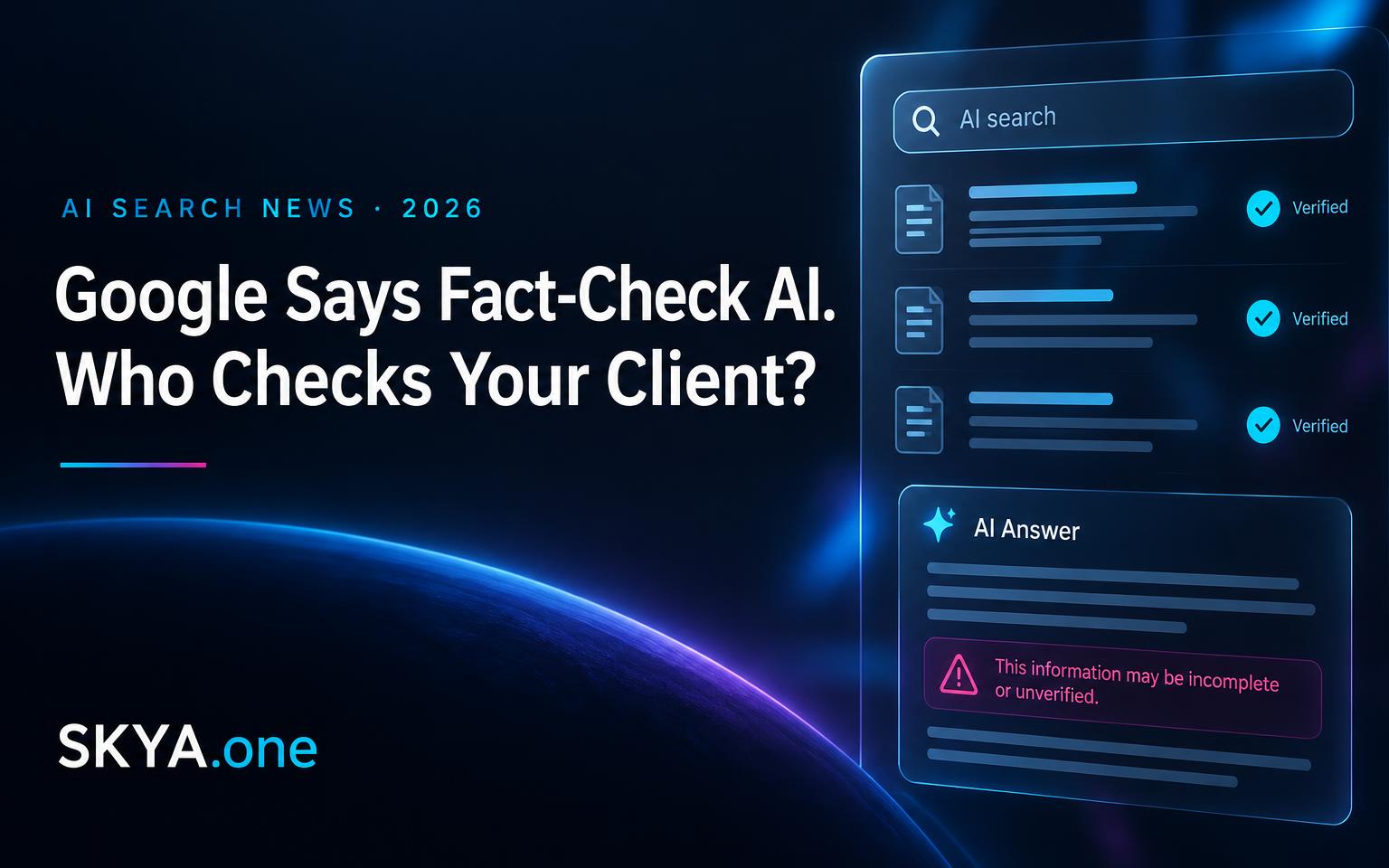
On October 1, 2026, Google told site owners to manually fact-check all AI-generated content before publishing. No one holds ChatGPT, Gemini or Perplexity to that rule when they describe your client. Their answers are written after the buyer asks, with no editor in the loop. People who search "fix AI hallucinations about my brand" can start by borrowing Google's standard.
What Google Actually Changed
SKYA reads the AI answers about clients every day, and part of that work is explaining what the changes mean. This guide does that for Google's update, in plain terms and with sources you can check.
Google revised its guidance on generative AI content on October 1, 2026. The Search Central page now says generative models do not retrieve facts. They "predict a likely sequence of words based on their training data." Outputs can therefore contain inaccuracies, which Google calls hallucinations. The instruction is plain: review all AI-generated content by hand before it goes live.
The review also covers metadata. Titles, meta descriptions, structured data and image alt text all fall under it, because they can appear in Search results.
Search Engine Journal compared the page with its December 10, 2025 version and counted three new sentences. Google's changelog says the edit draws on the Search Quality Raters guidelines. The same report notes that Google staff urged fact-checking AI output in public before, in April 2024 and again in August 2025. So the change is a codified warning. It is not a new penalty.
The timing is worth noting. Google rolled out its September 2026 spam update globally on September 24. On October 2 it added a warning against fabricated author profiles to its helpful content guidance, again per Search Engine Journal. Three moves in about a week point the same way: Google wants accountable, verifiable content. If a client is worried about a ranking drop, SKYA's guide on telling real volatility from a broken rank tracker covers the triage.
Who Owns the Check?
Google's rule works because the owner is clear. Someone owns the page and someone presses publish. Now look at what happens when an assistant describes a client.
| Question | Google's rule for publishers | AI answers about a client |
|---|---|---|
| Who is accountable? | The site owner who publishes | No one. The model writes the answer |
| What gets checked? | Copy, titles, meta descriptions, structured data, alt text | Whatever the model assembles that day |
| When does the check happen? | Before publishing | After the answer has reached a buyer |
| Is there an evidence trail? | Editorial notes the team can keep | None, unless the answer was captured |
| What does a miss cost? | A page that fails Search quality standards | A wrong price or claim on a buyer's shortlist |
| How is it fixed? | Edit the page | Fix the sources the model reads, then re-check |
The gap is structural. A page has an editor. An AI answer has none. It is assembled when the buyer asks, from sources the client may never have reviewed, and it can differ on the next run.
The two cases also share something useful. Both fail the same way: a fluent sentence that nobody verified. Google's own explanation, that models predict words and do not look facts up, applies to an answer about your client exactly as it applies to a draft on your blog.
What Independent Research Shows
The strongest independent test of assistant accuracy is not about brands. It is about news. Journalists from 22 public service media organizations in 18 countries, coordinated by the European Broadcasting Union and led by the BBC, reviewed more than 3,000 responses from ChatGPT, Copilot, Gemini and Perplexity. NPR, one of the participants, reported the headline numbers.
-
45% of answers had at least one significant issue.
-
31% showed serious sourcing problems, such as missing or misleading attributions.
-
20% had major accuracy problems, including hallucinated details and outdated information.
Three cautions apply. The questions were about news, not client facts. The study dates from October 2025, and models have changed since. And the grading was done by journalists against editorial standards. Read it as a signal about failure modes, which are weak sourcing and stale details. Do not read it as an error rate for any one client.
Brand-level error rates also circulate, and several come from vendors that sell monitoring tools. Before quoting one, check who graded the facts, how the sample was chosen and how recent the data is.
What the Google Update Proves, and What It Does Not
| Claim | Does it hold? | Why |
|---|---|---|
| "Google now requires fact-checking AI content." | Partly | It is guidance. The page ties spam risk to mass-produced pages that add no value, not to individual errors. It also says rater ratings do not directly influence ranking. |
| "This applies to what ChatGPT says about a client." | No, by analogy only | The page covers content on your own site. The parallel to third-party AI answers is a comparison, not Google policy. |
| "AI hallucinations are a documented risk." | Yes | Google's documentation now says so, and an independent study of news answers found significant issues in 45% of responses. |
| "Fixing the client's site fixes the answer." | Not on its own | A correct page removes one source of error. Other sources the model reads can still carry the old claim. |
One more tension is worth stating. Google asks publishers to verify AI text, while AI-generated answers also appear inside Search. Publishers received an instruction. The people and businesses described by those answers received no comparable review step that they control.
None of this weakens the case for checking. It sharpens it. The standard is clear, and the owner of a page can meet it. The harder job is the answer nobody owns.
Start With the Client's Own Site
Google's extension to metadata matters beyond Google. Titles, descriptions, structured data and alt text are short, machine-readable statements about a client. Any system that reads the page can pick them up. An AI-written wrong price in a meta description or an Organization schema block is a fact error in more than one place.
That makes the client's own pages the first audit target. An old pricing page, a retired plan still named in schema, or a stale "about" description can feed a wrong claim back into answers. Fixing them costs nothing but attention.
Two live SKYA guides cover the technical side: schema markup for AEO and the LLMs.txt guide. Treat both as part of the fact-check, not as a separate project.
A Five-Step Loop for Checking Client Answers
Google's standard is "check before publishing." For AI answers the equivalent is "check, trace, fix and check again." The loop below keeps each step small.
List the checkable facts. Pricing, plans, eligibility, locations, leadership and integrations. Pick facts with one right answer. Sentiment and framing come later.
Write the source of truth. One dated page or document per client. Every check needs a stable baseline.
Capture answers on a schedule. Run the same prompts across assistants and store the full text. AI visibility tracking that keeps the answer it read gives you evidence to show the client.
Trace each error to a source. Wrong claims usually trace to a page. Two guides explain the mechanics: how AI platforms cite differently and why AI citations disappear.
Fix the source, then re-check. Correct the client's own pages and structured data first. Then work on any third-party source that carries the error. Corrected claims can return from sources nobody touched, which is why continuous hallucination monitoring beats a single audit.
Someone typing "fix AI hallucinations about my brand" into a search bar usually wants step five. Steps one to four are what make it possible. Without a source of truth and a stored answer, a fix is a guess.
On cadence, check volatile facts such as pricing weekly. Check stable facts monthly. For the full fix workflow, see the guide to finding and fixing wrong brand claims.
Five Mistakes Teams Make When Applying Google's Rule to AI Answers
Applying a publisher standard to AI answers is sound. Applying it carelessly is not. These are the usual failures.
| Mistake | Why it fails | Better move |
|---|---|---|
| Checking one assistant | Assistants draw on different sources, so one clean answer proves little | Read every assistant the client's buyers use |
| Checking once | Answers regenerate, and a fix can be undone by a source nobody touched | Re-run the same prompts on a schedule with AI visibility tracking |
| Fixing only the client's site | Other sources can carry the same wrong claim | Trace each error to its source before editing anything |
| Grading tone as fact | Praise or caveats are framing, not accuracy | Separate checkable facts from sentiment, and track sentiment on its own |
| Keeping no record | Without the stored answer there is nothing to show the client | Save the full answer text, the date and the platform |
What to Tell the Client
Clients rarely ask for a methodology. They ask whether AI is saying something wrong. A short answer works: here is the standard Google now applies to its own publishers, here is what each assistant said about you this week, and here is the one claim we are fixing.
That framing turns AI visibility tracking from a vague retainer line into a weekly report with a verdict. It also keeps the conversation on facts that can be verified, which is the same discipline Google is asking publishers to adopt.
What SKYA Does in This Loop
SKYA's job in this loop has two parts. The first is education: explaining how AI answers are built, where errors come from and how to check them. That is what this guide and the linked ones do. The second is the checking itself.
On the product side, SKYA supports monitoring across up to nine AI platforms: ChatGPT, Gemini, Perplexity, Claude, Google AI Overview, Google AI Mode, DeepSeek, Grok and Copilot. Platform coverage and refresh frequency depend on the plan. Each paid plan includes a hallucination audit. Multi-client workspaces keep every client's source of truth and answers apart.
The method matters for the standard in this article. Every number SKYA shows comes from a stored reading, and when the evidence is thin the product says so instead of printing a figure. Teams that need to "fix AI hallucinations about my brand" for a client need that evidence first.
SKYA does not edit what a model says. It captures the answer, shows what changed and points to where the claim came from. The fix still happens at the source.
SKYA publishes guides like this one so agencies can explain AI visibility to clients in plain language. The method works with a spreadsheet and a calendar reminder. The platform makes it faster and keeps the evidence in one place.
Google checks what publishers say. SKYA checks what AI says about your client. Run the first check in a 7-day free trial. No card required.
Frequently Asked Questions
Did Google really tell sites to fact-check AI content?
Yes. Google updated its generative AI content guidance on October 1, 2026. It now says generative models can produce inaccuracies, called hallucinations, and that all AI-generated content should be manually fact-checked before publishing. The review includes titles, meta descriptions, structured data and image alt text.
Does Google's rule apply to what ChatGPT or Gemini says about a client?
Not directly. The guidance covers content published on your own site. The parallel to third-party AI answers is an analogy. It still gives teams a clear standard: verify claims against a source of truth before they reach a buyer.
How do I fix AI hallucinations about my brand?
Start with the source. List the facts that matter, write a dated source of truth, capture what each assistant says and trace every wrong claim to the page it came from. Correct your own pages and structured data first. Then re-check on a schedule, because corrected claims can return.
Why does Google mention metadata in its AI content guidance?
Titles, meta descriptions, structured data and image alt text can appear in Search results. AI-written metadata can carry the same invented or stale facts as body copy. Google's update says the manual review applies to them too.
How often should agencies check AI answers about clients?
Weekly for volatile facts such as pricing and availability. Monthly for stable ones. A scheduled routine catches changes between checks. This is a practical default, not a Google requirement.

Written by
SKYA Editorial Team
The SKYA Editorial Team publishes field-tested research on Answer Engine Optimization, Generative Engine Optimization and AI Visibility. Every article is reviewed by senior practitioners from the SKYA product and research groups before publication.
Related posts
Keep exploring the SKYA Journal.