On this page12
- Why Do People Look for an AthenaHQ Alternative?
- The Question Behind Every Alternative
- Nine Checks to Run on Any AI Visibility Tool
- What the Checks Mean in Practice
- A Two-Week Test That Settles It
- What Happens to Your History if You Switch?
- A Critical Look at Comparison Pages
- When Not to Switch
- How Tool Choice Fits the Wider Method
- What to Ask Any Vendor
- What to Tell Clients
- Frequently Asked Questions
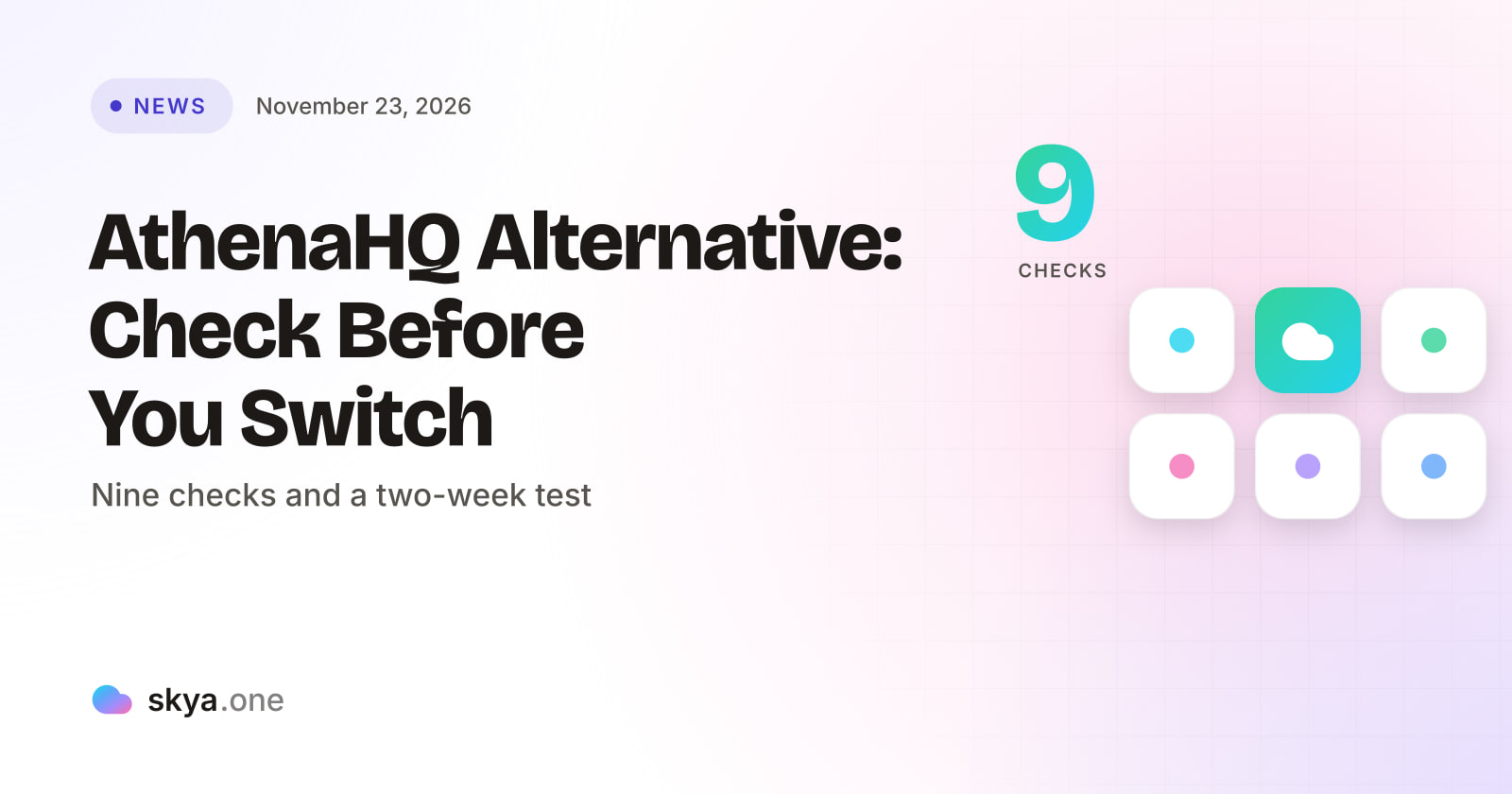
If you are searching for an AthenaHQ alternative, do not start with feature lists. Start with evidence. Any AI visibility tool should show the stored answer behind each score, state which assistants it reads and admit when it measured nothing. This guide gives nine checks and a two-week test that works on any tool, including this one.
Why Do People Look for an AthenaHQ Alternative?
Nobody changes tools for fun. Switching costs time, history and client trust. So the first job is to name the reason.
Here are the reasons agencies and in-house teams usually give. They are inferences from how buyers describe tool searches, not findings from a survey. Price per prompt or per seat grows faster than client revenue. The tool covers too few assistants for a client's market. Reports cannot carry an agency's own branding. Scores move and nobody can say why. Or support is slow when a number looks wrong.
Notice that only one of these is about features. The rest are about cost, coverage, trust and reporting. That matters, because a new tool with a longer feature list can still fail on all four.
A note on scope. This guide makes no claims about AthenaHQ's features, plans or prices. It does not link to any competitor. Check any vendor's own pages for current details, and use the checks below to judge what you find.
The Question Behind Every Alternative
Before comparing, write one sentence: “We are switching because ______.” Keep it specific. “We cannot show clients why a score changed” is a reason. “We want something better” is not.
That sentence becomes your test. If a tool cannot fix the problem in the sentence, it is not an alternative for you, however good it looks.
Nine Checks to Run on Any AI Visibility Tool
Run these in order. Each one has a simple pass or fail.
| Check | What a pass looks like |
|---|---|
| Evidence | You can open the stored answer behind a number, with a date |
| Method | The vendor publishes how each number is calculated |
| Coverage | It names which assistants it reads and how many your plan includes |
| Honesty | It shows “not measured” when it read nothing, not a guessed zero |
| Cadence | It states how often each assistant is read |
| Retention | You can see history, and you know how long it is kept |
| Accuracy | It checks claims in answers, not only whether a name appears |
| Reporting | You can export client reports under your own branding |
| Cost | You can predict the bill when clients, prompts or assistants grow |
Two of these deserve a closer look.
Evidence Is the One That Decides
A score is a summary. A summary you cannot open is an opinion. When a client asks why visibility fell, the only good answer is a dated answer you can read together. If a tool cannot show that, every other feature is decoration.
Ask for a demonstration with your own question set. Pick a number and ask the vendor to open the answers behind it. The reaction tells you more than any sales page.
Honesty Is the Quiet One
Many tools show a score even when an assistant failed to respond. The result looks like a drop, and the agency spends a week explaining a gap that was never real. A fair tool shows that nothing was measured. SKYA, for example, shows “Not measured yet” before any answers are read, and a zero only after answers were read and none named the client. Look for that distinction in any tool you test.
What the Checks Mean in Practice
Coverage
Assistants name different clients. A client strong in one may be missing in another. So ask which assistants a plan includes, not only which the product supports. In SKYA's published method, only the platforms on a plan count toward the figure, and the number of platforms that named the client is shown beside it. That is a good habit to ask of any vendor: show the denominator.
Cadence and Retention
A tool that reads once a week will miss a change on Tuesday. A tool that reads often but keeps history for a month cannot show a quarter. Ask both questions. SKYA's tracking page says it sweeps the full prompt set every three days on core platforms and every 14 days on extended ones, with a daily pulse on every plan, and keeps stored readings for up to two years. Use that as a model of the detail you should be able to get from any vendor.
Accuracy
Being named is half the story. A client named with the wrong price, the wrong location or the wrong service is worse off than one not named. Ask whether the tool checks claims. SKYA runs a hallucination audit on every paid plan. SKYA's guide to why AI hallucinations about a client matter explains the cost.
A Two-Week Test That Settles It
Reading sales pages will not tell you which tool is better for you. A test will.
-
Write the reason for switching in one sentence.
-
Choose ten buyer questions for one client. Cover a broad “best option” question, a comparison, a price question and a trust question. Keep the wording fixed.
-
Load the same ten questions into both tools on the same day.
-
Ask each tool to read the same assistants. Note any it cannot read.
-
After one week, open five answers behind each tool's score. Check that the stored text matches what you see by asking the assistant yourself.
-
Note any day a tool showed a number with no answers behind it.
-
After two weeks, compare cost at the volume you expect in six months, not today.
-
Build one client report in each tool. Time it.
-
Decide against the sentence from step one.
The ninth step matters most. A tool that wins on features and fails the sentence has failed.
What Happens to Your History if You Switch?
This is the part most guides skip. History built by AI visibility tracking is an asset. If you leave a tool, you may lose the trend line that proves what you achieved for a client.
Before you cancel, export everything you can: scores, answer text and dates. Run both tools in parallel for at least a month, so the new tool builds its own history while the old one still reports. Tell clients about the change and explain that trend lines may break at the switch point. Mark the date on every chart.
A break in a line, honestly marked, is better than a smooth line stitched from two methods. Two tools will not agree exactly, because they ask in slightly different ways and read at different times. That is normal. Do not average them.
A Critical Look at Comparison Pages
Be careful with the pages that rank for alternative searches. Most are written by vendors, and a vendor page will favor its author. This one is no different, so read it with the same care.
Look for four warning signs. A table with no dates, since tools change fast. Claims about a competitor with no source. Prices quoted without a plan name or a date. And “best” with no stated test. A page that passes none of these is an advertisement, whatever it is called.
The honest use of a comparison page is as a list of questions. Take the questions, ask them of every tool, and trust only the answers you can open yourself.
When Not to Switch
Sometimes the right answer is to stay. Do not switch if your problem is a weak question set, not the tool. A poor question set gives poor results in any product. Do not switch in the middle of a client reporting cycle, unless the current tool is wrong in a way that harms a client. And do not switch only because a competitor's page promised more.
If your reason is cost, ask your current vendor first. If the reason is trust in the numbers, ask for a walk-through of one score. Either answer is useful. A vendor who cannot explain its own number has told you what you need to know.
How Tool Choice Fits the Wider Method
A tool does not replace judgment. It stores readings so that you can apply it. The method underneath is the same whatever you buy: fixed questions, dated answers, a check of claims and a trend over weeks. SKYA's guide to AI visibility tracking explains that method, and its comparison of AI visibility tool pricing shows how to compare costs fairly.
If you are weighing several tools, SKYA's notes on the Otterly, Peec and Semrush alternatives use the same checks. Run the same nine on each.
What to Ask Any Vendor
| Requirement | Why it matters | How SKYA handles it |
|---|---|---|
| Stored answer behind every number | A score you cannot open is an opinion | A stored reading and evidence panel, with the timestamp of each reading |
| Published method | You must be able to explain a change | A methodology page that states each formula, including answers that named the client divided by answers read |
| Honest empty state | A guessed zero hides gaps | “Not measured yet” before any answer is read |
| Claim checking | A named client can still be described wrongly | A hallucination audit on every paid plan |
| Agency reporting | Many clients, one workflow | Multi-client workspaces and white-label PDF reports |
SKYA publishes how every number is calculated. Its page on daily AI answer readings shows what a stored reading looks like.
What to Tell Clients
If you do switch, keep the message short. We are changing the tool that reads AI answers. The reason is better evidence for your reports. For the next month we will run both, so you see no gap. Trend lines will be marked where the method changes.
Do not promise higher scores from a new tool. A new tool measures differently. It does not change what assistants say about the client. Only work on the client's facts and sources does that.
Frequently Asked Questions
What should I look for in an AthenaHQ alternative?
Look for stored answers behind every score, a published method, clear assistant coverage, honest empty states, claim checking and reporting that fits your clients. Test with your own question set.
How do I switch AI visibility tools without losing data?
Export scores, answers and dates first. Run both tools in parallel for at least a month. Mark the switch date on every chart and tell clients that trend lines may break there.
Will a new tool give me the same scores?
No. Tools ask in slightly different ways and read at different times, so scores differ. Compare trends within one tool, and do not average two tools together.
Is AI visibility tracking worth paying for?
It is worth it when you need a dated record of what assistants say about a client. Without a record, any change in answers is a guess. A fair test is whether the tool helps you explain a change to a client.
Does SKYA offer a free trial?
Yes. SKYA offers a 7-day free trial and no card is required, so you can run the two-week test above on a small question set.
Run your ten questions through SKYA free for 7 days, open every answer behind the score and judge it against your own reason for switching. Start a 7-day free trial with SKYA. No card required.

Written by
SKYA Editorial Team
The SKYA Editorial Team publishes field-tested research on Answer Engine Optimization, Generative Engine Optimization and AI Visibility. Every article is reviewed by senior practitioners from the SKYA product and research groups before publication.
Related posts
Keep exploring the SKYA Journal.