On this page10
- What the Court Filing Actually Says
- Two Ways to Measure the Same Answer
- What Independent Data Adds
- Where "Users Won't Click" Goes Too Far
- What a Mention Must Prove
- A Report Line for Each Old Metric
- A One-Week Start
- What to Tell a Client Who Asks About Traffic
- What SKYA Does in This Report
- Frequently Asked Questions
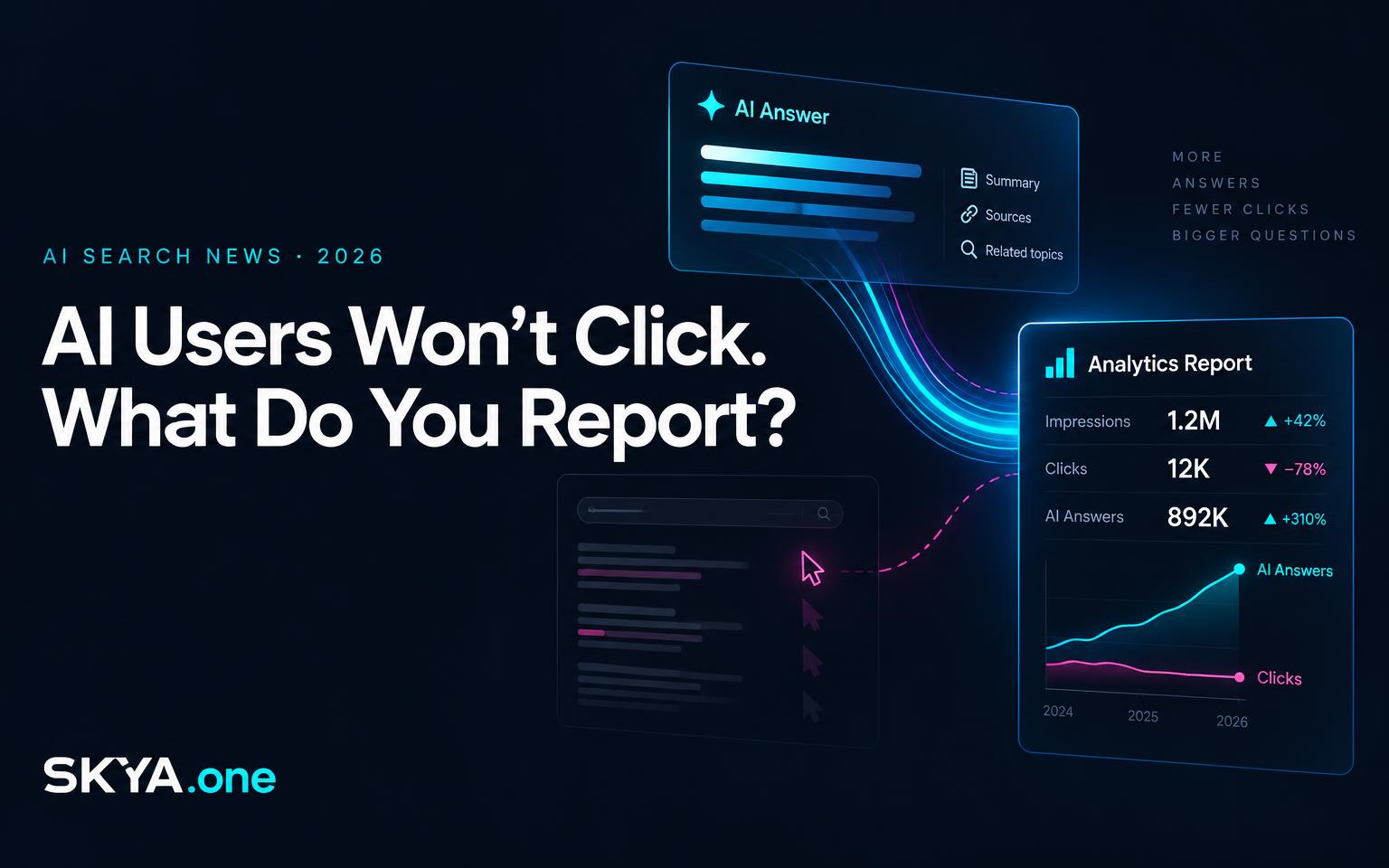
A September 17, 2026 court filing quotes an OpenAI engineer saying users won't click links in AI answers. It is only one side's claim, but independent data points the same way. When clicks shrink, traffic reports miss the moment a buyer first meets your client. That is why agencies now need to track brand mentions in ChatGPT and other assistants.
What the Court Filing Actually Says
SKYA reads AI answers about clients every day, and part of the job is explaining what the news means for reporting. This is the short, sourced version.
News publishers suing OpenAI and Microsoft filed a combined summary judgment brief on September 17, 2026, in a federal court in New York. Search Engine Journal reported on it on September 28. The case is a consolidated copyright suit. The plaintiffs include The New York Times, the Daily News plaintiffs and Ziff Davis.
The brief quotes an OpenAI engineer from February 2023: "no matter how prominently we show the links, users won't click." It also reports that ChatGPT's head saw little reason for users to click through once an answer was given.
The filing adds Microsoft data on click-through rates in Bing Chat against Bing Web Search. Click-through was 87% to 93% lower for Times sites. It was 83% to 91% lower for the Daily News plaintiffs and 51% to 94% lower for Ziff Davis sites.
Now the limits. The same report says the filing does not state when the data was collected, how many queries or clicks it covers, how it was selected or what the low and high ends of each range mean. Microsoft renamed Bing Chat to Copilot in November 2023, and the filing does not say whether the figures apply to the product today. The court has not ruled. This is one party's argument.
Two Ways to Measure the Same Answer
Most agency reports still count clicks. The alternative counts what the answer says. Here is how they differ.
| Question | Click-based report | Mention-based report |
|---|---|---|
| What does it count? | Visits that arrive from a search or an AI link | Answers that name the client |
| What does it assume? | The buyer clicks to learn more | The buyer may decide inside the answer |
| What can it see? | The visit and what happens after | The answer, its position and its wording |
| What does it miss? | Every buyer who read the answer and never clicked | Whether a mention led to a visit or a sale |
| What does it prove? | That interest turned into a session | That the client was in the room, and what was said |
| Best use | Conversion and cost reporting | Visibility and accuracy reporting |
The two are not rivals. They answer different questions. A click report shows what happened after interest. A mention report shows whether the client earned that interest, and whether the answer was right.
What Independent Data Adds
The court filing is not the only evidence. Two independent studies measure click behavior directly.
The Pew Research Center studied the browsing data of 900 U.S. adults in March 2025, covering 68,879 Google searches. Pew reported that users clicked a traditional result in 8% of visits when an AI summary appeared and in 15% of visits when it did not. Only 1% of visits included a click on a link inside the summary.
SparkToro analyzed Similarweb clickstream data for U.S. Google searches from January to April 2026. Search Engine Land summarized the results. 68.01% of searches ended without a click, up from 60.45% in 2024. AI Overviews appeared on more than 20% of searches, and click-through fell by roughly 60% when they did.
| Source | What it measured | What it cannot tell you |
|---|---|---|
| Court filing, September 2026 | Bing Chat against Bing Web Search click-through, per Microsoft data cited by publishers | Collection dates, volume, or whether it applies to current products |
| SparkToro, June 2026 | U.S. Google clickstream, January to April 2026, two thirds mobile | Other countries, the Google mobile app, or other assistants |
All three agree on direction. None measures what a buyer does after reading a ChatGPT answer.
Where "Users Won't Click" Goes Too Far
The quote is absolute. The data is not. In Pew's sample, 8% of visits with an AI summary still included a click on a traditional result. Clicks fall. They do not disappear.
The quote also dates from 2023, and the Microsoft figures come from the Bing Chat era. The Pew and SparkToro numbers describe Google. So the evidence supports a clear claim: AI answers reduce clicks on search pages. It does not yet support a precise claim about every assistant today.
Click measurement is also improving. Search Engine Journal reported that site owners spotted Gemini adding UTM parameters to outgoing links around September 24 and 25, 2026. Google has not documented when they trigger. The same report notes that ChatGPT already tags links this way. Traffic from AI assistants is becoming easier to separate from "direct."
So the sound conclusion is narrower than the headline. Keep click data. Stop treating it as the only proof that an AI answer worked.
The other side needs the same scrutiny. A mention is not a win by default. It can be wrong, buried or dismissive. A mention metric only means something if it passes four tests.
What a Mention Must Prove
To track brand mentions in ChatGPT in a way a client will trust, score every answer on four tests.
-
Named. Does the answer include the client at all?
-
Correct. Are the facts right? A wrong price or retired plan can do more harm than silence. SKYA's guide to continuous hallucination monitoring covers this test.
-
Placed. Where does the client sit, and next to whom? The guide to AI share of voice explains the math.
-
Framed. Is the tone enthusiastic, caveated or dismissive? The guide to tracking brand sentiment in AI search shows how to classify it.
A count of mentions that skips tests two to four is a vanity number. It flatters the report and tells the client nothing.
A Report Line for Each Old Metric
Most teams cannot drop their current report overnight. The table below keeps the old line and pairs it with a new one.
| Old report line | Pair it with | Why |
|---|---|---|
| Organic sessions | Answers that named the client, by assistant | Counts exposure that never reached the site |
| Click-through rate | Share of voice across a fixed prompt set | Shows the client's share of each answer |
| Keyword rankings | Answer position and stability | Position inside the answer is the new first page |
| Referral traffic | Tagged AI referrals, kept as a supporting line | Still real, and easier to segment now |
| Backlink count | Sources the assistants cite about the client | Shows which pages shape the answer |
On that last row, how AI platforms cite differently explains why the cited sources differ by assistant.
A One-Week Start
You do not need a new stack to begin. A spreadsheet is enough for the first client.
-
Pick 10 to 15 buyer prompts. Use the questions a real buyer asks, not keyword lists.
-
Run them across the assistants your client's buyers use. One assistant is not a sample.
-
Store the full answers. AI visibility tracking that keeps the text lets you show the client exactly what was said.
-
Score each answer on the four tests. Named, correct, placed and framed.
-
Add click data as a supporting line. Segment AI referrals in GA4. SKYA's guide on joining Search Console and GA4 covers the click side.
Repeat the same prompts every week. One run is a snapshot. A series is a trend, and a trend is what a client can act on. The guide to tracking your client across five AIs explains why a monthly check falls short.
What to Tell a Client Who Asks About Traffic
Clients still ask about traffic, and they are right to. A calm answer works: clicks from search are falling, here is the independent data, and here is what the assistants said about you this week.
That framing keeps the conversation on evidence. It also turns AI visibility tracking from a vague retainer line into a weekly report with a verdict. The client sees what was said, whether it was true and what changed since last week.
What SKYA Does in This Report
SKYA's role has two parts. The first is education: explaining how AI answers are built, where the evidence is strong and where it is thin. This guide and the linked ones do that. The second is the measurement itself.
On the product side, SKYA reads up to nine assistants on a plan-dependent schedule: ChatGPT, Gemini, Perplexity, Claude, Google AI Overview, Google AI Mode, DeepSeek, Grok and Copilot. Platform coverage and refresh frequency depend on the plan. Each paid plan includes a hallucination audit. Multi-client workspaces keep every client's prompts and answers apart.
Every number SKYA shows comes from a stored reading. When the evidence is thin, the product says so instead of printing a figure. That is the standard AI visibility tracking should meet. Teams that need to track brand mentions in ChatGPT for a client need that discipline, because a mention count without the stored answer cannot be checked.
For the how-to side of monitoring, see the ChatGPT brand monitoring playbook. This guide is about what to report and why.
Frequently Asked Questions
Do users click links in AI answers?
Less often than in classic search. Pew found that users who saw a Google AI summary clicked a traditional result in 8% of visits, against 15% without one. Only 1% clicked a link inside the summary. That study covers Google, not ChatGPT.
What should agencies report if AI clicks are low?
Report what the answers say. Count how often the client is named, whether the facts are correct, where the client is placed and how it is framed. Keep click data as a supporting line, and tag AI referrals in GA4 so they stop hiding in direct traffic.
How do I track brand mentions in ChatGPT?
Pick 10 to 15 buyer prompts and run the same set every week. Save the full answer each time. Score each answer on four tests: named, correct, placed and framed. Compare weeks, not single runs, because answers change between runs.
Is a brand mention better than a click?
They measure different things. A click shows that interest became a visit. A mention shows the client was part of the answer. A mention only helps if it is correct and favorably framed, so check both before reporting it as a win.
Can I measure traffic from AI assistants at all?
Yes, in part. Search Engine Journal reports that site owners spotted Gemini adding UTM parameters to outgoing links in late September 2026, and that ChatGPT already tags links this way. Segment those sources in GA4. Some AI-driven visits will still land in direct traffic.
Pick one client. Run ten buyer prompts across the assistants this week.
Start a 7-day free trial. No card required.

Written by
SKYA Editorial Team
The SKYA Editorial Team publishes field-tested research on Answer Engine Optimization, Generative Engine Optimization and AI Visibility. Every article is reviewed by senior practitioners from the SKYA product and research groups before publication.
Related posts
Keep exploring the SKYA Journal.