On this page13
- What Did OpenAI Announce?
- What the Announcement Does Not Say
- Why This Matters in the EU
- What Changes for Media and Publishing Clients
- How to Track Brand Mentions in ChatGPT Before and After a Deal Like This
- Reading the Sources an Answer Names
- A One-Week Check for Any Client in France or the EU
- Why Language and Market Need Their Own Test
- A Critical Look at the Deal
- What to Look for in an AI Brand Monitoring Tool
- What to Ask Any Vendor
- What to Tell Clients
- Frequently Asked Questions
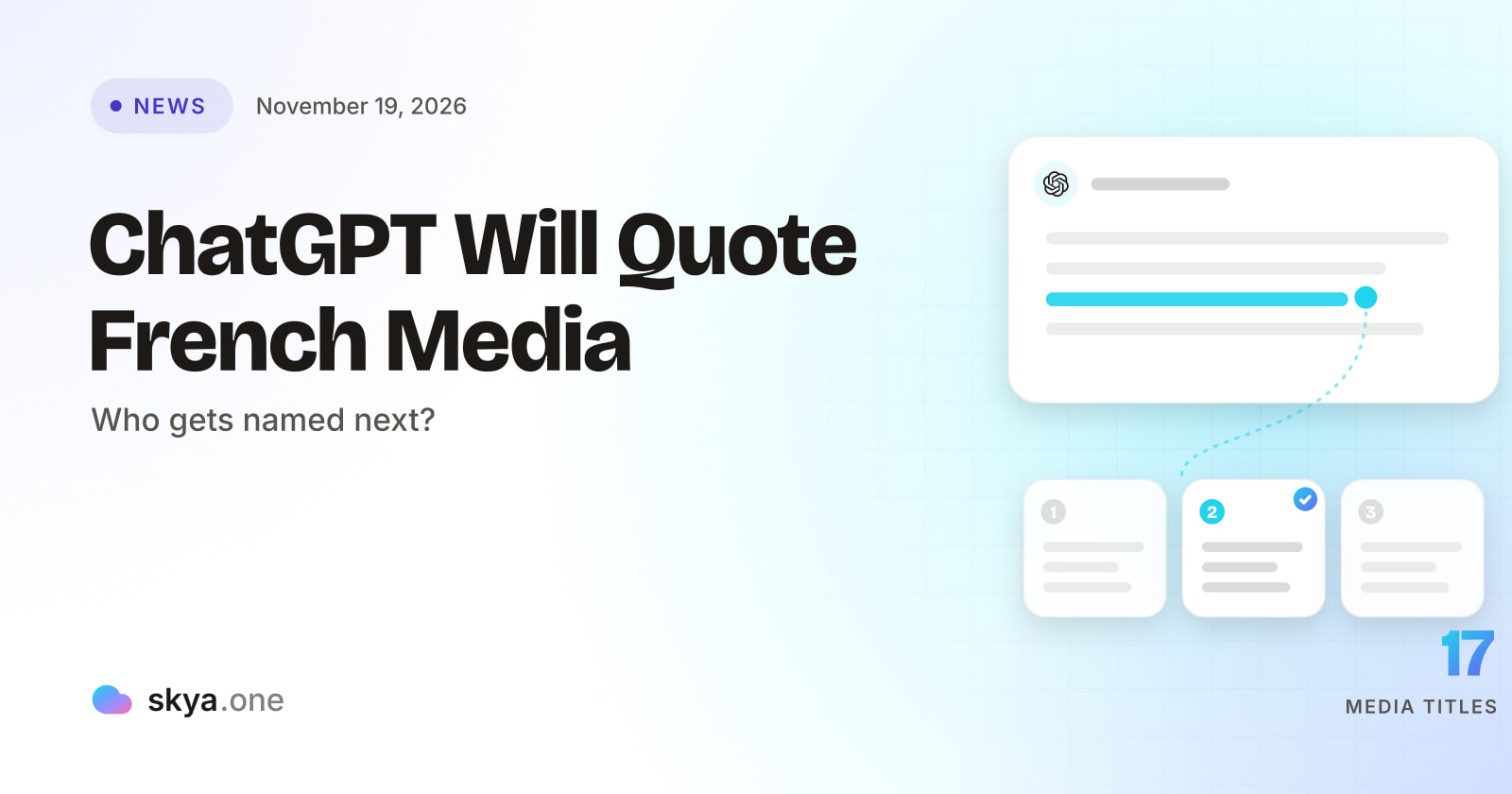
OpenAI announced on November 16, 2026 that all 17 titles of LVMH’s media division will appear in ChatGPT answers, with summaries, excerpts, source names and links. Payment and duration are not disclosed. For clients with press coverage in France, the question is simple: does ChatGPT now name them differently? Track brand mentions in ChatGPT to find out.
What Did OpenAI Announce?
OpenAI’s announcement says the partnership covers every publication in LVMH Group’s media division, known as Groupe Les Echos-Le Parisien. It names Les Echos, Le Parisien, Challenges, Paris Match, L’Opinion, Investir and L’Agefi, among 17 brands in total.
Two things are promised. First, division content will appear in ChatGPT in response to relevant questions, with summaries and excerpts, source identification and direct links to the original articles. Second, OpenAI tools and ChatGPT Enterprise will go to the division’s teams for tasks such as document research, comparison and early translation, with training.
PPC Land reviewed both language versions of the release. It notes that the English version adds figures on staff and readership, and that neither text gives payment, duration, start date or exclusivity.
What the Announcement Does Not Say
| Question | What is known |
|---|---|
| Is money changing hands? | Not disclosed, in either direction |
| How long does the deal last? | Not disclosed |
| When does it start? | No effective date given |
| Is it exclusive? | Not disclosed |
| Can OpenAI train models on the articles? | Not disclosed |
| Is paywalled content included? | Not disclosed |
| Which titles feed ChatGPT answers? | Not disclosed |
Seven empty rows. That is the honest state of the story. An agency should not tell a client that ChatGPT now favors these outlets, because nothing in the announcement says so. It says these outlets will appear, with links. It does not say others will appear less.
Why This Matters in the EU
France is a priority market for any client selling in Europe. The release is also not an isolated event. PPC Land places it beside earlier French moves: ChatGPT search launched with news partners in October 2024, Le Monde among them, and French regulators have pressed Google and Meta over publisher content this year. The article draws on dated events, but it does not claim that they are linked.
For clients, the practical reading is narrower. A large French business and lifestyle publisher group now has a formal path into ChatGPT. When a buyer asks about a financial product, a wine house, a hotel or a software tool, an answer may quote one of these titles and link to it.
Here is the inference, labeled as one. If a client has been covered by these titles, that coverage may now reach buyers through ChatGPT with a source label attached. If the client has not been covered, the answer may quote a competitor’s coverage instead. No report cited here measures how often either happens. It follows from the stated design of the deal.
What Changes for Media and Publishing Clients
Media and publishing is one of SKYA’s priority verticals, so look at this from the publisher side too.
A publisher in this deal gains a path for its articles to appear with attribution and a link. It also takes on an exposure it does not control: ChatGPT summarizes and excerpts the work. If the summary is wrong, the title still carries the name. A publisher whose reporting is misdescribed in an answer has a double problem, since readers may blame the source.
Publishers outside the deal face a different question. Their content may still appear in answers through ordinary web search, but they have no stated route and no stated terms. SKYA covered a parallel case in its guide to Yahoo Scout and publisher licensing. The pattern is the same: licensing creates a reason for an answer engine to rely on its partners, and no one outside the engine knows how much.
How to Track Brand Mentions in ChatGPT Before and After a Deal Like This
The first job is to know where the client stands today. That means a baseline, taken before anyone draws a conclusion.
Write ten questions in the words French and European buyers use. Include a broad “best option” question, a comparison, a price question and a question on trust. Ask each in ChatGPT on three different days. Save the full text each time. Then read for four things: whether the client is named, where it sits, which sources the answer cites and whether the claims are right.
That is how to track brand mentions in ChatGPT in a way that survives a client meeting. It produces a dated record, not an impression. Repeat it every week. After a month, compare. If the cited sources shift toward the LVMH titles, you have evidence of a change. If they do not, you have evidence of none. Both are useful. SKYA explains the method step by step in its guide to tracking brand mentions in ChatGPT.
Reading the Sources an Answer Names
When ChatGPT shows a source, the source tells you something. Note which outlets appear, how often and beside which clients. Over weeks, a pattern may emerge: the same three titles cited for the same buyer question.
Do not assume that a cited title caused the mention. An answer can name a client because of many inputs. A cited outlet may only be the place that repeated what others said. Treat citations as clues, and keep a list of the outlets that appear most often for each client’s category. SKYA’s guide to how AI platforms cite explains why different assistants lean on different sources.
A One-Week Check for Any Client in France or the EU
-
List the client’s press coverage from the last 24 months. Mark which of it appeared in the 17 titles.
-
Choose ten buyer questions in French and English. Keep the wording fixed.
-
Ask each question in ChatGPT. Save each answer with the date.
-
Record whether the client is named, whether a source link is shown and which outlet it points to.
-
Ask the same questions in two other assistants. Compare.
-
Check every claim in each answer against the client’s facts. Mark it right, old, wrong or missing.
-
Repeat after seven days.
-
Write one paragraph for the client: what was found, what was not and what is still unknown.
Do not turn one test into a trend. Answers vary from run to run, and a single answer shows what ChatGPT can say, not how often it says it.
Why Language and Market Need Their Own Test
A client selling across Europe cannot test in English alone. A buyer in Paris asks in French, and the answer may draw on French outlets that an English question never reaches. The same client can be named in one language and missing in the other.
So run the question set twice, once in each language the client sells in. Record the language beside each answer. Where the two disagree, that gap is the finding. It may point to coverage the client has in one market and lacks in the other, and it gives the account team a concrete, local task.
A Critical Look at the Deal
Press announcements flatter their authors. This one is no different, so read it as a buyer would.
The strongest line is the promise of source names and direct links. That is a better deal for publishers than an anonymous summary. The weakest part is what is missing: terms, duration, scope. A reader cannot tell whether the arrangement is a pilot or a long commitment. A second caution concerns scale. The division reports about 27 million monthly readers in France, but that number describes its own audience, not the share of ChatGPT answers it will touch.
A third point is easy to miss. The announcement is mostly about the division’s own use of OpenAI tools, plus a presence in ChatGPT. It does not say how often the titles will be shown or ranked. Until a test shows a change in real answers, a fair report calls this a signal to watch, not a ranking factor.
What to Look for in an AI Brand Monitoring Tool
A deal like this tests any AI brand monitoring tool. A good AI brand monitoring tool does four things. It asks fixed questions on a schedule. It stores each answer with its date. It records the sources an answer shows. And it checks each claim against the client’s facts.
Source recording matters most here, because the story is about sources. A score alone cannot tell you whether an LVMH title was cited. A stored answer can. Ask any vendor to show the answer behind a number, and treat a refusal as an answer in itself.
What to Ask Any Vendor
| Requirement | Why it matters | How SKYA handles it |
|---|---|---|
| Keeps answer text with dates | You must show who was named and when | Every reading is stored with its date, and each figure says when it was read |
| Reads ChatGPT and the other assistants | Each one draws on different sources | Daily readings across supported AI platforms, with coverage shown for each reading |
| Checks claims, not only mentions | A named client can still be described wrongly | A hallucination audit on every paid plan |
| Admits what it cannot read | A guessed score hides gaps | No answers read means no figure. A run that measured nothing gives its credit back |
| Fits agency work | Many clients, one report | Multi-client workspaces, GA4 and Search Console integration and white-label PDF reports |
SKYA publishes how every number is calculated. Its page on daily AI answer readings shows what a stored reading looks like.
What to Tell Clients
Say what is known. OpenAI signed a content and tools deal with 17 French media titles. Their articles will appear in ChatGPT with source names and links. The terms are not public. We are checking whether it changes what ChatGPT says about you, and we will report what we find.
Do not promise that press coverage will now win placement. Do not warn of a loss. State that a new route exists, that you are watching it and that a dated record will show whether it matters.
Frequently Asked Questions
What did OpenAI and LVMH announce?
On November 16, 2026, OpenAI announced a partnership with LVMH’s media division. Content from its 17 titles will appear in ChatGPT with summaries, excerpts, source names and links, and its teams will get ChatGPT Enterprise.
Which publications are included?
OpenAI names Les Echos, Le Parisien, Challenges, Paris Match, L’Opinion, Investir and L’Agefi, among 17 brands in the division.
Will ChatGPT now favor these outlets?
The announcement does not say so. It describes presence with attribution and links. It gives no ranking or frequency detail, so test before you claim a change.
How do I track brand mentions in ChatGPT?
Ask fixed buyer questions in ChatGPT on a schedule, save each answer with its date, and record whether the client is named, which sources are shown and whether the claims are correct. Repeat weekly and compare.
What should monitoring software record after a media deal?
It should store each answer with its date, note the sources shown, check every claim against the client’s facts and state clearly which assistants it covers.
Press coverage may now speak through ChatGPT. See who gets quoted for your client. Try SKYA free for 7 days. No card required.

Written by
SKYA Editorial Team
The SKYA Editorial Team publishes field-tested research on Answer Engine Optimization, Generative Engine Optimization and AI Visibility. Every article is reviewed by senior practitioners from the SKYA product and research groups before publication.
Related posts
Keep exploring the SKYA Journal.