On this page13
- What Is ChatGPT Wallet?
- The Background: In-Chat Buying Is Not New
- What the Reports Do Not Say
- Why This Is a Mention Problem First
- What an Agent Needs From a Site
- A Safe Check Before Changing Anything
- Which Clients Should Look First
- Why One Check Is Not Enough
- What a Mention Check Looks Like in Practice
- Why Product Facts Need Extra Care
- What to Ask Any Vendor
- What to Tell Clients
- Frequently asked questions
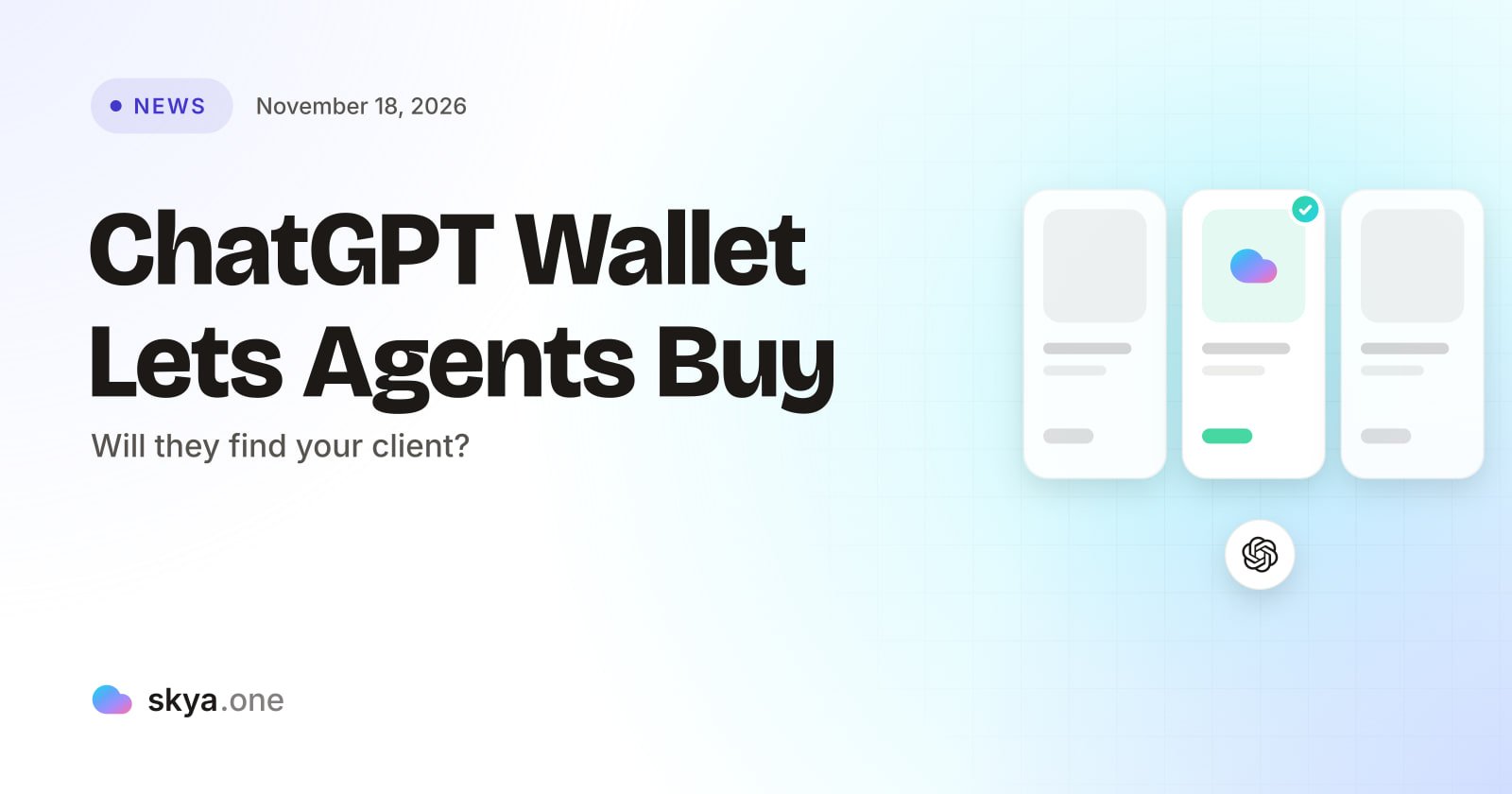
OpenAI reportedly launched ChatGPT Wallet on November 13, 2026, so agents can pay for purchases on a user’s behalf. It starts with US Pro subscribers. OpenAI also asked sites not to block its agents. If an agent cannot read a client’s site, it cannot buy there. This guide covers what is reported and how to check a client.
What Is ChatGPT Wallet?
Details here are thinner than usual, so read this section with care. OpenAI’s own announcement page could not be opened for this guide. The facts below come from news logs that summarize it, and they should be confirmed against OpenAI’s page before anyone quotes them to a client.
According to LovedBy’s AI search news log, OpenAI launched ChatGPT Wallet on November 13 for agent purchases, starting with US Pro subscribers, and asked websites not to block its agents. A separate daily news digest describes Wallet as handling agent payments through card networks. A release-notes summary says it supports agent-assisted purchases.
That is the whole confirmed picture: a payment tool for agents, a first audience of US Pro users and a request to site owners. Pricing, fees, limits and protections are not covered in what could be read.
The Background: In-Chat Buying Is Not New
OpenAI first added purchases inside ChatGPT in September 2025, as Fortune reported. That feature let users buy from selected merchants without leaving the chat. Wallet appears to take a further step. It gives an agent a way to pay as it works, including on sites that were not set up as ChatGPT merchants.
Here is the inference, labeled as one. If agents can pay on ordinary sites, the question changes from “does ChatGPT mention my client” to “can ChatGPT’s agent complete a purchase on my client’s site”. Those are two separate checks. A client can be mentioned and still be unbuyable by an agent, because of a robots rule, a login wall or a checkout the agent cannot use.
What the Reports Do Not Say
| Question | What is known |
|---|---|
| Who can use Wallet? | US Pro subscribers first, per the news log |
| How are payments made? | Through card networks, per a daily digest |
| What does OpenAI ask of sites? | Not to block its agents |
| Which agents does the request cover? | Not stated in what could be read |
| What happens if a site blocks agents? | Not stated |
| What fees or protections apply? | Not stated |
The empty rows matter. An agency should not tell a client to open every door to every agent on the strength of one sentence. The request is reported, the details are not, and the right response is to test, not to guess.
Why This Is a Mention Problem First
A buyer who asks ChatGPT for a recommendation sees names. An agent that buys for the buyer needs one name and a working path. The first step in that path is still the mention. If the client is not in the answer, the agent never reaches the checkout.
That is why the first job is still to track brand mentions in ChatGPT, week after week. Ask the questions a buyer would ask. Note whether the client appears, in what position and with what description. Then, and only then, ask whether an agent could finish the purchase. This order keeps the work simple: first learn to track brand mentions in ChatGPT, then test the path. SKYA covers the first step in its guide to tracking brand mentions in ChatGPT.
The second step is new. It is a technical check, and it belongs to the website, not the answer.
What an Agent Needs From a Site
An agent works like a very fast visitor with no patience. It needs a few basic things to succeed.
It needs to be allowed in. If a robots rule or a firewall blocks the agent, nothing else matters. It needs to read the page. If prices and stock load only after a script runs that the agent does not run, the page looks empty. It needs a clear path. A short checkout with plain labels is easier than one with pop-ups and mandatory accounts. And it needs facts that match. If the page says one price and the checkout says another, the agent may stop, or buy at the wrong price.
None of this is exotic. Most of it is good practice for human visitors too. The difference is that a human can work around a clumsy page. An agent may simply leave.
SKYA’s guide to technical AEO and AI crawlability explains the crawl-side checks. Its note on the llms.txt file covers a way to give machines a clear summary of a site.
A Safe Check Before Changing Anything
The reported request is for sites not to block OpenAI’s agents. Before changing any rule, an agency should check what it currently does.
-
Open the client’s robots.txt file. Note any rules that block AI crawlers or agents. Record which ones and why they were added.
-
Ask the client’s developer or host whether a firewall blocks automated visitors. Some do so by default.
-
Check the server logs for visits from OpenAI’s agents. Note whether they reach product and checkout pages or stop at the first page.
-
Test the client’s product pages without scripts. Do the price, stock and description still appear?
-
Walk through the checkout as a guest. Count the steps, the forced sign-ins and the pop-ups.
-
Write down the findings and the options. Let the client decide what to allow. Blocking agents may be a deliberate choice for security, cost or policy reasons.
Step six is the one agencies skip. A rule that blocks agents may exist for a reason. The agency’s job is to show the trade-off, not to remove the rule.
Which Clients Should Look First
Retail and ecommerce clients come first, because their products can be bought in a few steps. Ticketing, travel and subscription clients come second. Their checkouts are longer and often involve accounts, so an agent may fail more often. Service and B2B clients with quote forms come last. An agent is unlikely to buy a consulting contract through a wallet.
For all of them, the same discipline applies. Do not assume. Test the path. Record the result. Then check again after any site change, because a new cookie banner can stop an agent as surely as a robots rule.
Why One Check Is Not Enough
Agents and assistants change fast. A page that works today can fail after a site release. An answer that names the client today may not tomorrow. A single test shows one moment.
AI visibility tracking gives the series. It asks fixed buyer questions on a schedule, stores each answer with its date and shows how often the client appears across many runs. Combine that with a monthly technical check and you have both halves, with AI visibility tracking covering the answer half: whether the client is named, and whether an agent can act on the name.
SKYA explains the stored-reading method on its page about daily AI answer readings. SKYA does not complete purchases or test checkouts, so the technical half stays with the site team.
What a Mention Check Looks Like in Practice
Many agencies say they track mentions and mean they glance at ChatGPT once a month. A real check is more structured.
Start with ten questions in the words buyers use. Include one for each stage: a broad “best option for” question, a comparison question, a price question and a “where do I buy” question. Ask each question on three different days, because answers vary. Save the full text each time. Then read the answers for four things: whether the client is named, where it sits in the list, how it is described and whether any price, stock or delivery claim is right.
That last item is the one agents will care about. An agent that reads a wrong price may refuse to buy, or buy and cause a dispute. The client’s own page may be correct, and the answer may still be wrong. A repeated, stored check is the only way to catch it. This is the discipline behind any serious effort to track brand mentions in ChatGPT.
Why Product Facts Need Extra Care
Facts about products change fast. Prices, stock, sizes, delivery times and promotions can move weekly. Assistants may repeat an old value for a long time, because the old page still ranks or a review site never updated.
For ecommerce clients, keep a list of the facts that an agent would need to complete a purchase: price, availability, shipping cost, delivery time and returns. Check those first in every assistant. Then check them against the live page and the checkout. When all three agree, the path is clean. When one differs, that is where to work.
Also keep dates visible on the page. A line such as “Prices checked on 14 November” gives both people and machines a way to judge freshness. It is a small habit with an outsized payoff, and it costs nothing.
What to Ask Any Vendor
| Requirement | Why it matters | How SKYA handles it |
|---|---|---|
| Keeps answer text with dates | You must show who was named and when | Every number is dated and comes from a reading kept on record |
| Reads ChatGPT and the other assistants | Agents and answers differ by tool | Nine assistants every day: ChatGPT, Gemini, Perplexity, Claude, Google AI Overview, Google AI Mode, DeepSeek, Grok and Copilot |
| Checks claims, not only mentions | A wrong price in an answer can stop a sale | A hallucination audit on every paid plan |
| Says what it cannot do | Purchases and checkouts are outside a reading tool | No answers read means no figure. A run that measured nothing gives its credit back |
| Fits agency work | Many clients, one report | Multi-client workspaces, GA4 and Search Console integration and white-label PDF reports |
| SKYA publishes [how every number is | ||
| calculated](https://skya.one/methodology). Ask any vendor | ||
| to say plainly what it measures and what it does not. |
What to Tell Clients
Say what is known and no more. OpenAI reportedly launched a wallet that lets agents pay for purchases, starting in the US, and asked sites not to block its agents. We are checking whether you are named in ChatGPT answers and whether an agent could reach your checkout. We will report what we find and ask you to decide on any change.
Do not promise sales from agents. Do not warn of lost sales either. The honest position is that this is new, the details are thin and a test costs little.
Frequently asked questions

Written by
SKYA Editorial Team
The SKYA Editorial Team publishes field-tested research on Answer Engine Optimization, Generative Engine Optimization and AI Visibility. Every article is reviewed by senior practitioners from the SKYA product and research groups before publication.
Related posts
Keep exploring the SKYA Journal.